







Key takeaways
- Form AOC-4 (Form for Filing Financial Statements and Other Documents with the Registrar) is the annual e-form used to file a company's financial statements with the Registrar of Companies (RoC), under Section 137 of the Companies Act, 2013.
- All companies registered under the Companies Act, 2013, must file AOC-4 every year, including private companies, public companies, and one person companies (OPCs), even with no business activity.
- AOC-4 is due within 30 days of the annual general meeting (AGM). OPCs file within 180 days of the financial year-end instead, since they don't hold an AGM.
- Three variants exist: standard AOC-4, AOC-4 XBRL (for companies above ₹5 crore paid-up capital or ₹100 crore turnover, or listed companies), and AOC-4 CFS (for companies with subsidiaries filing consolidated financials).
- Most companies need certification from a practising Chartered Accountant, Company Secretary, or Cost Accountant. OPCs and small companies (paid-up capital up to ₹10 crore, turnover up to ₹100 crore) can self-certify through a director.
- Late filing adds ₹100 per day, charged automatically at filing under Section 403. Separately, Section 137(3) sets a civil penalty of ₹10,000 plus ₹100/day, capped at ₹2 lakh for the company and ₹50,000 per responsible officer, assessed by the Registrar through adjudication rather than at the point of filing. Three consecutive years of non-filing also triggers director disqualification under Section 164(2).
- The MCA's Companies Compliance Facilitation Scheme, 2026 (CCFS-2026) waives 90% of the additional fee on pending filings through 31 August 2026.
What is Form AOC-4
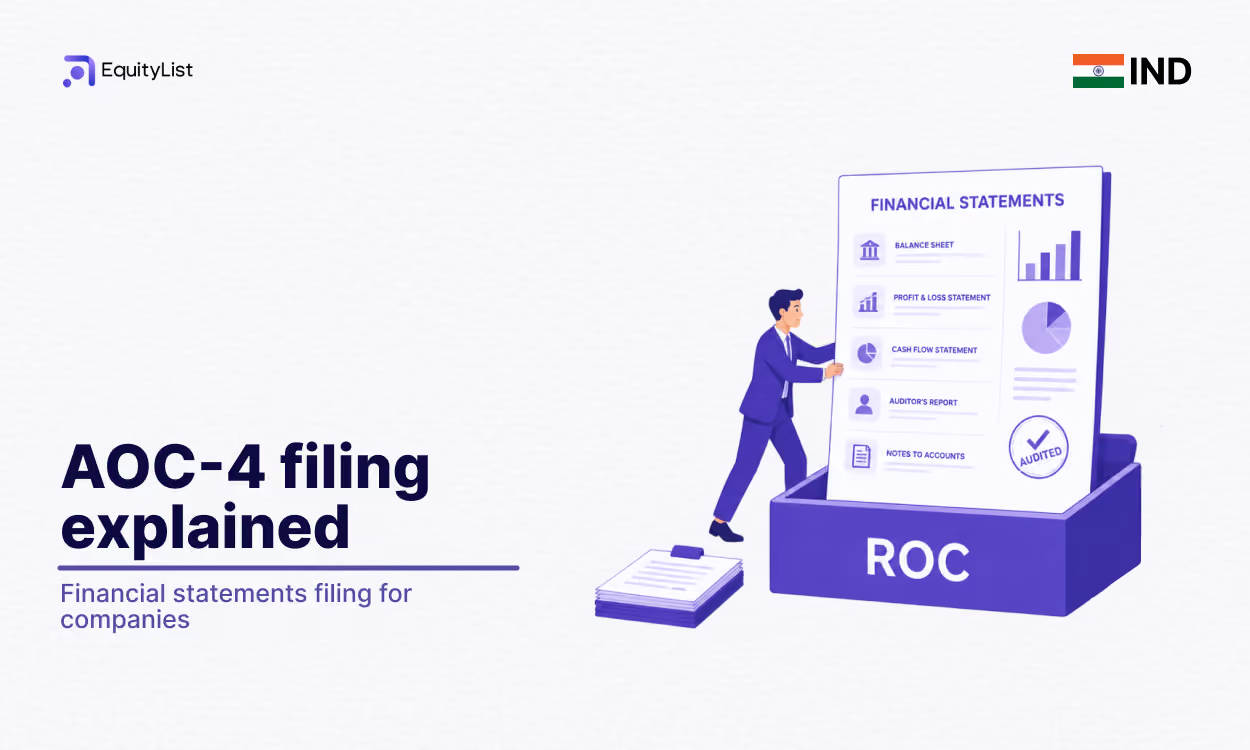
Form AOC-4, short for Form for Filing Financial Statements and Other Documents with the Registrar, is the e-form through which a company files its financial statements (balance sheet, profit and loss account, and related reports) with the Registrar of Companies (RoC), the government office that maintains a company's official records. This obligation comes from Section 137 of the Companies Act, 2013, which requires every company to send the RoC a copy of the financial statements that shareholders adopted at the annual general meeting (AGM), the yearly meeting where shareholders formally approve the company's accounts.
Who must file AOC-4
Every company registered under the Companies Act, 2013, must file AOC-4 annually, including private limited companies, public companies, and one person companies (OPCs). This holds even if your company had no business activity during the year. A dormant startup still files a "nil" set of financial statements.
The one exception worth knowing: Instead of filing within 30 days of an AGM (OPCs don't hold one), they file within 180 days from the end of the financial year, since the sole member simply signs off on the accounts rather than convening a meeting.
AOC-4, AOC-4 XBRL, and AOC-4 CFS: which one applies to you
AOC-4 has three variants, and which one your company files depends on its size and structure.
Standard AOC-4 is what most private companies file. It's a straightforward upload of your financial statements as documents.
AOC-4 XBRL applies once your company crosses certain size thresholds: paid-up capital of ₹5 crore or more, turnover of ₹100 crore or more, or if you're listed on an Indian stock exchange (or a subsidiary of one), under Rule 3 of the Companies (Filing of Documents and Forms in Extensible Business Reporting Language) Rules, 2015. XBRL stands for Extensible Business Reporting Language, a standardised electronic format that tags each financial figure so it can be read and compared by software rather than a human scanning a PDF. The government mandates it for larger companies because it lets regulators, auditors, and analysts compare financial data across companies without manually re-entering figures from each filing.
AOC-4 CFS is for companies that prepare consolidated financial statements, meaning they combine their own accounts with those of one or more subsidiaries into a single set of numbers. If your company has acquired or set up a subsidiary, this filing runs alongside your standalone AOC-4, not instead of it.
Documents required to file AOC-4
The core attachment is your set of financial statements, duly authenticated as required under Section 134 of the Companies Act, 2013. This means the accounts must be signed on the board's behalf by the chairperson (if authorised by the board), or by two directors, one of whom must be the managing director, along with the CEO, CFO, and company secretary wherever these roles exist, before the auditor prepares their report on them. In a one person company, a single director's signature is enough.
Alongside this, you'll typically attach:
- The auditor's report and the board's report, both of which must accompany the financial statements as a matter of law, since Section 137 requires the documents attached to the accounts to be filed together with them.
- Form AOC-1, if your company has one or more subsidiaries, since this statement summarises each subsidiary's financial position for the parent's shareholders.
- Form AOC-2, if the company entered into related-party transactions during the year, meaning deals with directors, key managerial personnel, or entities they control.
- Form CSR-2, if your company falls under the corporate social responsibility (CSR) provisions of Section 135. This is filed as an addendum to AOC-4, separately, after the main form goes through.
{{cta-form}}
Due date for filing form AOC-4
AOC-4 must be filed within 30 days of your AGM. The law structures it this way because your financial statements only become official once shareholders adopt them at the AGM. Filing before that point would mean sending the RoC unapproved numbers.
So the sequence runs: your board approves draft accounts, the AGM adopts them, and the 30-day filing clock starts from that adoption date.
If your AGM gets adjourned and reconvenes on a later date, the 30 days count from the adjourned meeting instead. And if you don't hold an AGM at all in a given year, whether by choice or because you got an extension, you still owe the filing within 30 days of the last date on which the AGM should have been held.
Certification: who can sign AOC-4
Most companies need a practising Chartered Accountant, Company Secretary, or Cost Accountant to certify the form before it goes to the RoC. This certification is a professional's formal statement that they've checked the attached financial statements and confirm they're accurate and complete, and they sign it with their membership number.
There's a carve-out for smaller entities. OPCs and small companies can self-certify, meaning a director signs off without needing a separate practising professional's certification.
"Small company" here has a specific legal meaning under Section 2(85) of the Companies Act. Following the Companies (Specification of Definition Details) Amendment Rules, 2025, effective 1 December 2025, a small company is a private company (not a holding or subsidiary company) with paid-up share capital up to ₹10 crore and turnover up to ₹100 crore. If your company sits under both thresholds, the certification requirement is lighter.
Filing fees and the penalty for late filing
The government filing fee for AOC-4 depends on your company's nominal share capital (your company's authorised share capital), following the standard RoC fee schedule under the Companies (Registration Offices and Fees) Rules, 2014:
Miss the deadline, and you owe two separate charges. The first is a flat ₹100 per day of delay, charged automatically by the MCA portal at the point of filing. The second is a civil penalty under Section 137(3): ₹10,000 plus ₹100 per day, capped at ₹2 lakh for the company, and the same formula capped at ₹50,000 for the managing director and CFO (or the responsible director in their absence).
Unlike the daily fee, the Registrar assesses it through formal adjudication under Section 454, so a company always pays the daily fee on late filing but may or may not face 137(3) adjudication.
Repeated defaults carry a sharper consequence: three consecutive years of non-filing triggers director disqualification under Section 164(2), barring every director in office during that period from any directorship for five years.
A temporary exception applies right now. The Companies Compliance Facilitation Scheme, 2026 (CCFS-2026), extended to 31 August 2026, lets companies with pending AOC-4 or MGT-7/7A filings pay just 10% of the additional fee, plus conditional immunity from the above penalties if filed within the scheme window.
How to file AOC-4 on the MCA portal
Once your financial statements are board-approved and AGM-adopted, the practical filing sequence looks like this:
- Log in to the MCA V3 portal as a Business User, which is either the company's own ID or a professional's (CA/CS) ID.
- Navigate: MCA Services → Company e-Filing → Annual Filing → select AOC-4 (online mode; an offline JSON-upload mode also exists for bulk data).
- Enter CIN: Auto-fills company details.
Note: Keep last year's AOC-4 handy, since DINs, dates, and SRNs can be copied forward.
- Fill Part A: financial year, board meeting date (approving the financial statements), nature of statements (adopted/unadopted/revised), signatory details, AGM date (can't be a future date), subsidiary status.
- Enter auditor details via the ADT-1 SRN (auto-fills name/membership); industry type, Schedule III applicability, CFS requirement, electronic books-of-account details.
- Enter balance sheet and P&L figures: Prior year auto-fills for comparison; current year must be entered in full rupees, and assets/liabilities must tally or the form won't save.
- Fill share capital movement, cost audit details, and product/service codes (NPCS 4-digit and 8-digit).
- Attach the financial statements (with auditor's report, under 10MB) and add certifying-professional details.
- Review and submit: This automatically opens two linked webforms: Extract of Auditor's Report and Extract of Board's Report.
- Complete both linked forms by transcribing (not just referencing) the actual auditor's opinion/qualifications and the board's report content, CARO, Section 186 disclosures, POSH compliance, energy/technology disclosures, etc.
- Download the generated ZIP containing all three forms, affix DSCs (director's DSC on all three; the certifying professional's DSC only on AOC-4 itself), and upload each signed PDF back individually.
- Proceed to payment once all three are verified. This completes the filing.
AOC-4 vs MGT-7: how the two annual filings differ
The conceptual difference is this: AOC-4 reports what your company owns, owes, and earned. MGT-7 reports who owns your company and how it's governed. One is a financial snapshot; the other is a structural and ownership snapshot.
Procedurally, they diverge too. AOC-4 is due within 30 days of the AGM, while MGT-7 (or MGT-7A, the simplified version for OPCs and small companies) is due within 60 days. Both are mandatory annual filings under the Companies Act regardless of whether your company did any business that year, and both draw the same kind of scrutiny from the RoC, but they are not substitutes for each other, and filing one does not excuse you from the other. Both filings are also reviewed together as part of routine cap table due diligence, where an investor or acquirer checks whether a company's annual filings are up-to-date before closing a deal.
.svg)
.svg)