







Key takeaways
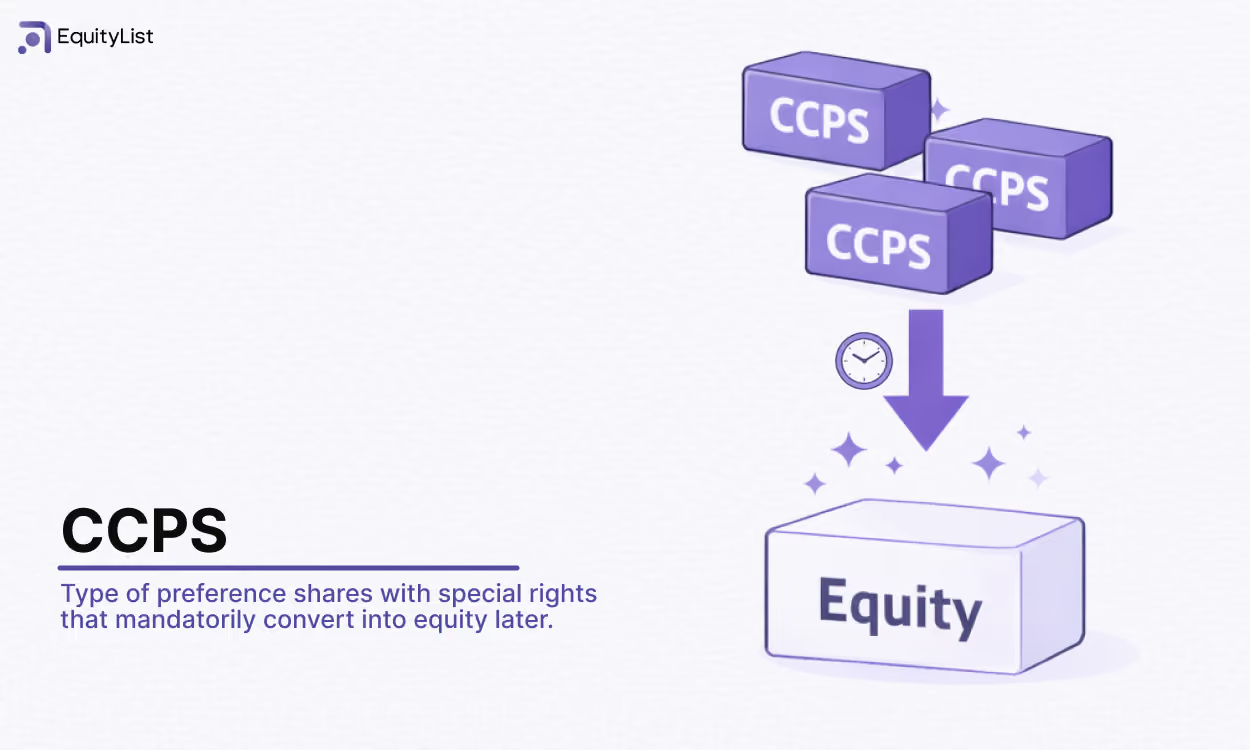
- Compulsory Convertible Preference Shares (CCPS) are preference shares that must convert into equity shares after a specified period or trigger event, such as an IPO or acquisition.
- CCPS carry negotiated rights such as dividend preference, liquidation preference, anti-dilution protection, and certain governance safeguards before they convert into equity shares.
- For tax purposes under Section 47(xb) of the Income Tax Act, conversion of CCPS into equity shares is not treated as a transfer and does not attract capital gains tax. Dividends received on CCPS are taxable in the hands of the investor.
- Issuance of CCPS follows a structured procedure under the Companies Act, 2013, involving board approval, registered valuation, a special resolution at an EGM, and regulatory filings including PAS-4 and PAS-3.
Under Indian company law, companies may issue different classes of shares, most commonly equity shares (commonly known as 'common shares' outside India) and preference shares.
Both equity shares and preference shares represent ownership in the company, but they carry different rights. Equity shareholders typically have voting rights and participate in the company's upside in proportion to their shareholding. Founders and employees usually hold equity shares.
Preference shares carry certain priority rights over equity shareholders, including receiving dividends first and being repaid before equity shareholders if the company distributes capital on liquidation. They can also carry additional negotiated rights depending on the terms of issuance.
Compulsorily Convertible Preference Shares (CCPS), also commonly referred to as Compulsory Convertible Preference Shares, are one such type of preference share.
What are Compulsory Convertible Preference Shares?
Compulsory Convertible Preference Shares (CCPS) are a specific class of preference shares that must convert into equity shares after a defined time or specified events, such as an IPO or acquisition.
Until conversion, CCPS retain their preferential character, meaning they rank above equity shares in terms of priority. Upon conversion, they become equity shares and rank equally with all other equity shareholders.
Under Section 55 of the Companies Act, 2013, preference shares must generally be redeemed or converted within 20 years from issuance (subject to certain exceptions, such as infrastructure projects where the period may extend to 30 years). In startup practice, conversion timelines are usually much shorter and tied to commercial milestones.
How to calculate the conversion ratio of CCPS into equity shares
When CCPS convert into equity shares, they do so based on a predetermined conversion ratio. This ratio determines how many equity shares an investor receives for each CCPS held.
The conversion ratio may be:
- A fixed ratio (e.g., 1:1 or 1:2), or
- A formula-based ratio, typically linked to valuation metrics.
For example:
- If the conversion ratio is 1:1, one CCPS converts into one equity share.
- If the conversion ratio is 1:2, one CCPS converts into two equity shares.
Conversion ratio is generally calculated as:
Conversion ratio = Issue price of CCPS ÷ conversion price
- Issue price is the price paid by the investor for each CCPS at the time of investment.
- Conversion price is the agreed price per equity share at which the CCPS will convert.
For example, if a CCPS is issued at ₹100 and the conversion price is ₹50, the formula produces a ratio of 2 (₹100 ÷ ₹50). This means one CCPS converts into two equity shares, i.e., a conversion ratio of 1:2.
The ratio may be adjusted for specific corporate actions.
For example, if the company carries out a 2-for-1 stock split after the CCPS are issued, every 1 equity share becomes 2 equity shares.
If the CCPS originally converted on a 1:1 basis (1 CCPS = 1 equity share), the conversion ratio would automatically adjust to 1:2 (1 CCPS = 2 equity shares).
This adjustment ensures that the CCPS holder receives the same overall economic value and is not disadvantaged by the increase in the number of equity shares.
Similar protective adjustments are typically made in the case of bonus issues or anti-dilution events triggered by a down-round, so that the investor’s economic position remains unchanged.
Note: The conversion price, or a clearly defined formula for determining the conversion ratio, must be specified at the time of issuance. Companies cannot leave the conversion terms open to be determined at a later stage.
FEMA and FMV requirements for CCPS
Under the Foreign Exchange Management Act (FEMA), CCPS are treated as equity instruments and may be issued to foreign investors under the FDI policy (subject to sectoral caps and pricing guidelines).
A key rule is that the conversion price cannot be lower than the Fair Market Value (FMV) determined at the time the CCPS are issued. This effectively sets a pricing floor.
If conversion happens below the original FMV, it violates FEMA pricing norms under the Foreign Exchange Management (Non-Debt Instruments) Rules, 2019.
After a company issues CCPS or any other equity instrument to an investor who is a resident outside India, the company is required to file Form FC-GPR with the Reserve Bank of India within 30 days of the allotment/issue of those instruments.
CCPS vs OCPS
Optional Convertible Preference Shares (OCPS) give the holder the choice of whether to convert into equity shares. CCPS, by contrast, require mandatory conversion. This distinction carries significant regulatory consequences.
Under FEMA, only fully and mandatorily convertible instruments qualify as equity instruments for FDI purposes. OCPS, because they carry an option not to convert, are classified as debt instruments and fall under External Commercial Borrowing (ECB) regulations. This makes CCPS the preferred instrument for foreign investment in Indian startups, as they avoid the compliance requirements and restrictions associated with the ECB framework.
From a founder's perspective, CCPS also provide greater certainty about the future cap table. Because conversion is mandatory, the eventual equity shareholding structure is known in advance.
What are the rights attached to CCPS?
CCPS are preference shares that carry certain preferential rights while being structured to compulsorily convert into equity shares at a predetermined time or upon specified events. Some rights apply automatically under the Companies Act since CCPS are a type of preference share. Others are negotiated between investors and the company and documented in the investment agreements and articles of association.
1. Rights arising from the preference share structure
- Preferential dividend rights: Preference shareholders rank above equity shareholders in dividend distribution and are paid first when dividends are declared.
- Priority in return of capital: On winding up of the company, preference shareholders are paid their share of the proceeds before equity shareholders participate in the remaining proceeds.
2. Negotiated economic rights
These rights are typically negotiated in venture financing transactions and incorporated into the investment agreements and the company's articles.
- Liquidation preference: On exit, winding up, or distress sale, CCPS holders receive their investment (often with a multiple) before equity shareholders participate. Liquidation preference extends beyond the statutory right to return of capital by specifying a multiple (such as 1x or 2x) and defining what constitutes a "liquidation event" for contractual purposes.
- Anti-dilution protection: If new shares are issued at a lower valuation (down-round), the conversion ratio adjusts to protect the investor's ownership percentage.
3. Negotiated governance and voting rights
- Protective voting rights (reserved matters): Investors may have the right to approve certain major decisions, such as issuing new shares, taking on significant debt, entering into mergers or acquisitions, or increasing the ESOP pool. These rights help protect the investor’s stake by ensuring the company cannot take actions that affect ownership or control without their consent.
- Board nomination / observer rights: Institutional investors often secure board representation to oversee strategy and governance.
- Enhanced voting rights upon dividend default (Section 47(2)): If dividends remain unpaid for two consecutive years or more, preference shareholders gain voting rights on all matters, not only those affecting their class.
- Information rights: Access to financial statements and management reports ensures transparency.
4. Negotiated exit rights
- Automatic conversion upon IPO: CCPS typically convert into equity shares before listing, aligning investors with public shareholders.
- Participation in strategic sale: Investors may also negotiate rights to participate in or influence a strategic sale transaction.
- Buyback rights (subject to law): Buyback of CCPS before conversion may be permissible under Section 68 of the Companies Act, 2013, subject to the conditions and limits prescribed therein. However, most shareholder agreements do not structure CCPS with buyback as the primary exit pathway. Conversion followed by IPO or acquisition remains the expected route.
CCPS vs CCD vs equity shares
In Indian startup funding, three instruments are commonly used: Compulsorily Convertible Preference Shares (CCPS), Compulsorily Convertible Debentures (CCD), and equity shares.
- Equity shares represent direct ownership.
- CCD begins as debt and later converts into equity.
- CCPS begins as preference shares and later converts into equity shares.
One notable difference between the two convertible instruments is the tax treatment of periodic returns. CCD interest is generally treated as a deductible business expense for the company, while CCPS dividends are paid from post-tax profits and are not deductible. This makes CCDs more attractive in certain deal structures from a tax efficiency standpoint.
How to issue CCPS
The issuance of CCPS follows a structured procedure under the Companies Act, 2013. The key statutes governing issuance are Section 42 (private placement), Section 55 (preference shares), and Section 62 (further issue of share capital), read with the Companies (Prospectus and Allotment of Securities) Rules, 2014 and the Companies (Share Capital and Debentures) Rules, 2014.
Step 1: Verify authorised capital
Before issuing CCPS, the company must confirm that its authorised capital is classified into both equity and preference share capital. If the Memorandum of Association does not include preference share capital, the company must first alter its authorised capital structure by filing Form SH-7 with the Registrar of Companies.
Step 2: Appoint a registered valuer
The board convenes a meeting to appoint a registered valuer to determine the issue price of the CCPS. The valuation must follow an internationally accepted pricing methodology, particularly where foreign investors are involved.
Step 3: Board approval
Once the valuation report is ready, the board holds another meeting to approve the draft offer letter, issue price, dividend rate, conversion ratio, and other terms of issuance. These approvals are subject to shareholder confirmation at an Extraordinary General Meeting (EGM).
Step 4: Shareholder approval
The company issues notice of the EGM at least 21 days in advance, along with an explanatory statement detailing the proposed CCPS issuance. Shareholders must pass a special resolution (requiring at least 75% approval) authorising the issuance.
Note: The EGM can also be held at a shorter notice if the majority of the shareholders agree.
Step 5: File MGT-14
A copy of the special resolution, along with the explanatory statement, must be filed with the Registrar of Companies in Form MGT-14 within 30 days of the EGM.
Step 6: Issue the offer letter (PAS-4)
The Private Placement Offer Letter (Form PAS-4) is circulated to identified investors within 30 days of recording their names. Each offer letter must be serially numbered and addressed personally to the investor.
Step 7: Allotment and PAS-3 filing
After receiving funds from investors, the board holds another meeting to allot the CCPS and issue share certificates. Form PAS-3 (Return of Allotment) must be filed with the Registrar of Companies within 15 days of allotment. The company cannot utilise the funds until PAS-3 is filed.
For issuances involving foreign investors, additional FEMA compliance applies, including FC-GPR filing through the RBI's FIRMS portal within 30 days of allotment.
Risks and limitations of CCPS
While CCPS offer structural advantages for both founders and investors, they carry certain limitations that should be understood before issuance.
Limited voting rights before conversion. Until CCPS convert into equity shares, holders can generally vote only on matters directly affecting their class of shares. This restricts their participation in broader company decisions, unless dividends remain unpaid for two consecutive years, at which point full voting rights apply under Section 47(2) of the Companies Act.
Liquidity constraints. CCPS issued by private companies are not publicly traded. Transfers are typically subject to board approval, Right Of First Refusal (ROFR), and lock-in provisions under the shareholder agreement. Finding a buyer before conversion can be difficult, making CCPS a medium-to-long-term commitment.
Dividend payments depend on company profits. Preferential dividends on CCPS are paid only if the company declares dividends and has sufficient distributable profits. Unlike interest on debt instruments, dividends are not a guaranteed obligation.
Taxation of CCPS in India
Tax implications arise at different stages in the lifecycle of CCPS.
When dividends are declared on CCPS, they are taxable in the hands of the investor as per applicable income tax provisions.
Under Section 47(xb) of the Income Tax Act, conversion of preference shares into equity shares of the same company is not treated as a transfer. Accordingly, no capital gains tax arises at the time of conversion. This provision was introduced by the Finance Act, 2017, with effect from 1 April 2018.
Capital gains tax becomes applicable when the converted equity shares are subsequently sold.
The holding period for capital gains purposes is computed by including the period for which the CCPS were held prior to conversion, as provided under Section 2(42A)(hf) of the Income Tax Act. The cost of acquisition of the equity shares is deemed to be the cost of the original preference shares under Section 49(2AE).
Under Section 49(2AE) of the Income Tax Act, the cost of acquisition of the converted equity shares is deemed to be the price originally paid by the investor to subscribe to the CCPS.
Note: Because tax treatment may vary depending on specific structuring clauses and the applicable accounting standard classification, professional advice is recommended.
Final thoughts
CCPS provide investors with downside protection through liquidation preference and dividend priority during the holding period. Upon conversion, the investor holds equity shares with full voting rights and equal standing alongside other shareholders. Because conversion is mandatory, the investor's long-term return depends on the equity value of the company at the time of exit. This gives both founders and investors a shared incentive to increase the company's value over time. The terms negotiated at the time of funding, particularly the conversion ratio and liquidation preference, can shape outcomes years later, especially at exit.
For companies issuing CCPS across multiple rounds or to foreign investors, maintaining accurate records of share classes, conversion terms, and allotment details becomes an ongoing operational requirement. A well-maintained cap table helps ensure that conversion events, dilution calculations, and regulatory filings are handled correctly as the company scales.
FAQs
1. Is CCPS better than equity shares?
Whether CCPS are better than equity shares depends on what the holder needs. Equity shares carry full voting rights on all resolutions from the date of issuance, and equity shareholders participate proportionately in any increase in the company's value. CCPS holders receive certain preferential rights, such as liquidation preference and dividend priority, but can generally vote only on matters directly affecting their class until conversion occurs. After conversion, CCPS holders stand on equal footing with other equity shareholders.
From a founder's perspective, CCPS are commonly used because investors in venture rounds typically require the protections that CCPS provide, such as liquidation preference and anti-dilution rights. These protections are not available through ordinary equity shares. Although CCPS convert into equity shares at a later date, companies and investors typically track ownership on a fully diluted basis from the date of issuance, so the economic effect on the cap table is immediate.
2. Can CCPS be sold?
Transfers are possible but depend on the company's structure and shareholder agreements. In private companies, transfers are often subject to board approval, right of first refusal (ROFR), and lock-in provisions. In listed companies, regulatory rules may apply.
Since CCPS are typically issued in private companies, they are less liquid than publicly traded shares. Investors view them as medium-term strategic investments rather than tradable securities.
3. Can CCPS be bought back?
Buyback of CCPS before conversion may be permissible under Section 68 of the Companies Act, 2013, subject to the conditions and limits prescribed therein. However, most venture agreements do not structure CCPS with buyback as the primary exit route. Conversion followed by IPO or acquisition remains the expected pathway.
4. Can foreign investors subscribe to CCPS in India?
Yes. Under FEMA, CCPS are classified as equity instruments and foreign investors can subscribe to them under the FDI policy through the automatic route, subject to applicable sectoral caps and pricing guidelines. The conversion price must not be lower than the Fair Market Value at the time of issuance. Following allotment, the company must file Form FC-GPR through the Single Master Form on the RBI's FIRMS portal within 30 days.
Non-convertible and optionally convertible preference shares, by contrast, are treated as debt instruments under FEMA and fall under External Commercial Borrowing (ECB) regulations, which carry additional restrictions.



.svg)
.svg)