
Key takeaways
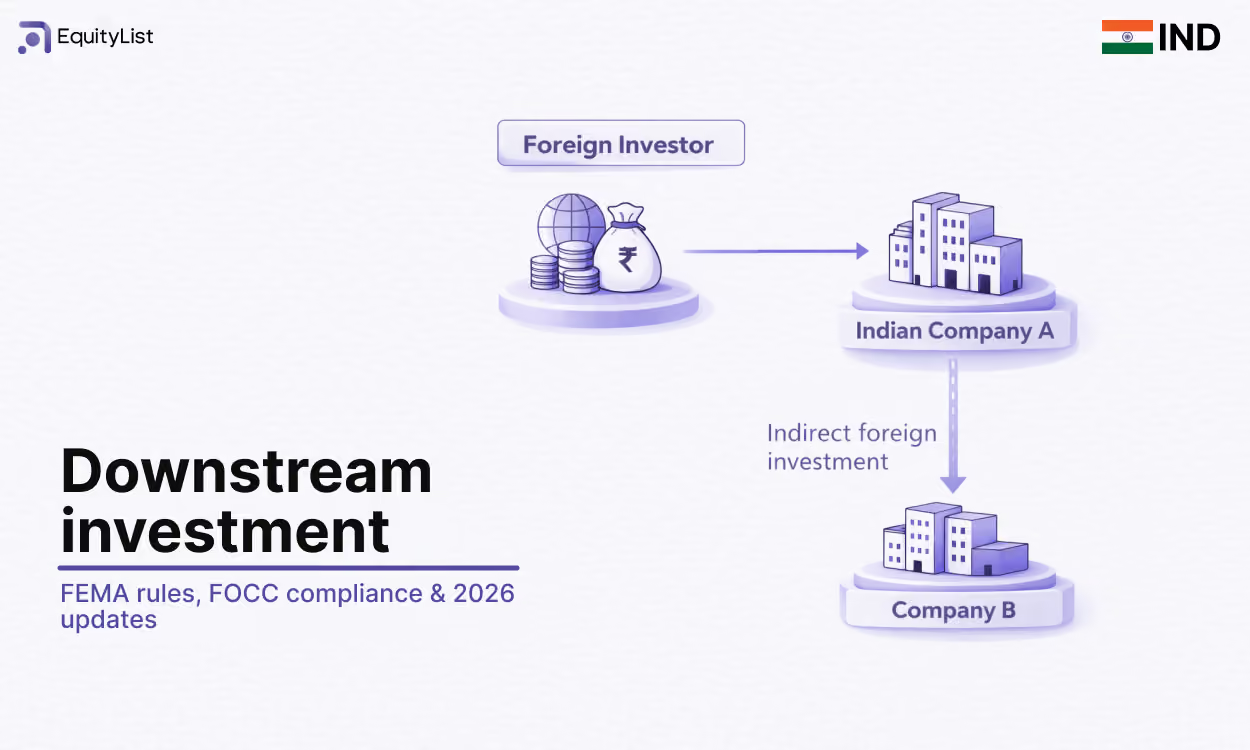
- Downstream investment is an investment by an Indian entity that has received foreign investment, into the equity instruments of another Indian entity, governed by Rule 23 of the Foreign Exchange Management (Non-Debt Instruments) Rules, 2019.
- Indirect foreign investment is a subset of downstream investment that arises only when the investing Indian entity is a Foreign Owned or Controlled Company (FOCC), meaning non-residents hold more than 50% of its equity on a fully diluted basis, or control its board or management decisions.
- When an FOCC makes a downstream investment, the investee must comply with FDI entry routes, sectoral caps, pricing guidelines, and all other conditions applicable to direct foreign investment under the NDI Rules.
- An FOCC can fund downstream investment only through fresh funds from abroad, internal accruals (post-tax profits transferred to reserves), equity instrument swaps, or deferred consideration arrangements. Domestically borrowed funds cannot be used.
- The RBI's updated Master Direction on Foreign Investment in India (January 20, 2025) expressly permits share swaps and deferred consideration for FOCC downstream investments, resolving longstanding regulatory ambiguity.
- Reporting obligations include Form DI filing with RBI within 30 days of allotment, DPIIT intimation within 30 days of investment, and an annual statutory auditor certificate confirming compliance with downstream investment rules.
- If an Indian company transitions from domestic investor status to FOCC status (for example, after a foreign-led funding round), it must now file Form DI within 30 days of reclassification under the January 2025 Master Direction.
What is downstream investment?
Downstream investment is an investment made by an Indian entity that has received foreign investment, in the equity instruments or capital of another Indian entity. Rule 23 of the Foreign Exchange Management (Non-Debt Instruments) Rules, 2019 (NDI Rules) governs this framework.
The NDI Rules use the term 'capital instruments' in the definition of downstream investment but do not define it separately. They do define a related term, 'equity instruments,' which includes equity shares, compulsorily convertible debentures (CCDs), compulsorily convertible preference shares (CCPS), and share warrants. Since 'capital instruments' is undefined, practitioners generally treat it as covering the same instruments listed under 'equity instruments.'
The concept applies when a foreign investor does not invest directly into an Indian target company, but instead routes the investment through an intermediary Indian entity, typically a subsidiary, that already has foreign capital on its books. The intermediary Indian entity then deploys that capital, or its own internally generated funds, into a second Indian entity.
For example, if a Japanese corporation holds 70% equity in an Indian subsidiary, and that Indian subsidiary subscribes to shares in another Indian company, the second transaction is a downstream investment. The Indian subsidiary is the investing entity. The second Indian company is the downstream or investee entity.
Downstream investment covers both companies incorporated under the Companies Act, 2013, and limited liability partnerships (LLPs) registered under the Limited Liability Partnership Act, 2008, though LLPs face additional restrictions discussed later in this post.
Downstream investment vs indirect foreign investment
These two terms are often used interchangeably, but they are not the same. The distinction has real compliance consequences.
Downstream investment is the broader category. It refers to any investment by an Indian entity that has received foreign investment, into another Indian entity. Every Indian company with even a small amount of foreign capital on its cap table makes a downstream investment when it invests in another Indian entity.
Indirect foreign investment is a subset of downstream investment. It arises only when the investing Indian entity is not owned and controlled by resident Indian citizens, or is owned or controlled by persons resident outside India. The NDI Rules classify such an entity as a Foreign Owned or Controlled Company (FOCC).
The compliance implications differ significantly. When an Indian entity that is not an FOCC makes a downstream investment, the investee company does not receive indirect foreign investment. The investing entity files Form DI, but the investee need not comply with FDI entry routes, sectoral caps, or pricing guidelines on account of that investment.
When an FOCC makes a downstream investment, the entire investment is treated as indirect foreign investment for the investee. The investee must then comply with entry routes, sectoral caps, pricing guidelines, and all other conditions applicable to direct foreign investment under the NDI Rules, as though a foreign investor had invested directly.
Consider a scenario where a Singapore-based fund holds 40% equity in an Indian holding company, and Indian founders hold the remaining 60% with full board control. If this holding company invests in another Indian startup, it is a downstream investment but not indirect foreign investment, because the holding company is owned and controlled by Indian residents. The investee startup does not need to check FDI sectoral caps on account of this investment.
Now change one fact: the Singapore fund holds 55% equity and has the right to appoint three of five directors. The holding company is now an FOCC. Its investment in the startup is both a downstream investment and indirect foreign investment. The startup must comply with all FDI conditions applicable to its sector.
What is a foreign owned or controlled company (FOCC)?
An FOCC is an Indian entity that has received foreign investment and is either owned or controlled by persons resident outside India (PROI), or is not owned and not controlled by resident Indian citizens.
The NDI Rules define "ownership" and "control" separately, and either condition independently triggers FOCC classification.
a. Ownership test for a company: An Indian company is considered "owned" by non-residents if more than 50% of its equity instruments are beneficially held by persons resident outside India. Beneficial holding means the actual economic interest, not just the registered ownership.
b. Ownership test for an LLP: An LLP is considered "owned" by non-residents if non-residents contribute more than 50% of its capital and hold the majority profit share.
c. Control test for a company: Control means the right to appoint a majority of the directors, or to control the management or policy decisions of the company, whether through shareholding, management rights, shareholders' agreements, or voting agreements.
A single foreign investor who holds less than 50% equity can still trigger the control test if they have the right to appoint a majority of directors, or if their contractual rights (through shareholders' agreements, voting agreements, or management rights) give them the ability to direct the company's management or policy decisions. Standard investor protective rights, such as the right to block a related-party transaction or a change in business activity, do not by themselves constitute control.
d. Control test for an LLP: Control means the right to appoint a majority of the designated partners who have exclusive authority over the LLP's policies.
Ownership is assessed on a fully diluted basis. All convertible instruments, including CCDs, CCPS, and share warrants, are included in the computation as though they have already been converted. A company where non-residents currently hold 45% of issued equity but also hold warrants that would take their fully diluted holding to 55% is classified as an FOCC.
What happens when ownership shifts after a funding round?
If an Indian company that was previously resident-owned raises a Series B round from a foreign investor, and the foreign investor's post-round holding exceeds 50% on a fully diluted basis (or the investor obtains board control), the company becomes an FOCC. The January 2025 update to the RBI Master Direction on Foreign Investment in India now requires the company to report this reclassification by filing Form DI within 30 days of the change in status. Any subsequent investment by the company into another Indian entity will be treated as indirect foreign investment from that date onward.
The guiding principle behind downstream investment regulation
The regulatory logic behind downstream investment rules is captured in a single principle embedded in Rule 23(1) of the NDI Rules: "what cannot be done directly, shall not be done indirectly."
A foreign investor subject to sectoral caps, entry route restrictions, or pricing guidelines cannot circumvent those restrictions by routing the investment through an Indian subsidiary. If the foreign investor controls or owns the Indian subsidiary, the subsidiary's downstream investment is treated as though the foreign investor made the investment directly.
For founders, this means that if your company has an FOCC as a shareholder that subsequently invests in another entity through your company, the investee must comply with FDI norms. If your company itself is an FOCC, every investment you make in another Indian entity carries the full weight of FDI compliance.
The corollary is equally important: what can be done directly can also be done indirectly. If a foreign investor is permitted to invest directly in a sector under the automatic route, an FOCC can also invest in that sector through a downstream investment without requiring government approval (subject to other conditions under Rule 23). The January 2025 Master Direction reinforced this corollary by expressly confirming that share swaps and deferred consideration arrangements available for direct FDI are also available for downstream investments by FOCCs.
Regulatory framework governing downstream investment
Downstream investment in India is governed by a layered set of regulations. Founders should be aware of each layer because compliance obligations draw from all of them.
Foreign Exchange Management Act, 1999 (FEMA)
The parent legislation that empowers the Central Government to frame rules (such as the NDI Rules) and the RBI to frame regulations and issue directions governing foreign exchange transactions, including foreign investment.
Foreign Exchange Management (Non-Debt Instruments) Rules, 2019 (NDI Rules)
The primary subordinate legislation governing downstream investment. Rule 23 contains the substantive provisions, including the FOCC classification, ownership and control tests, funding restrictions, pricing guidelines, and compliance obligations. The NDI Rules are framed by the Ministry of Finance (Department of Economic Affairs).
Consolidated FDI Policy Circular of 2020
Issued by the Department for Promotion of Industry and Internal Trade (DPIIT) under the Ministry of Commerce and Industry. The FDI Policy sets out sectoral caps, entry routes (automatic or government approval), and sector-specific conditions. DPIIT also receives the mandatory intimation when an FOCC makes a downstream investment.
RBI Master Direction on Foreign Investment in India (updated January 20, 2025)
Issued by the Reserve Bank of India under FEMA. The Master Direction consolidates and clarifies the operational framework, including guidance on downstream investments. The January 2025 update provided critical clarifications on share swaps, deferred consideration, and reclassification reporting for FOCCs.
Foreign Exchange Management (Mode of Payment and Reporting of Non-Debt Instruments) Regulations, 2019 (Reporting Regulations)
These RBI-issued regulations prescribe the forms and timelines for reporting downstream investments, including Form DI and DPIIT intimation.
Conditions for making a downstream investment
When an FOCC plans to invest in another Indian entity, several conditions must be satisfied before and during the transaction.
1. Board approval
The downstream investment requires prior approval from the board of directors of the FOCC, as mandated under Rule 23(4)(a) of the NDI Rules. This requirement also aligns with the Companies Act, 2013, which requires the Board of Directors to approve investment decisions by passing a resolution at a board meeting Section 179(3)(e). Any shareholders' agreement in place must also be complied with, meaning if the SHA requires investor consent for downstream investments, that consent must be obtained before proceeding.
2. Entry route compliance
The FOCC must verify whether the downstream investee's sector falls under the automatic route (no prior government approval required) or the government approval route (prior approval mandatory from the relevant ministry). For instance, if the investee operates in the defence sector, where FDI above 74% requires government approval, the FOCC must obtain that approval before making the investment.
3. Sectoral caps
The investee's total foreign investment, computed on a fully diluted basis, must not exceed the sectoral cap applicable to its business activity. Since the FOCC's downstream investment is treated as indirect foreign investment, it counts toward this cap.
4. Pricing guidelines
The price of equity instruments issued to the FOCC must be determined at fair market value (FMV) using any internationally accepted pricing methodology, valued on an arm's length basis. The valuation must be certified by a SEBI-registered merchant banker or a chartered accountant. This is the same pricing discipline that applies when a foreign investor subscribes to shares in an Indian company directly.
5. Press Note 3 restrictions
Press Note 3 of 2020, issued by DPIIT, restricts investment from entities in countries that share a land border with India (including China, Pakistan, Bangladesh, Nepal, Myanmar, Bhutan, and Afghanistan) or where the beneficial owner of the investment is situated in or is a citizen of such a country. This restriction applies at the downstream level as well.
Following the March 2026 amendment (Press Note 2 of 2026 series), if the FOCC's beneficial ownership from a land-bordering country is 10% or below and the investor does not exercise control, the downstream investment can proceed under the automatic route, subject to a reporting obligation to DPIIT. If beneficial ownership exceeds 10% or the investor exercises control, prior government approval remains mandatory.
{{cta-form}}
How to fund a downstream investment
The NDI Rules restrict how an FOCC can fund its downstream investment. Rule 23(4)(b) specifies the permitted sources.
1. Fresh funds from abroad
The FOCC can bring in requisite funds from outside India. This includes capital raised by the FOCC through issuing securities (including equity instruments and non-convertible debentures) to investors outside India.
2. Internal accruals
The FOCC can use its own internal accruals. Rule 23(4)(b) of the NDI Rules defines internal accruals as 'profits transferred to reserve account after payment of taxes.' In accounting terms, reserves (shown as 'Reserves and Surplus' on the company's balance sheet) are the accumulated portion of net profits that the company has retained rather than distributing as dividends.
3. Share swap (equity instrument swap)
Following the January 2025 update to the RBI Master Direction, FOCCs can now make downstream investments by swapping equity instruments. For instance, an FOCC holding shares in a foreign subsidiary can swap those shares for equity instruments issued by an Indian investee company, under the automatic route (where the sector permits), without requiring separate RBI approval. Prior to this clarification, there was regulatory ambiguity, and many Authorised Dealer (AD) banks had adopted a conservative position requiring government approval for swap-based downstream investments.
4. Deferred consideration
The January 2025 Master Direction also confirmed that deferred payment arrangements permitted for direct FDI under Rule 9(6) of the NDI Rules are available for downstream investments. Under this provision, up to 25% of the total consideration can be deferred for a period not exceeding 18 months from the date of the transfer agreement. The deferred consideration arrangement must be documented in the share purchase or transfer agreement.
5. Prohibition on domestic borrowings
An FOCC cannot use funds borrowed from the Indian domestic market to make a downstream investment. If the FOCC has taken a working capital loan or term loan from an Indian bank, those borrowed funds cannot be deployed for investing in another Indian entity. The FOCC's general business borrowings remain permissible for operational purposes, but the downstream investment itself must be funded only through the sources listed above.
Reporting and compliance obligations for downstream investment
Downstream investment triggers multiple reporting requirements, each with specific forms, recipients, and timelines.
1. Form DI with RBI
The FOCC making the downstream investment must file Form DI with the Reserve Bank of India within 30 days from the date of allotment of equity instruments by the investee entity. For secondary acquisitions (where the FOCC purchases existing shares from another holder), Form DI must be filed within 30 days from the date of acquisition. This filing is submitted through the FOCC's Authorised Dealer (AD) bank.
2. DPIIT intimation
The FOCC must notify the Secretariat for Industrial Assistance under the Department for Promotion of Industry and Internal Trade (DPIIT) within 30 days of the investment (date of remittance). This intimation is submitted through the Foreign Investment Facilitation Portal (FIFP).
3. Form FC-TRS for secondary acquisitions
When the downstream investment involves purchasing equity instruments from a non-resident seller, the FOCC must file Form FC-TRS within 60 days of the transfer of equity instruments or receipt of funds, whichever is earlier.
4. Reclassification reporting (introduced January 2025)
If an Indian entity that was previously classified as a domestic investor transitions to FOCC status (for example, after a funding round shifts majority ownership to non-residents), it must now report this reclassification by filing Form DI within 30 days from the date of acquiring FOCC status. This requirement was introduced by the January 2025 Master Direction and applies prospectively.
5. Annual statutory auditor certificate
The first-level Indian company (the FOCC) that makes a downstream investment is responsible for ensuring compliance with the NDI Rules for the downstream investment made by it at the second level and further levels. The FOCC must obtain a certificate from its statutory auditor, annually, confirming compliance with downstream investment rules. This compliance status must be mentioned in the Director's Report in the company's Annual Report, as required under Rule 23(6) of the NDI Rules. If the auditor issues a qualified report, the FOCC must immediately bring it to the notice of the regional office of the RBI in whose jurisdiction the company's registered office is located.
Downstream investment by LLPs
Under Indian law, limited liability partnerships (LLPs) and companies are distinct legal forms. A company is incorporated under the Companies Act, 2013, while an LLP is registered under the Limited Liability Partnership Act, 2008. The NDI Rules treat them separately, and LLPs that qualify as FOCCs face tighter restrictions on downstream investment compared to FOCC companies.
An FOCC-LLP can make downstream investment only in another Indian entity (company or LLP) that operates in a sector where foreign investment up to 100% is permitted under the automatic route, and where there are no FDI-linked performance conditions.
The reporting obligations, including DPIIT intimation and Form DI filing, apply to FOCC-LLPs in the same manner as they apply to FOCC companies. The compliance certification by the statutory auditor and the Director's Report disclosure also apply to LLPs under Rule 23(7), with the necessary modifications to account for the different governance structure of LLPs.
Sectors where downstream investment is restricted or prohibited
Since downstream investment by FOCCs is treated at par with FDI, all sectoral restrictions that apply to direct foreign investment also apply at the downstream level.
1. Prohibited sectors
No downstream investment is permitted in sectors where FDI is prohibited. These include: lottery business (including government, private, and online lotteries), gambling and betting (including casinos), chit funds, Nidhi companies, trading in transferable development rights, real estate business or construction of farm houses (excluding real estate development), manufacturing of cigars, cheroots, cigarillos, and cigarettes (tobacco and tobacco substitutes), activities not open to private sector investment (such as atomic energy and railway operations, with certain exceptions).
2. Government approval route sectors
Downstream investment in sectors that require government approval for FDI (such as multi-brand retail trading, broadcasting, mining, defence above 74%, or certain financial services) requires prior government approval before the FOCC makes the investment.
3. Press Note 3 restrictions (as amended in March 2026)
Press Note 3 of 2020, as amended by Press Note 2 of 2026, restricts investment from entities in countries that share a land border with India (including China, Bangladesh, Nepal, Bhutan, Pakistan, Myanmar, and Afghanistan). This restriction applies at the downstream level because Rule 23(1) of the NDI Rules requires indirect foreign investment to comply with all conditions applicable to direct foreign investment.
Under the March 2026 amendment, if an FOCC's beneficial ownership from a land-bordering country is 10% or below and the investor does not exercise control, the downstream investment can proceed under the automatic route, subject to a reporting obligation to DPIIT. If beneficial ownership exceeds 10%, or if the investor exercises control, prior government approval remains mandatory.

.png)
.svg)
.svg)
.svg)

