







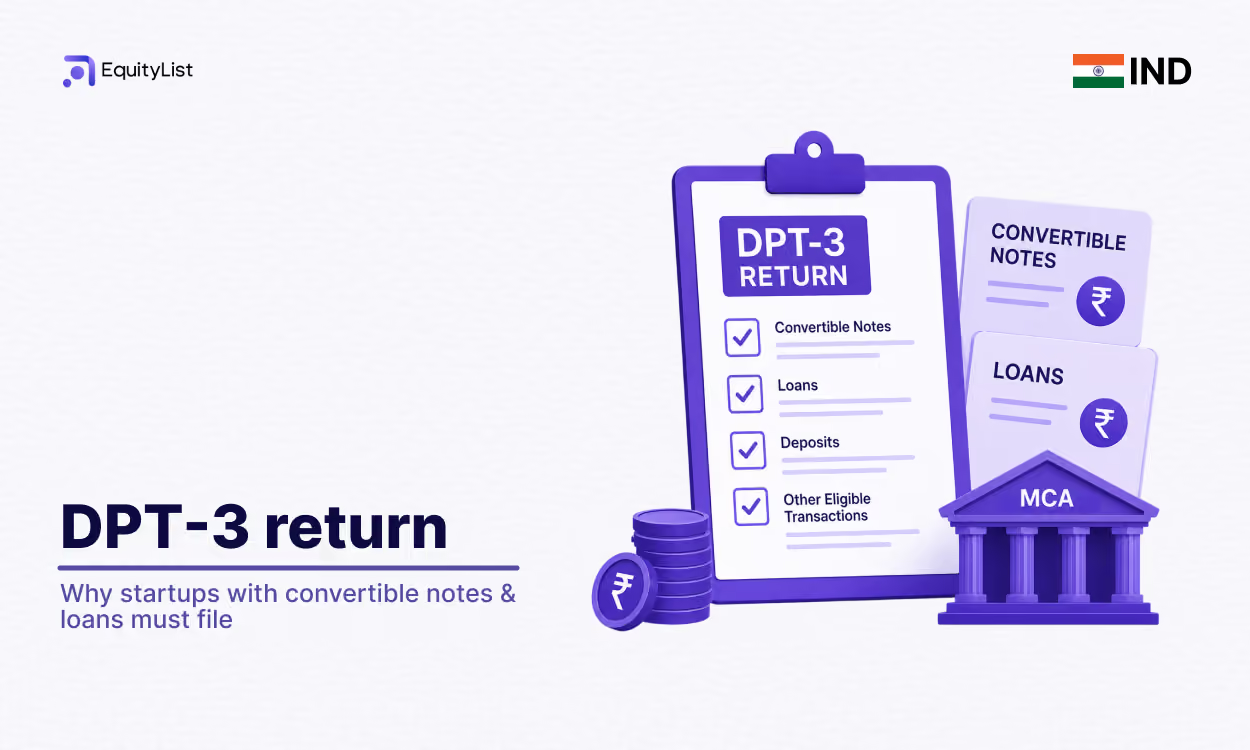
Key takeaways
- Form DPT-3 is the annual return filed under Rule 16 of the Companies (Acceptance of Deposits) Rules, 2014, due by 30 June each year for the position as on 31 March.
- The form applies even if a company has no deposits at all, because it also covers exempted receipts such as convertible notes, director loans, and inter-company loans.
- A convertible note qualifies for the Rule 2(1)(c)(xvii) exclusion only if the company is DPIIT-recognised as a startup, the amount is ₹25 lakh or more, it comes from one investor in one tranche, and it converts or repays within 10 years.
- Director loans need a written declaration that the funds aren't borrowed from a third party. Inter-company loans are excluded without conditions. Customer advances stay exempt only if adjusted within 365 days.
- Government companies, banking companies, NBFCs registered with the RBI, and housing finance companies are exempt from filing DPT-3 altogether.
- There is no requirement to file a NIL DPT-3 if the company has no deposits or exempted deposits outstanding as on 31 March.
- Late or incorrect filing carries a Rule 21 penalty of up to ₹5,000 plus ₹500 per day of continuing default; this is separate from Section 76A, which applies when a receipt turns out not to qualify for its exemption.
What Form DPT-3 is and why it applies to your startup
Form DPT-3 is the annual return a company files with the Registrar of Companies (RoC) to report two things: any deposits it has accepted, and any outstanding loans or other money it has received that doesn't count as a deposit but still needs to be disclosed.
Every company other than a government company must file it, under Rule 16 of the Companies (Acceptance of Deposits) Rules, 2014, made under Section 73 of the Companies Act, 2013. Section 73 restricts how companies can raise money in the form of deposits, and the rules made under it set out what counts as a deposit, what doesn't, and what reporting is required either way.
The return must be filed on or before 30 June every year, covering the company's position as on 31 March of that year. It's filed through the Ministry of Corporate Affairs' MCA portal.
Why exempted deposits still need to be reported in DPT-3
Rule 2(1)(c) of the Deposit Rules lists a long set of receipts that are carved out of the definition of "deposit," including convertible notes, loans from directors, loans from other companies, and customer advances under certain conditions.
These exclusions matter because money classified as a deposit triggers Section 73's conditions on accepting deposits from members. A startup raising a convertible note usually doesn't have the revenue history for a credit rating, the free capital to lock into a repayment reserve, or unpledged assets to offer as security, which is exactly why Rule 2(1)(c)(xvii) exists as a separate route.
But being excluded from the definition of "deposit" only changes how the receipt is regulated. It doesn't remove the obligation to disclose it. Rule 16 requires every company to file DPT-3 to report both deposits and "particulars of transactions not considered as deposits." A startup with zero deposits but an outstanding convertible note or a loan from its founder still has something to file.
There's no separate NIL filing to worry about either way: if a company genuinely has no outstanding deposits or exempted deposits as on 31 March, it doesn't need to file a NIL DPT-3 at all.
How convertible notes are reported in DPT-3
Convertible notes are excluded from the deposit definition under Rule 2(1)(c)(xvii) of the Deposit Rules, but only when four conditions are all met:
- The company is recognised as a startup by the DPIIT,
- The amount received is ₹25 lakh or more,
- It comes from a single investor in a single tranche,
- The note converts into equity or becomes repayable within ten years of issue (the window was extended from five years to ten years by an amendment effective 7 September 2020).
If any of these conditions isn't met, the convertible note doesn't qualify for this particular exclusion.
{{cta-form}}
Loans your startup needs to report in DPT-3
Director loans are excluded from the deposit definition under Rule 2(1)(c)(viii), but only if the director provides a written declaration confirming the money isn't itself borrowed from somewhere else. The declaration exists so the MCA can distinguish a director genuinely funding the company from a director routing third-party money through themselves to dodge the deposit rules. Even with a valid declaration, the loan still goes into DPT-3.
Loans from another company, whether a holding company, subsidiary, or unrelated corporate lender, are excluded entirely under Rule 2(1)(c)(vi). The same disclosure rule applies: excluded from "deposit" does not mean excluded from DPT-3.
Customer advances are excluded only if they're adjusted against the supply of goods or services within 365 days of receipt.
DPT-3 due date, filing portal, and documents required
The return is due by 30 June each year, reflecting figures as on 31 March. It's filed on the MCA portal using audited financial data. An auditor's certificate is required specifically for the deposit portion of the form; it isn't needed if you're only reporting exempted receipts like convertible notes or director loans.
Before filing, you'll typically need:
- Your company's net worth as per the latest audited balance sheet.
- The company's CIN and other basic identification details.
- A list of depositors, if the company has actual deposits (not required for exempted-receipts-only filings).
- Particulars of any charge created to secure deposits, where applicable.
The exact fields required depend on which of the form's filing purposes you select (deposits only, exempted receipts only, or both). Because the e-form has been revised more than once, confirm the current field layout on the live MCA form rather than relying on older guides.
Companies that don't need to file DPT-3
Government companies, banking companies, NBFCs registered with the RBI, and housing finance companies registered with the National Housing Bank don't need to file DPT-3 (each is already regulated separately when it comes to taking money from the public). If your company isn't one of these, this exclusion doesn't apply to you.
Penalties for missing the DPT-3 deadline or filing it incorrectly
If your company has no deposits, only exempted receipts like the ones above, and you file DPT-3 late or get the disclosure wrong, the applicable penalty falls under Rule 21, the general punishment provision for any contravention of the Deposit Rules with no other specified penalty: a fine of up to ₹5,000 on the company and each officer in default, plus ₹500 for every day the default continues. This is a compliance penalty for a filing failure, not the much larger Section 76A penalty that applies to actual unauthorised deposit-taking.
Section 76A is a different matter. It applies only when a company has actually accepted money that qualifies as an unauthorised deposit, for instance, a convertible note that fails one of the four conditions in Rule 2(1)(c)(xvii) and therefore isn't genuinely exempt. The penalty here is a minimum fine of ₹1 crore (or twice the deposit amount, whichever is lower) extending up to ₹10 crore for the company, with officers in default facing imprisonment of up to seven years or a fine between ₹25 lakh and ₹2 crore. This is the consequence of getting the underlying classification wrong, not the filing itself.
This is why the convertible note conditions deserve a careful check before you assume the exemption applies. The DPT-3 filing is the easy part. Making sure the receipt actually qualifies for the exclusion you're relying on is where the real risk sits.


.svg)
.svg)