
Key takeaways
- Form PAS-6 is the half-yearly Reconciliation of Share Capital Audit Report, filed with the ROC under Rule 9A(8) of the Companies (Prospectus and Allotment of Securities) Rules, 2014.
- Every unlisted public company must file PAS-6, as must every private company that is not a small company, brought in through Rule 9B(5)'s cross-reference to Rule 9A.
- Since December 1, 2025, a company qualifies as small under Section 2(85) if paid-up capital doesn't exceed ₹10 crore and turnover doesn't exceed ₹100 crore. Holding, subsidiary, and Section 8 companies never qualify as small, regardless of size.
- Private companies not small as on March 31, 2023 had their dematerialisation deadline extended to June 30, 2025, making November 29, 2025 their first PAS-6 due date.
- PAS-6 must be certified by a practising company secretary or chartered accountant before filing.
- Late filing attracts an additional fee scaling with delay length, under the Companies (Registration Offices and Fees) Rules, 2014.
- Non-compliance with the underlying dematerialisation rule carries a Section 450 penalty capped at ₹2,00,000 for the company and ₹50,000 per officer.
What is form PAS-6?
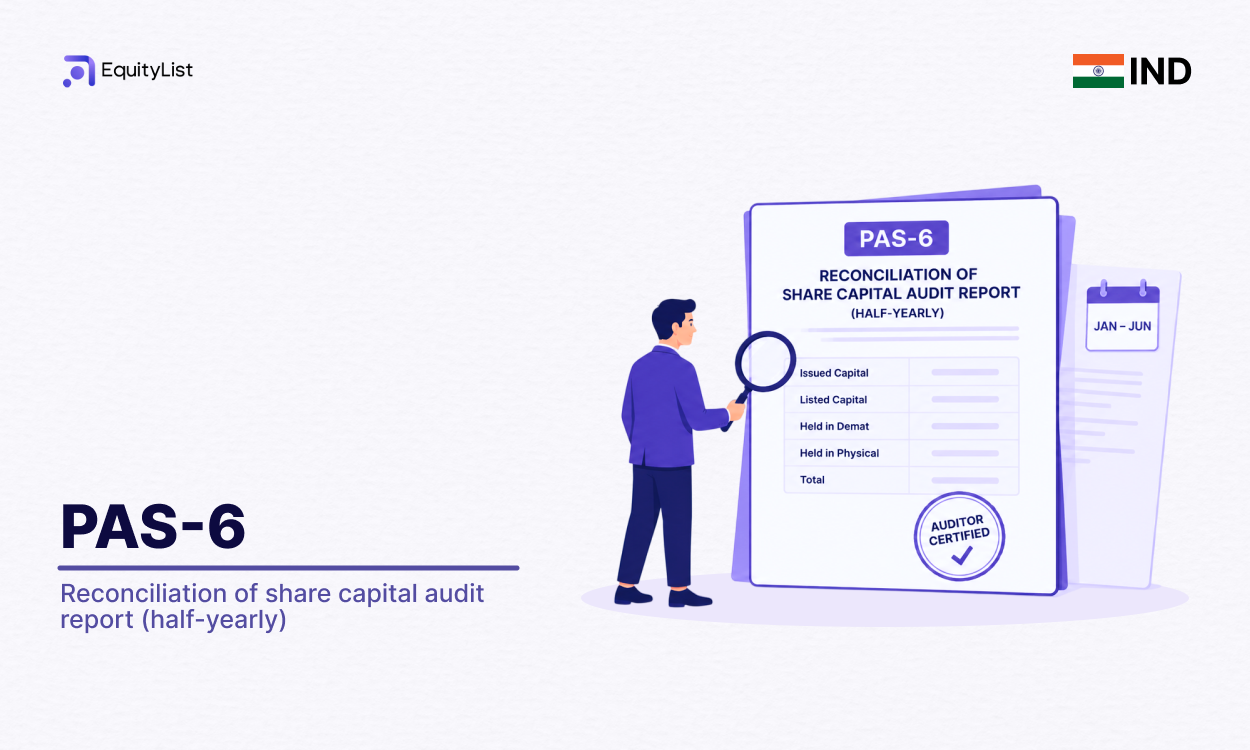
Form PAS-6 is the half-yearly Reconciliation of Share Capital Audit Report that Indian companies file with the Registrar of Companies. It reconciles what a company's own records say it has issued against what a depository says it actually holds in dematerialised, or electronic, form.
What Form PAS-6 checks and why it exists
PAS-6 exists to catch a mismatch problem. A company's own share register might show one figure for issued capital, while CDSL or NSDL, the two depositories registered under the Depositories Act, 1996, show a different figure for how many of those shares are actually sitting in dematerialised (electronic) form.
Rule 9A(8) requires every company it governs to submit this reconciliation to the Registrar of Companies (ROC) within sixty days of the end of each half year, certified by a practising company secretary or chartered accountant. Rule 9B(5) then applies that same sub-rule, along with sub-rules (4) through (10) of Rule 9A, to private companies covered under Rule 9B.
Which companies must file PAS-6
Unlisted public companies. Every unlisted public company must file, except a Nidhi company, or a government company. That last exemption matters, because it does not carry over to private companies.
Non-small private companies. Every private company must file once it is not a small company, except a government company. Holding companies, subsidiary companies, and Section 8 companies incorporated as private companies are categorically excluded from the small-company definition under the proviso to Section 2(85), regardless of their paid-up capital or turnover, so no threshold calculation applies to them at all: they file PAS-6 if Rule 9B otherwise reaches them. Producer companies are also brought within Rule 9B, but on a separate, longer runway extended to March 31, 2028, rather than the deadlines that apply to other private companies.
As of December 1, 2025, following the Companies (Specification of Definition Details) Amendment Rules, 2025, a private company qualifies as small if its paid-up share capital does not exceed ₹10 crore and its turnover for the preceding financial year does not exceed ₹100 crore, with both conditions needing to hold at once. Before that amendment, the limits stood at ₹4 crore and ₹40 crore, in force since September 2022.
{{cta-form}}
When a private company's PAS-6 obligation actually starts
Rule 9B(2) ties a private company's compliance deadline to the financial year in which it was first assessed as not small, giving it eighteen months from the end of that year to dematerialise. For the very first cohort, companies not small as on March 31, 2023, that eighteen-month calculation would have landed on September 30, 2024. A later amendment specifically extended that cohort's deadline to June 30, 2025.
That extension matters for PAS-6 because the filing obligation attaches to the half year in which the company's compliance deadline falls. For the March 2023 cohort, that is the half year running April to September 2025, making November 29, 2025 (sixty days after September 30) their first PAS-6 due date, not the May 2025 date that circulated before the extension.
What the reconciliation actually covers
The PAS-6 form asks for a company's share capital position broken down by ISIN (International Securities Identification Number, a valid 12-digit alphanumeric code assigned to each class of security once dematerialisation is set up). For each ISIN, it wants shares held in demat form with CDSL, shares held in demat form with NSDL, and shares still held in physical form, with reasons where physical holdings remain.
Because the form is filed per ISIN, a company with more than one class of security in demat form, equity and CCPS, say, files a separate PAS-6 for each one, not a single consolidated return.
It also records every change in capital during the half year by category: rights issue, bonus issue, private placement, ESOP allotment, amalgamation, conversion, buyback, capital reduction, forfeiture, and so on, along with whether each change was intimated to the depositories. The reason this level of detail exists is that a capital movement not properly reported to CDSL or NSDL is exactly the kind of event that creates the issued-versus-demat mismatch the form is designed to surface.
Finally, it captures the demat status of promoter, director, and key managerial personnel holdings specifically, because Rule 9A(2) and Rule 9B(3) both require those holdings to be fully dematerialised before the company can make certain offers, such as a rights issue or buyback.
Who certifies PAS-6 and what that certification means
A practising company secretary or chartered accountant must certify the form before it goes to the ROC. Certification here is not a formality. A false statement in the PAS-6 filing is punishable under Section 448, which carries penalties through Section 447's fraud provisions, scaling with the amount involved. The certifying professional is confirming they have checked the company's actual records, not just accepted the numbers handed to them.
Fees and penalties for late or missed filing
Normal filing fee, based on the company's nominal share capital:
Additional fee for late filing, scaling with how long the delay runs:
FAQs on PAS-6 filing
Is PAS-6 applicable to Section 8 companies?
Yes, unconditionally, if the Section 8 company is incorporated as a private company. Section 8 companies are one of the categories the proviso to Section 2(85) excludes from ever qualifying as a small company, regardless of size, so there is no threshold to check: they fall within Rule 9B's scope the same way a holding or subsidiary company does.
Can PAS-6 be filed without ISIN?
No. PAS-6's core table reports holdings ISIN by ISIN, so there's no field to complete without one. Rule 9A(4) and Rule 9B make ISIN allotment a prerequisite for dematerialisation itself, not just for the filing: a company secures an ISIN, then dematerialises, and only then does PAS-6 apply to it.

.png)
.svg)
.svg)
.svg)

