







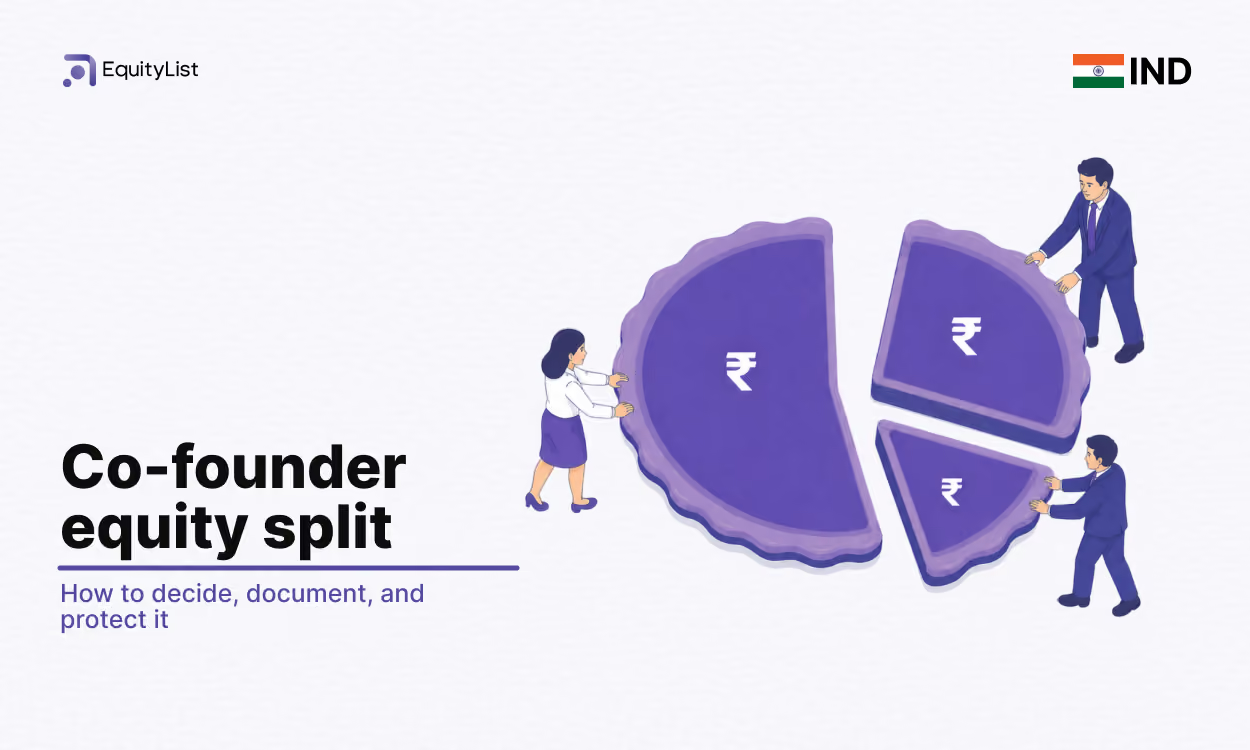
Key takeaways
- A co-founder equity split is the distribution of issued share capital among the founders.
- The three main equity split structures are equal splits (50/50 or 33/33/33), weighted contribution splits (60/40, 70/30), and role-based splits that include a CEO premium negotiated as part of the founding conversation.
- The ratio between co-founders established at incorporation typically holds through dilution events, but can shift if the split is revisited or one founder departs and the company exercises its repurchase right under the shareholders' agreement (SHA).
- A founders' agreement is essential to enforce vesting provisions, transfer restrictions, and the mechanism by which the company recovers equity from a departing co-founder.
- The founding split should be modelled through anticipated dilution events, including ESOP pool creation, seed round, and Series A, before it is finalised.
- Equity splits are not permanently fixed. When a founder's role, commitment, or contribution changes materially, the founding team should revisit the split through a formal process and document any adjustments in a revised SHA.
- Investors typically require a properly executed SHA and a documented rationale for the founding split as part of due diligence.
What is a co-founder equity split?
A co-founder equity split is the agreed distribution of ownership in a company among its founders. The split is decided at or before incorporation and shapes every ownership conversation that follows: how much each founder retains after a funding round, and what happens if one of them leaves.
Legal ownership is recorded in the register of members, which is the statutory document maintained under section 88 of the Companies Act, 2013 that reflects each shareholder's holding at any given time. The percentage each founder holds determines three things:
Economic rights: the share of proceeds each founder receives at exit, during a dividend distribution, or in a liquidation event.
Voting rights: the influence each founder has over board and shareholder resolutions.
Dilution baseline: the initial ownership starting point, from which a founder’s stake may decrease over time due to share dilution (e.g., new funding rounds, ESOP pool expansion) or share transfers (e.g., secondary sales).
The split is not permanent. Dilution from investors and ESOP pools reduces each founder's percentage over time. The ratio between co-founders typically holds through dilution events, but can change if founders actively restructure it, or if a departure triggers the company's right to repurchase unvested shares.
The three types of co-founder equity splits
1. Equal split
An equal split (50/50 or 33/33/33) works when founders join the company on the same day, take equivalent risk, and will occupy symmetrical roles over the long term.
Equal splits assume a symmetry that rarely holds as the company grows. Roles diverge: one founder typically assumes the CEO function, leads fundraising, and carries significantly more external responsibility than the founding arrangement originally anticipated. The economic and governance rights embedded in the split remain fixed while those responsibilities expand, which is what makes an uncorrected equal split feel inequitable at scale.
An equal split also means no single founder can break a tie on a contested decision. Without a deadlock provision (a clause in the founders' agreement that establishes a resolution mechanism when equal shareholders cannot agree) any fundamental disagreement between founders has no internal resolution path.
2. Weighted contribution split
A weighted split (60/40, 65/35, 70/30) reflects genuine differences in what each founder brings to the company. Where founding contributions differ, a weighted split is more accurate than an equal one. Factors that justify a higher share include:
- Full-time versus part-time commitment at founding
- Prior IP or product work brought into the company before other founders joined
- Capital invested by one founder
- Scarcity of the skill each founder contributes
- Opportunity cost of joining
A founder who built the product for six months before bringing in a co-founder is not on equal footing with someone who joined at incorporation. The split should reflect that.
3. Role-based split with a CEO premium
A CEO premium is the additional equity the CEO holds to reflect that the role expands disproportionately over time. The CEO primarily drives fundraising, manages investors, and becomes the company's principal external face. The premium varies by team composition and role scope, and is negotiated as part of the founding split conversation rather than benchmarked against a fixed range.
How to determine the co-founder equity split
Step 1: Agree on roles first
Before discussing percentages, each founder should define their long-term responsibilities. Who makes the final call on a product? On revenue? On engineering? Role clarity makes the split conversation more tractable and removes ambiguity that generates disputes later.
Step 2: Evaluate contributions honestly
The founding split should reflect the long-term vision of the company. The relevant question is not just what each founder brings today but what their role will look like as the company scales. A technical co-founder whose work is largely finished after the product is launched is in a different position from one whose responsibilities continue to grow with every hire and funding round.
Prior contribution matters for the same reason. A founder who built the product, developed early customer relationships, or brought IP into the company before the other joined has already absorbed risk and created value that the split should reflect. That contribution does not disappear because both founders are now working full-time.
Step 3: Incorporate the CEO premium
If one founder will clearly occupy the CEO role over the long term, include a premium above what a contribution-weighted split alone would produce. The CEO role expands as the company scales, and the equity should reflect that from the start rather than being renegotiated later when it is considerably harder to do.
Step 4: Set the vesting schedule
The split ratio and the vesting schedule are one decision, not two. A vesting schedule is the timeline over which each founder earns their equity. It is typically four years with a one-year cliff, meaning no equity vests in the first year, after which 25% vests immediately and the remainder vests monthly or quarterly over the following three years. Agreeing on the vesting structure, the cliff period, and the conditions that apply if a founder leaves at the same time as the split ratio produces fewer disputes than introducing vesting as a separate conversation after the ratio is already agreed.
Step 5: Model the split through dilution
Once the ratio feels equitable, model it through anticipated dilution before treating it as final. Add a 10% ESOP pool, then apply a 20% seed round and a further 20% at Series A. A founder who is comfortable with 40% at incorporation may feel differently when that number sits at 23% post-Series A. Working through this in advance prevents the split from feeling unfair once funding begins.
Step 6: Document the rationale before executing the SHA
Once the split and vesting terms are agreed, record the reasoning. The document does not need to be formal, but there should be a written record of what each founder contributes, why the ratio is what it is, and what roles each founder will hold, acknowledged by all parties. This record becomes valuable during investor due diligence, when a new co-founder joins and needs context, or when the founding team revisits the decision years later.
How the split is recorded and governed in India
The founders' agreement
A founders' agreement is typically executed at or before incorporation, between the co-founders only. It records the agreed equity split, vesting schedule, and the assignment of IP developed before incorporation to the company. It also defines each founder's roles and responsibilities, decision-making authority, and time commitment. The agreement does not require execution by external parties and is often the first document to put the split in writing.
Memorandum of Association (MoA) and Articles of Association (AoA)
The Memorandum of Association (MOA) is the constitutional document filed at incorporation that defines the company’s scope and records the initial subscribers and the number of shares each agrees to take. The Articles of Association (AOA) govern the company’s internal management, including the rights and obligations attached to different classes of shares. Together, they establish the company’s initial ownership framework at incorporation, while legal title to shares is recognized through incorporation and the register of members. Separate contractual arrangements between founders may exist alongside or prior to this structure.
Share allotment and the register of members
Share ownership arises upon allotment. The register of members (maintained under Section 88 of the Companies Act, 2013) serves as the official record of that ownership, typically updated shortly after allotment. Prior to allotment, founders may have contractual rights under agreements, but they do not yet hold legal title to shares.
{{cta-form}}
How the equity split changes as you raise funding
The founding ratio holds between co-founders, but each round dilutes every founder proportionally, considering there’s no change in equity split structure. The following example tracks two founders: Founder A at 60% and Founder B at 40%.
At incorporation
After creating a 10% ESOP pool
An ESOP pool is a block of shares set aside to grant as equity to future employees. Creating it before a funding round dilutes both founders proportionally, because new shares are issued from the company's authorised capital, increasing the total share count and reducing each existing holder's percentage.
After seed round (investors take 20%)
Note: This model assumes the ESOP pool is not expanded at each round. Investors may require a refreshed ESOP pool before a funding round closes, which would produce lower founder percentages at each stage than the figures above.
After series A (investors take a further 20%)
By series A, the founders hold under 58% combined. The 60:40 ratio between them is preserved, but absolute stakes have diluted significantly.
When to revisit the equity split
The founding split is not a one-time decision. As a company grows, the roles founders occupy, the time they commit, and the contributions they make can diverge significantly from what the original split assumed. When that divergence becomes material, the split deserves a structured review.
There is no automatic mechanism under the Companies Act, 2013 that adjusts a founder's equity based on performance or commitment. Any change to ownership must be agreed upon by the affected parties and executed through a formal legal process, typically a share transfer, a buyback of unvested shares under the repurchase right, or a new share issuance. This means the founding team must identify when a review is warranted, rather than waiting for a legal trigger.
Common mistakes in co-founder equity splits
No founders' agreement executed after agreeing on the split
The register of members records who holds how many shares, but without a founders' agreement, no rules exist for what happens next: no transfer restrictions, no vesting schedule, and no mechanism to recover equity from a founder who leaves. The split is recorded on paper but entirely unprotected.
Skewed split with no documented rationale
A 75/25 split is not inherently problematic. A 75/25 split with no record of why that ratio reflects the founders' relative contributions is a different matter. The shareholders' agreement or a separate founders' agreement should record the basis for the split (including roles, prior contributions, and capital invested) so the cap table tells a coherent story during due diligence.
Not modelling dilution before agreeing on the split
Founders who agree on a ratio without running it through a dilution model may feel the split is unfair once funding begins. Running a basic scenario, such as ESOP pool creation followed by seed and Series A rounds, before the founders' agreement is signed ensures co-founders are comfortable with where each stake lands post-dilution.
Treating the split as permanently fixed
A split agreed at incorporation reflects the founding arrangement at that moment. As the company evolves, the underlying assumptions like roles, commitment, contributions may change. Founders who treat the original split as permanently fixed may find themselves in a harder conversation later, when entrenched positions, investor protections, and accumulated resentment make adjustments significantly more difficult than an earlier structured review would have been.
{{cta-form}}
FAQs on co-founder equity split
Is a shareholders' agreement required for a co-founder equity split in India?
The Companies Act, 2013 does not mandate a shareholders' agreement. The register of members records who holds how many shares, and that record alone satisfies the statutory requirement. An SHA becomes operationally necessary because it governs transfer restrictions, vesting, and board composition in ways the register of members cannot. Investors typically require a properly executed SHA as a condition of investment, which means companies that have not executed one will need to do so before closing a funding round.
.avif)
.svg)
.svg)