







.avif)
Key takeaways
- An ESOP scheme is a legal instrument adopted by shareholders under section 62(1)(b) of the Companies Act, 2013. Every grant your company issues draws its legal authority from this document.
- The scheme must be approved by a special resolution (75% shareholder majority) and filed with the Registrar of Companies (RoC) via form MGT-14 within 30 days of passing the resolution. Options issued before this is done have no legal standing.
- DPIIT-recognised startups that are also certified as eligible startups under section 140 of the Income Tax Act, 2025 (equivalent to Section 80-IAC of the Income Tax Act, 1961) get two advantages unavailable to other companies: they can issue options to promoters and directors holding more than 10% equity, and their employees can defer perquisite tax under section 392(3) read with section 289(3) of the Income Tax Act, 2025 until the earliest of 60 months from the end of the relevant tax year of allotment, the date of sale, or the date the employee leaves the company.
- A well-drafted scheme includes separation treatment, vesting acceleration on acquisition, and clawback provisions. None of these clauses is mandated by law for unlisted companies, but each addresses a scenario that the law leaves to the parties, and the absence of any one of them is a common source of disputes.
- The scheme requires revisiting each time the company raises a new funding round, since a pool top-up requires a fresh special resolution and a new Form MGT-14 filing. Significant changes to the capital structure or headcount trigger the same process.
Regulatory note: The Income Tax Act, 2025 came into force on 1 April 2026, replacing the Income Tax Act, 1961. All tax citations in this article refer to the new act. For ESOP grants exercised before 1 April 2026, the equivalent provisions of the Income Tax Act, 1961 continue to govern those transactions. The key section mappings are: section 17(2)(vi) is now section 17(1)(d), section 192(1C) is now section 392(3) read with section 289(3), and section 80-IAC is now section 140.
What is an ESOP scheme?
An ESOP scheme is the formal legal document under which a company grants stock options to its employees.
The definition of “employee stock option” under section 2(37) of the Companies Act, 2013 is the option given to directors, officers, or employees of a company (or of its holding or subsidiary company) to purchase or subscribe to shares at a predetermined price at a future date.
For unlisted private companies, the scheme must comply with section 62(1)(b) of the Companies Act, 2013 read with rule 12 of the Companies (Share Capital and Debentures) Rules, 2014. For listed companies, the governing regulation is the SEBI (Share Based Employee Benefits and Sweat Equity) Regulations, 2021.
The scheme is an operative legal instrument adopted by shareholders. In the absence of an approved scheme, no grant can be legally issued and no shares can be allotted upon exercise.
Who is eligible for an ESOP?
Rule 12(1) of the Companies (Share Capital and Debentures) Rules, 2014 defines the eligible categories:
- A permanent employee of the company, working in India or outside India
- A director of the company, whether whole-time or part-time, but excluding an independent director
- A permanent employee or director of a subsidiary or holding company, in India or outside India
Who cannot receive options:
- An employee who is a promoter or belongs to the promoter group
- A director who holds, directly or indirectly, more than 10% of the outstanding equity shares of the company
The startup exception:
For companies recognised under the DPIIT Startup India initiative, the promoter and 10% restrictions do not apply for a period of up to 10 years from the date of incorporation, as per the amendment to rule 12 notified via GSR 127(E) dated 16 August, 2019. This exception requires only DPIIT recognition. The separate perquisite tax deferral benefit, described in the taxation section below, has additional eligibility conditions.
Mandatory disclosures in the shareholder notice
The scheme requires shareholder approval by special resolution before it can be adopted. The explanatory statement attached to the meeting notice enables shareholders to make an informed decision. Rule 12(2) of the Companies (Share Capital and Debentures) Rules, 2014 specifies what this statement must cover:
- Total number of stock options to be granted
- Identification of classes of employees entitled to participate
- The appraisal process for determining eligibility of employees
- Requirements of vesting and the vesting period
- Maximum period within which options shall vest
- Exercise price or the formula for arriving at it
- Exercise period and the process of exercise
- Lock-in period, if any
- Maximum number of options that may be granted to any single employee
- The conditions under which vested options may lapse, for example in the case of termination of employment for misconduct
- The specified time period within which an employee must exercise vested options in the event of proposed termination or resignation
- Method of valuation of options
- A statement that the company will comply with applicable accounting standards
These disclosures form part of the shareholder notice and must be accurate. Any material inconsistency between the disclosures and the scheme document itself creates legal risk.
{{cta-form}}
Sections of the ESOP scheme
1. Objective. States why the scheme exists. This anchors how every other clause is interpreted if a dispute arises.
2. Definitions. Terms like “last working day” determine what happens to options when someone leaves. Undefined or ambiguous terms are a frequent source of disputes.
3. Term of the scheme. Specifies how long the scheme stays in force, typically 10 years. Options granted before expiry continue to be governed by the scheme until exercised, lapsed, or cancelled.
4. Pool size. The total options authorised under the scheme. Lapsed or cancelled options should revert to the pool automatically, without requiring fresh shareholder approval each time.
5. Administration. Designates who runs the scheme, typically the board or a compensation committee. This body, referred to as the authority in most schemes, determines eligibility, grant terms, vesting conditions, and how options are treated when someone leaves.
6. Specific terms governing the options.
a. Grant. Options are issued via a letter of grant specifying the number of options, grant date, vesting schedule, exercise price, and expiry. Employees have no rights under the scheme until the letter of grant is issued and accepted.
b. Vesting. Governs the schedule on which options convert into an exercisable right. The minimum cliff under rule 12(6)(a) of the Companies (Share Capital and Debentures) Rules, 2014 is one year from the grant date. The scheme should also give the authority discretion to accelerate unvested options on a liquidation event (such as an acquisition, merger, or winding up), failing which employees with significant unvested options have no contractual right to any particular treatment in a transaction.
c. Exercise. Sets the exercise price and covers how employees notify the company, payment modes, and what happens to unexercised options when the exercise period ends.
d. Separation. Covers events like resignation, termination with and without cause, retirement, death, and permanent incapacity. Death and permanent incapacity treatment is prescribed by rule 12(8). Everything else is the company's call but must be written down. Gaps here cause the most disputes.
e. Allotment. Sets out the timeline and mechanics for converting exercised options into actual shares. Under the Companies Act, shares must be allotted within 60 days of exercise and rank pari passu with existing equity shares, meaning the employee receives shares with the same rights as other equity shareholders.
f. Lock-in. Restricts the employee from selling or transferring shares acquired upon exercise for a defined period. This is discretionary under rule 12(6)(b), and most unlisted companies do not impose one since the shares are already illiquid.
g. Clawback. Allows the company to recover options or shares in cases of fraud, misrepresentation, or material breach.
7. Corporate transactions. This governs how outstanding options are treated when the company undergoes a structural change. In the event of a stock split or consolidation, the number of options and the exercise price shall be adjusted proportionately to preserve the economic value of existing grants. In the case of an acquisition or merger, the authority may, at its discretion, accelerate vesting or cash-settle vested options based on the difference between the market value and the exercise price.
8. Taxation. The scheme must state that tax is the employee's responsibility. Under the Income Tax Act, 2025, perquisite tax applies at the time of exercise. The perquisite value under section 17(1)(d) read with section 17(4)(h) is the fair market value of the shares on the date of exercise less the exercise price paid by the employee. This perquisite is taxed as salary income and the employer is required to deduct TDS. When the employee subsequently sells the shares, the fair market value used at the time of exercise becomes the cost of acquisition, and the further gain is taxed as capital gains.
Startups that are DPIIT-recognised and certified as eligible startups under Section 140 of the Income Tax Act, 2025 get an additional benefit: employees can defer perquisite tax under section 392(3) read with section 289(3) of the Income Tax Act, 2025 until the earliest of 60 months from the end of the relevant tax year of allotment, the date the shares are sold, or the date the employee leaves the company.
The deferred tax is calculated at the rates in force for the tax year in which the shares were allotted, not the year in which the deferral ends. For a detailed treatment of eligibility conditions, see the dedicated guide on perquisite tax deferral for eligible startups.
9. Buyback of vested options. Allows the authority to settle vested options in cash rather than shares, giving the company flexibility to run liquidity programmes without amending the scheme.
10. Non-transferability. Establishes that options are personal to the employee and cannot be transferred, pledged, or assigned to any third party, as prescribed under rule 12(8)(a) and (b). The only exception is transmission to legal heirs or nominees upon the death of the employee.
11. Share reservation. Requires the company to maintain sufficient authorised share capital at all times to satisfy the conversion of outstanding options into shares upon exercise. Without this headroom, the company cannot legally allot shares when employees exercise, creating a breach of both the scheme and the Companies Act.
12. Limitation of rights. Clarifies what the scheme does not confer. Holding options does not guarantee continued employment, a right to participate in future grants, or any financial gain. Shares acquired upon exercise remain subject to all transfer restrictions in the AoA, including any right of first refusal or drag-along obligations binding other shareholders.
13. Non-exclusivity. Confirms that the scheme operates independently of any other incentive arrangements the company may run. Adopting this scheme does not prevent the company from establishing additional equity or cash-based compensation programmes alongside it.
14. Amendment. Governs how the scheme itself can be changed after adoption. Any variation that affects options not yet exercised requires a fresh special resolution, and the variation must not be prejudicial to the interests of employees who already hold options under the scheme, as required under rule 12 of the Companies (Share Capital and Debentures) Rules, 2014.
15. Notices, confidentiality, governing law. Covers the administrative and legal framework within which the scheme operates. All communications between the company and participants must be in writing. Participants are bound to maintain confidentiality about their option holdings and the terms of their grants. The scheme is governed by Indian law, with disputes resolved through arbitration under the Arbitration and Conciliation Act, 1996.
Each of these clauses requires deliberate drafting choices that the law leaves entirely to the company. If you need help thinking through the right terms for your stage and structure, ESOP advisory services can help you build a scheme that holds up under diligence, through an acquisition, and across every employee exit scenario.
The approval process for an ESOP scheme
Step 1: Verify the Memorandum of Association (MoA) and Articles of Association (AoA)
Before drafting the scheme, verify two things in the company's constitutional documents.
First, check that the MoA contains sufficient authorised share capital to cover the proposed option pool and all future share allotments upon exercise. Authorised share capital is the statutory ceiling on the total shares a company can issue. If the pool size plus existing issued capital would exceed it, the MoA must be amended to increase authorised capital before the scheme is adopted. An increase in authorised share capital requires a separate ordinary resolution and filing of form SH-7 with the RoC.
Second, check that the AoA expressly authorises the issuance of shares through an ESOP. If the AoA is silent on this, an extraordinary general meeting must be convened to amend it. Both amendments, where required, can be passed at the same general meeting called for scheme approval.
Step 2: Draft the ESOP scheme document
Prepare the scheme in accordance with the Companies Act, 2013 and rule 12. This is the document that will govern all grants made under it.
Step 3: Pass a board resolution
The board reviews and approves the draft scheme, the option pool size (the total number of options authorised under the scheme), and authorises calling a general meeting to seek shareholder approval.
Step 4: Issue notice to shareholders
The notice must be sent at least 21 days before the general meeting. The explanatory statement annexed to the notice must contain all disclosures required under rule 12(2).
Step 5: Pass a special resolution at the general meeting
Shareholders must approve the scheme by a special resolution requiring at least 75% of votes in favour. Rule 12 additionally requires a separate shareholder resolution for:
(a) grants to employees of a subsidiary or holding company, and
(b) grants to any individual employee in a single year that equal or exceed 1% of the issued capital (excluding outstanding warrants and conversions) of the company at the time of grant of option.
Step 6: File Form MGT-14 with the RoC
Form MGT-14 must be filed with the RoC within 30 days of passing the special resolution. If the MoA was also amended at the same meeting, the form SH-7 filing for the capital increase must be completed separately.
Step 7: Start issuing grants
Once the scheme is adopted and all required filings are complete, the company can begin issuing letters of grant to eligible employees. Each grant must be in accordance with the terms of the adopted scheme, including the vesting schedule, exercise price, and eligibility criteria set out in it.
Step 8: Maintain the register of employee stock options
Under rule 12(10), the company must maintain a register of employee stock options in SH-6 form, recording all grants, vestings, exercises, and lapses.
Direct route and trust route to issue ESOPs
Companies can issue ESOPs through two structural routes. Under the direct route, the company grants options and issues fresh shares to employees when they exercise. This is the most common approach for unlisted private companies. Under the trust route, the company establishes an ESOP trust that holds shares on behalf of employees, which can be useful for managing liquidity. Each route has different operational and compliance implications.
Tax treatment for ESOPs
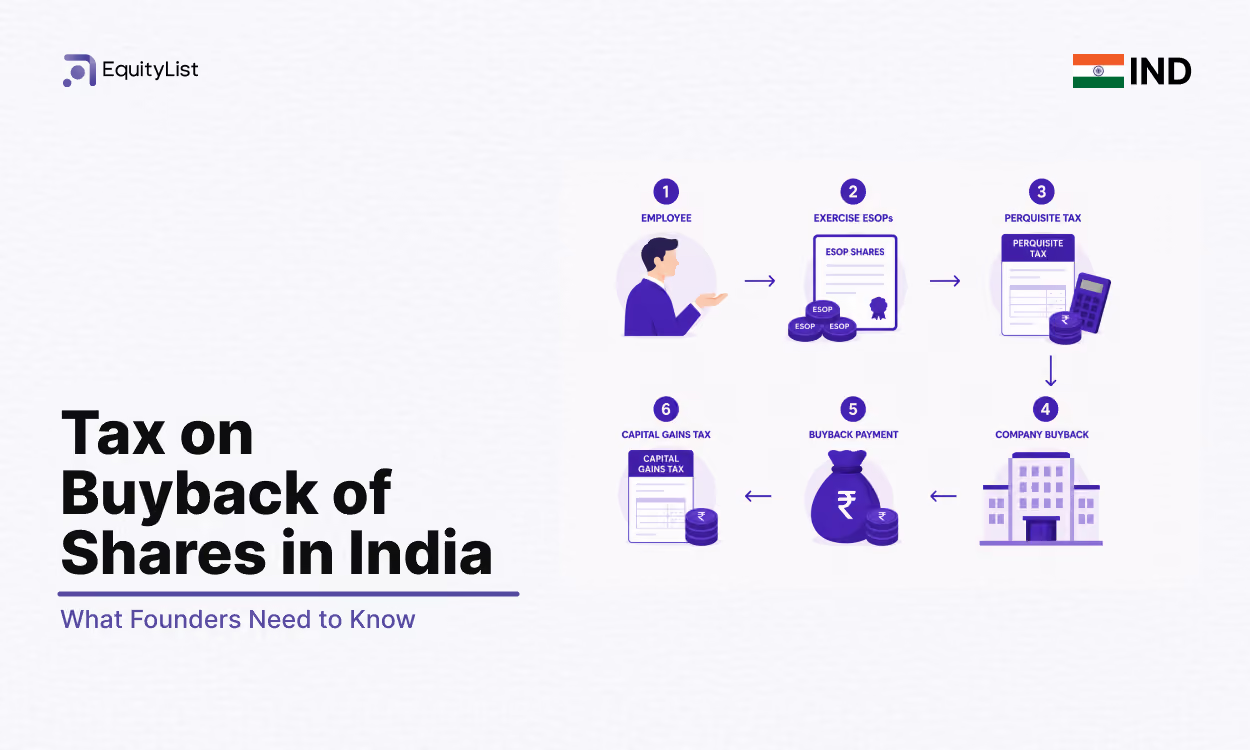
At the time of exercise, the difference between the fair market value of the shares on the date of exercise and the exercise price is treated as a perquisite under section 17(1)(d) read with section 17(4)(h) of the Income Tax Act, 2025, and taxed as salary income.
At the time of sale, the further gain between the sale price and the fair market value used at exercise is taxed as capital gains. The holding period for capital gains purposes is counted from the date of allotment.
- For unlisted ESOP shares: shares held for more than 24 months qualify as long-term capital assets and are taxed at 12.5% under section 197 of the Income Tax Act, 2025, without indexation. Shares held for 24 months or less are taxed at the applicable income tax slab rate.
- For listed ESOP shares: long-term capital gains (shares held more than 12 months) exceeding ₹1,25,000 are taxed at 12.5% under section 198 of the Income Tax Act, 2025. Short-term capital gains (shares held 12 months or less, where STT has been paid) are taxed at 20% under Section 196.
For employees of eligible startups certified under section 140, the perquisite tax obligation is deferred under section 392(3) read with section 289(3) until the earliest of 60 months from the end of the relevant tax year of allotment, the date the shares are sold, or the date the employee leaves the company.
What happens if the scheme is missing or defective
1. Due diligence will surface the gap. During a fundraising round or acquisition, investors and acquirers review the ESOP scheme, all shareholder resolutions, and form MGT-14 filings as part of standard legal due diligence. Missing or inconsistent documentation delays or blocks transactions.
2. Retroactive adoption does not cure prior grants. Adopting a scheme retrospectively does not validate grants that were already issued without one. Those options must be re-issued under the newly adopted scheme, which typically requires fresh board approvals and new grant letters for each affected employee.
3. Annual reporting obligations are triggered. Under rule 12(9) of the Companies (Share Capital and Debentures) Rules, 2014, the board's report must disclose the details of the ESOP scheme for the year, including options granted, vested, exercised, and lapsed. Non-disclosure attracts regulatory scrutiny.
FAQs on ESOP scheme
Can a private limited company issue ESOPs without a scheme document?
No. Under section 62(1)(b) of the Companies Act, 2013 and rule 12 of the Companies (Share Capital and Debentures) Rules, 2014, no options can be issued without a formally adopted scheme approved by shareholders through a special resolution.
Does the ESOP scheme need to be registered anywhere?
The scheme itself is not registered, but the special resolution approving it must be filed with the RoC via Form MGT-14 within 30 days of passing the resolution. Without this filing, the company is in regulatory default, which can be flagged during due diligence and may attract penalties under the Companies Act.
Can the company have more than one ESOP scheme?
Yes. Companies often adopt new schemes at different stages (for example, ESOP Scheme 2021 and ESOP Scheme 2024), each with its own pool, vesting terms, and eligibility criteria. Each new scheme requires fresh shareholder approval.
Can the terms of an existing ESOP scheme be changed?
Yes, but only through a special resolution, and any variation must not be prejudicial to the interests of employees who already hold options under that scheme. This requirement is explicitly stated in rule 12 of the Companies (Share Capital and Debentures) Rules, 2014.
What is the minimum vesting period allowed under Indian law?
Rule 12(6)(a) mandates a minimum period of one year between the grant date and the first vesting date. Companies can prescribe longer vesting periods. A four-year schedule with a one-year cliff is a common structure among Indian startups, though the law prescribes only the one-year minimum.
What happens to unvested options when a company is acquired?
The scheme should give the authority the discretion to accelerate vesting of unvested options upon a liquidation event, or to settle them in cash. If the scheme is silent, unvested options may be cancelled, rolled over into acquirer equity, or handled according to whatever the acquirer agrees to in the deal.
What is the role of Ind AS 102 in an ESOP scheme?
Ind AS 102 (Share-Based Payment) applies to companies that prepare financial statements under Ind AS. It requires those companies to recognise ESOP-related costs as an expense in their financial statements, calculated using option pricing models such as Black-Scholes. Companies that report under Indian GAAP follow the ICAI guidance note on accounting for share-based payments instead. Whichever standard applies, the scheme must include a statement of the company's intent to comply with applicable accounting standards. This is not only a compliance obligation; it affects reported profitability and is closely reviewed by auditors and investors.
Can employees transfer their options to a family member?
No. Under rule 12(8)(a) and (b), options are non-transferable and cannot be sold, pledged, or assigned. The only exception is transmission to nominees or legal heirs upon the death of the employee.
.avif)
.svg)
.svg)
.svg)