







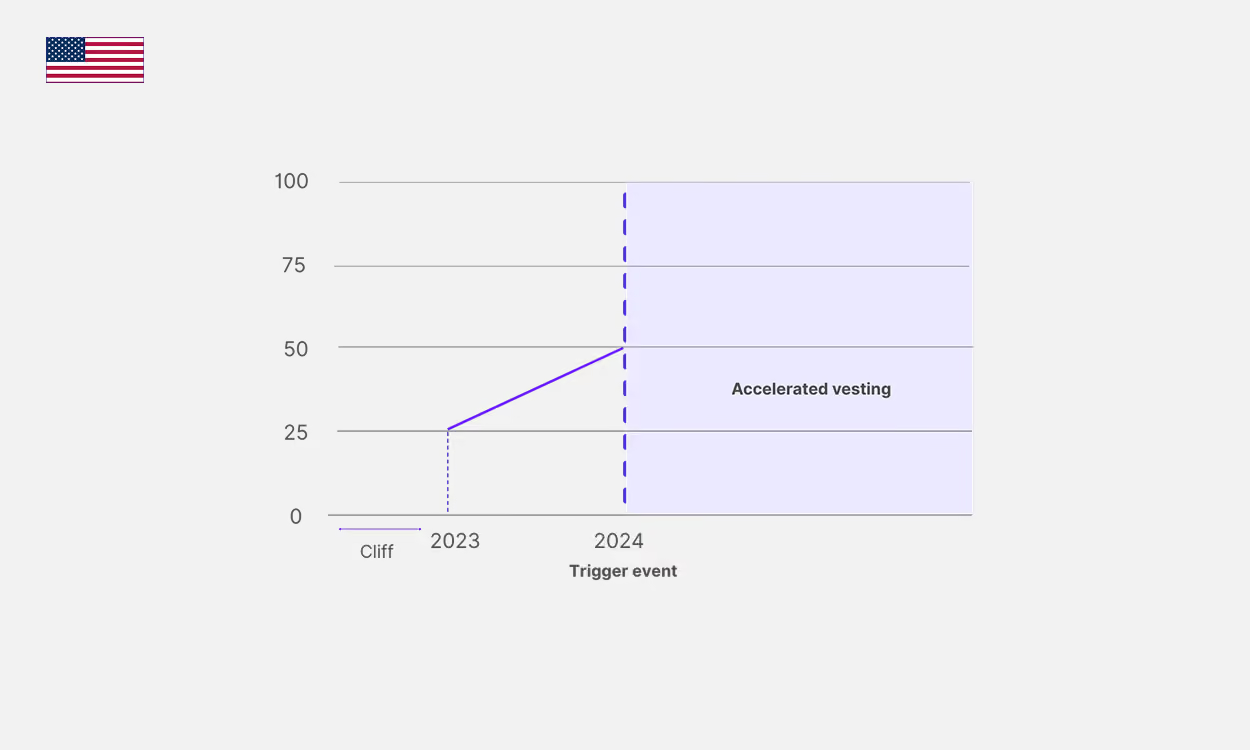
What is vesting acceleration?
Vesting acceleration is a contractual provision that allows unvested equity to vest immediately when certain events occur.
Most startup equity follows a predictable, time-based vesting schedule (for example, four years with a one-year cliff). Acceleration steps in as an exception to that schedule. When triggered, it converts some or all of the remaining unvested portion into vested equity immediately.
Acceleration exists because vesting itself is designed to solve two problems:
- rewarding ongoing contribution over time, and
- mitigating the risk of giving away equity to someone who may leave early.
When the company enters a disruptive event, such as being acquired, replacing leadership, or reshaping roles, the original time schedule may no longer reflect fairness or the company’s incentives. Acceleration fills that gap.
What is single-trigger acceleration?
Single-trigger acceleration allows unvested equity to vest automatically when one specified event occurs, most commonly a change in control such as a sale or merger.
Single-trigger clauses are most often negotiated by founders and senior executives. It protects them against that “early exit” risk. For most employees, single-trigger provisions are far less common unless the company is mature, well-funded, and competing aggressively for talent.
The benefit of single-trigger acceleration
From an employee perspective, the appeal is obvious. If a sale occurs, the unvested portion of the grant converts to vested equity instantly. This gives employees certainty: the full economic value of their grant becomes theirs at the moment the deal closes. They no longer need to stay through a transition period or rely on the acquirer to continue their role in order to receive the full benefit.
The drawback of single-trigger acceleration
From an acquirer’s point of view, single-trigger acceleration can be problematic. If every employee vests in full at closing, the buyer effectively inherits a team that has already received its financial incentive to stay. Buyers may respond by offering smaller retention packages or by lowering the acquisition price to offset the cost of accelerated vesting.
What is double-trigger acceleration?
Double-trigger acceleration requires two separate events to occur before unvested equity accelerates.
The first event is almost always a change in control, typically a sale, merger, or similar transaction. The second event is a qualifying termination, meaning the employee is either terminated without cause or resigns for “good reason,” usually within a defined period after the acquisition closes. In some RSU plans, the second trigger may instead be a continued-service requirement, such as being employed during the change in control or for a short period after the transaction. But the underlying idea is the same: acceleration requires both a change in control and a second, independent condition.
Only when both conditions are met does the unvested equity vest early.
Double-trigger acceleration depends on award treatment
Double-trigger acceleration only works if your unvested equity continues to exist after the acquisition.
But if the buyer pays out, cancels, or swaps your unvested equity for something new at the moment the deal closes, the original grant disappears. Once that happens, there is nothing left to accelerate later. This is why the way a buyer chooses to handle employee equity can significantly change what employees end up receiving.
The benefit of double-trigger acceleration
Double-trigger acceleration structures have become the market standard because they sit at a practical middle ground.
They protect employees who genuinely bear the risk of job loss during an acquisition, yet they avoid handing out automatic, across-the-board vesting at the moment of sale.
For acquirers, this is important because it helps keep key people motivated and willing to stay through the transition after the deal.
Most double-trigger provisions also define the “window” during which the second trigger can occur. Some companies include a short pre-closing window, often around three months, to prevent a situation where employees are terminated just before a deal closes to avoid triggering acceleration. The more common window is post-closing: a period, typically between nine and eighteen months, during which a qualifying termination gives rise to acceleration.
The drawback of double-trigger acceleration
The main drawback of double-trigger acceleration is that employees often cannot access the value of their equity until both conditions are met. This keeps them from participating in private market liquidity while waiting for the second trigger.
Some plans also include a “must be present to win” requirement, which restricts acceleration to employees who are still employed at the moment of the acquisition. This matters because certain equity plans or negotiated grants can allow former employees to receive acceleration at exit unless the plan explicitly limits eligibility.
Double-trigger vs single-trigger acceleration for RSUs and stock options
Restricted Stock Units (RSUs)
Restricted Stock Units (RSUs) are designed to settle into actual shares at the moment they vest, and that settlement is treated as ordinary income for tax purposes in the U.S. As a result, the trigger structure, whether single or double, has immediate financial consequences for employees.
Single-trigger RSUs
A single-trigger RSU vests and settles as soon as a change in control occurs. The employee receives shares (or their cash equivalent) at closing, and tax is due immediately.
This structure is uncommon in private companies because it can create substantial tax obligations at a time when there may be no liquidity to pay the tax. It is more typical in public companies, where shares can be sold instantly.
Double-trigger RSUs
Double-trigger RSUs require:
- A change in control, and
- A vesting condition that adds real risk of forfeiture, (usually qualifying termination, or sometimes continued employment through closing)
The U.S. tax rules require RSUs to be subject to a “substantial risk of forfeiture” in order to defer taxation until the employee’s right to the shares is no longer subject to a meaningful chance of loss.
Tender offers, buybacks, or secondary sales do not create a meaningful risk of forfeiture, hence cannot be used as the second trigger. This is why employees with double-trigger RSUs generally cannot participate in liquidity programs.
For example:
Jamie has 3,000 unvested RSUs, and her company is acquired for $20 per share.
Under a single-trigger structure, all 3,000 RSUs vest and settle at closing. Jamie immediately recognizes $60,000 of ordinary income, and the company would typically satisfy the withholding obligation by retaining a portion of the shares through net settlement.
Under a double-trigger structure where the second trigger is a qualifying termination, the RSUs settle only if Jamie resigns or is terminated after the acquisition. If Jamie stays employed, the second trigger never occurs and settlement is deferred.
Waiving the second trigger
Under double-trigger RSUs, the company may choose to waive the termination requirement so that the RSUs that have already met their time-based vesting condition can settle during a liquidity event. This gives employees access to partial liquidity.
However, the IRS requires RSUs to be subject to a “substantial risk of forfeiture” in order to defer taxation. If a company repeatedly waives the second trigger for broad groups of employees, the IRS may conclude that the forfeiture condition is not meaningful. In that case, the IRS can require employees to recognize income, even if they never sold their shares.
{{cta-form}}
Stock options
For stock options, vesting, whether accelerated or not, does not create tax by itself.
Options only become taxable when exercised for NSOs (Non-Qualified Stock Options) or when exercised in a way that triggers AMT for ISOs (Incentive Stock Options).
Single-trigger options
With single-trigger acceleration on stock options, any unvested options immediately vest when the trigger event occurs. Once vested, the employee gains the right to exercise all of those options.
After acceleration, the same rules that normally apply to vested options continue to apply. For example, ISOs must be exercised within 90 days of leaving the company to maintain ISO status; otherwise, they convert into NSOs.
Double-trigger options
Double-trigger acceleration for stock options almost always uses a qualifying termination as the second trigger. If the employee is terminated without cause (or resigns for good reason) within a set post-acquisition window, the remaining unvested options accelerate. If the employee stays on with the acquirer, the second trigger never occurs and vesting simply continues on the original schedule.
For example, Eli has 10,000 NSOs with a $1 strike price. After a sale, all 10,000 vest under a single-trigger. If he exercises at a $6 FMV, he pays $10,000 and recognizes $50,000 of ordinary income (the $5 spread × 10,000 shares).
If Eli’s options are ISOs:
- Exercising the options does not trigger ordinary income tax.
- The $50,000 spread counts toward AMT, possibly creating AMT liability.
- If he holds the shares long enough, future gains may qualify for long-term capital-gains treatment.
FAQs
1. What is a double trigger in RSU?
Double-trigger RSUs require two events before settlement: a change in control (such as an acquisition) and a vesting condition that adds real risk of forfeiture, such as a qualifying termination or, in some plans, a continued-employment requirement through the closing of the acquisition. Both conditions must occur for the RSUs to accelerate and become payable.
2. What is the difference between single trigger and double trigger stock options?
Single-trigger acceleration vests unvested equity when one specified event occurs, typically resulting in the change in control of the company. Double-trigger acceleration requires two events: the sale itself and a second, separate condition, typically a qualifying termination after the acquisition.
3. What are the two types of vesting?
The two common types of vesting are time-based vesting and performance-based vesting. Time-based vesting occurs gradually over a set schedule, such as monthly vesting over four years. Performance-based vesting depends on meeting a specific goal, such as revenue targets, product milestones, or profitability thresholds. Acceleration provisions sit on top of these mechanisms and allow unvested equity to vest faster when certain triggers are met.
.avif)
.svg)
.svg)