
Key takeaways
- Equity financing results in permanent ownership dilution while debt financing creates a repayment obligation. Neither is universally better.
- The central trade-off is dilution versus repayment pressure. Which constraint is more limiting depends on the company's stage and cash flow profile.
- Debt is generally cheaper than equity due to interest tax deductibility, but early-stage companies often cannot access it without cash flow or collateral.
- Equity financing changes governance, not just ownership. Institutional investors typically receive board rights and protective provisions alongside their shares.
- Most early-stage rounds use hybrid instruments like SAFEs, convertible notes, or venture debt. These defer the equity decision but do not eliminate dilution.
- Hybrid instruments that stack across multiple rounds can produce larger dilution at conversion than founders expect. Model every instrument before signing.
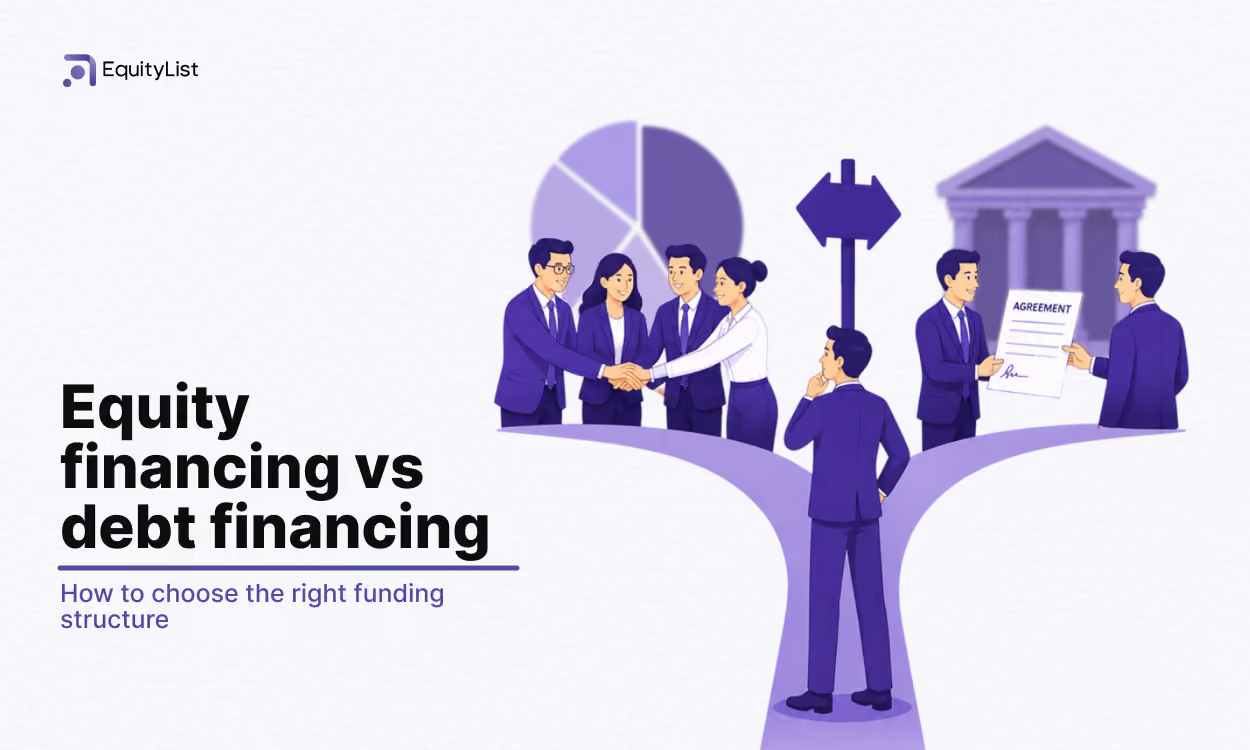
Equity financing and debt financing represent two fundamentally different claims on your company. Equity gives investors permanent ownership in exchange for capital, with no repayment obligation. Debt gives lenders a fixed claim on your cash flows, with no ownership transfer.
The decision that matters is which structure fits the company at its current stage, given its cash flow profile and the trade-offs founders are willing to accept.
The core difference between equity financing and debt financing
With equity financing, investors receive shares. They become co-owners of the business. Their return depends on what the company is ultimately worth, through an exit or secondary sale. There is no repayment obligation, but the dilution is permanent.
With debt financing, lenders receive a contractual right to repayment plus interest. They do not own anything. The company's shareholding structure stays intact, but the obligation to repay exists regardless of performance.
That asymmetry (permanent dilution vs fixed obligation) is the fundamental trade-off every financing decision revolves around.
What you give up with equity
Ownership: When new shares are issued, existing shareholders own a smaller percentage of the company. This is straightforward arithmetic. What founders sometimes underestimate is how dilution compounds across rounds. A 20% seed round followed by a 25% Series A leaves the founder with roughly 60%, before accounting for ESOP pool creation. Any SAFEs or convertible notes that convert at the same round will dilute this figure further.
Governance: Institutional equity investors typically negotiate more than just shares. Preferred equity (the share class issued to most institutional investors) commonly carries protective provisions: veto rights over major decisions such as new equity issuance, debt above a threshold, acquisitions, or amendments to the company's constitutional documents. Board seat rights are standard from Series A onward. These are not unusual or adversarial terms; they are market-standard and founders should expect them. The practical implication is that certain decisions will require investor sign-off.
What you take on with debt
Repayment obligation: Debt must be repaid (principal plus interest) on a schedule. If the business underperforms relative to projections, the obligation does not adjust. This is why debt is structurally unsuitable for pre-revenue companies or businesses with unpredictable cash flows.
Collateral or covenant requirements: Traditional bank lending requires assets to pledge or financial covenants (minimum revenue, minimum cash balance, restrictions on additional debt) that limit operational flexibility. Venture debt tends to be less restrictive, but it almost always includes warrant coverage, meaning the lender receives the right to purchase a small number of shares at a fixed price. This introduces a dilutive component into what is nominally a debt instrument.
The key test for debt suitability is simple: can the company model debt service coverage confidently on its most conservative revenue forecast? If not, the repayment obligation will create pressure at exactly the wrong time.
The cost comparison (and when it breaks down)
Debt is generally cheaper than equity, and the reason is tax treatment. Interest payments on debt are deductible from taxable income under most corporate tax regimes, which reduces the effective cost of borrowing. Equity investors, by contrast, expect returns that compensate for the risk of losing everything, which makes the implied cost of equity significantly higher.
To see why this matters, it helps to look at weighted average cost of capital (WACC).
WACC = (proportion of equity × cost of equity) + (proportion of debt × after-tax cost of debt)
If a company is 70% equity-financed at a 25% expected return and 30% debt-financed at a 7% after-tax interest rate, its WACC is roughly 19.6%.
Equity component: 70% × 25% = 17.5%
Debt component: 30% × 7% = 2.1%
WACC: 17.5% + 2.1% = 19.6%
Shift the mix to 50/50, and WACC drops. The lower the WACC, the less return the business needs to generate to satisfy both investors and lenders. That is why the financing mix matters beyond just ownership percentages.
For early-stage companies, though, this comparison rarely applies. Most startups cannot access conventional debt because they lack collateral, credit history, or operating cash flow. The real choice is not equity versus debt; it is equity versus no capital at all. Even where venture debt is available, it almost always comes with warrant coverage, which introduces a dilutive cost that makes the comparison less straightforward than it appears.
The cost argument for debt becomes compelling once the company has revenue, operating history, and access to credit on reasonable terms. Before that point, the WACC framework is theoretically correct but not a practical consideration.
When equity makes more sense
- The company is pre-revenue or early stage: With no operating cash flow, repayment obligations are not manageable. Equity financing, with its absence of scheduled repayment, fits the risk profile of the business.
- The business model requires a long investment horizon before returns: Capital-intensive businesses (such as biotech, hardware, or infrastructure) cannot generate cash fast enough to service conventional debt during the growth period. Equity financing allows capital deployment without creating a drag on operations.
- The investor brings strategic value beyond the cheque: If the right investor materially improves the company's trajectory through introductions, operational guidance, or access to markets, the equity given up may be worth less than the value received. Lenders do not offer this.
When debt makes more sense
- The company has predictable, recurring cash flow: A SaaS business with high net revenue retention, a company with multi-year contracts, or a business with consistent operating margins can model debt service coverage reliably. For these companies, debt preserves ownership without creating meaningful repayment risk.
- The company wants to extend the runway without diluting at the current valuation: If the founders believe the company's value will be materially higher in 12 to 18 months, taking on venture debt to extend how long the company can operate before running out of cash, without issuing new shares, preserves equity that would otherwise be lost permanently at today’s lower valuation.
- The financing need is short-term and defined: Bridge loans and revolving credit facilities can close faster than equity rounds, which typically take 3 to 6 months at the Series A stage and beyond, and are well-suited to situations where capital is needed for a specific, bounded purpose.
The hybrid path: convertible notes, SAFEs, and venture debt
Most early-stage funding rounds do not use pure equity or pure debt. They use instruments that sit between the two.
- Convertible notes are debt instruments that convert into equity at a future priced round. They accrue interest (typically 4–8% per annum), carry a maturity date (usually 18–24 months), and include a valuation cap and discount rate that give noteholders more favourable conversion terms than new investors in the priced round. If conversion does not happen before maturity, the principal and accrued interest must be repaid.
- SAFEs are not debt. They carry no interest, no maturity date, and no repayment obligation. They convert into equity at a future priced round based on the agreed valuation cap and discount. SAFEs are faster and simpler than convertible notes, which is why they are now the default early-stage instrument in many markets. The trade-off is that investors may wait years before conversion occurs.
- Venture debt is purpose-built debt for venture-backed companies, typically raised alongside or after an equity round to extend runway. It does not convert into equity (apart from the warrant component) and must be repaid.
The critical point about hybrid instruments is that they defer the equity decision, not eliminate it.
Mistakes worth avoiding
- Over-diluting early: Issuing too much equity at a low valuation locks in permanent dilution that compounds through every subsequent round. Raise what is needed to reach the next meaningful milestone, not the maximum possible.
- Taking on debt without conservative cash flow modeling: Debt service does not adjust for underperformance. Before accepting debt, model repayment on the most pessimistic revenue forecast, not the base case.
- Signing equity term sheets without reading the governance provisions: Valuation and round size are not the whole picture. Protective provisions, board seat rights, and information rights define what the company can and cannot do without investor consent.
- Stacking convertible instruments without modeling conversion: The dilution from a single SAFE or convertible note is straightforward to model. The dilution from four of them, each with a different valuation cap, is not. When multiple instruments convert simultaneously at a priced round, the combined effect compounds in ways that are easy to underestimate if each instrument was evaluated in isolation. Use EquityList’s SAFE calculator to model how each SAFE converts at a priced round and see the impact on founder ownership before you commit.
FAQ on equity financing vs debt financing
What is the main difference between equity financing and debt financing?
Equity financing involves selling ownership in the company to investors in exchange for capital. Debt financing involves borrowing money from lenders with an obligation to repay principal and interest. Equity makes founders give up a permanent ownership stake; debt creates a fixed repayment obligation regardless of the company's performance.
Which is cheaper, equity or debt financing?
Debt financing is generally cheaper than equity financing because interest payments are tax-deductible under most corporate tax regimes, which reduces the effective cost of borrowing. Equity investors require returns that reflect the risk of losing their entire investment, making the implied cost of equity higher. However, early-stage companies often cannot access debt financing and must rely on equity regardless of cost.
When should a startup use equity financing instead of debt?
Equity financing is more appropriate when the company has no operating cash flow, when the business model requires a long period before generating returns, or when the investor provides strategic value beyond the capital itself. Pre-revenue companies typically cannot service debt and have no realistic alternative to equity.
What is venture debt and how does it differ from a bank loan?
Venture debt is debt financing designed specifically for venture-backed companies. Unlike traditional bank loans, it does not require the same level of collateral or operating history. It is typically raised alongside or after an equity round to extend the runway. Venture debt almost always includes warrant coverage, which gives the lender the right to purchase shares at a fixed price.
What happens if a convertible note is not converted before maturity?
If a convertible note reaches its maturity date without converting into equity at a priced round, the company is obligated to repay the principal and accrued interest. This creates a repayment obligation that can affect companies that have not yet raised a priced round within the note's maturity window.

.svg)
.svg)
.svg)

