
Key takeaways
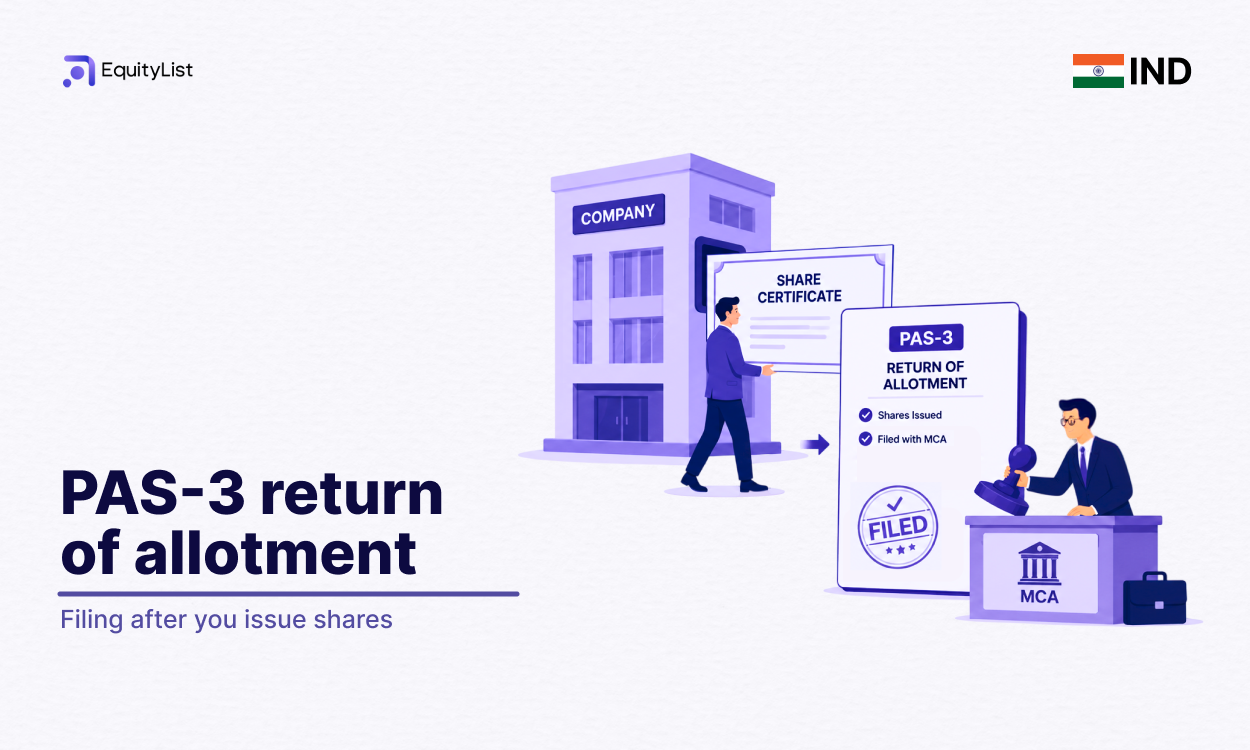
- Form PAS-3 is the return of allotment that every Indian company with share capital must file with the Registrar of Companies (ROC) after issuing shares or other securities. It confirms the allotment happened and updates the company's recorded capital structure.
- The filing deadline depends on how the shares were allotted: private placement and preferential allotment under Section 42 get 15 days, while rights issues, bonus shares, ESOP exercises, and sweat equity get 30 days under Section 39(4).
- A company cannot use money raised through private placement until it has both allotted the shares and filed PAS-3. This condition, under Section 42(4), can delay access to fundraise proceeds if the filing is late.
- Section 42(9) sets a penalty of ₹1,000 per day of delay in filing PAS-3 for private placement rounds, capped at ₹25 lakh. A separate, larger penalty under Section 42(10) applies to broader violations of the private placement process itself.
- PAS-3 is processed as a Straight Through Process (STP) form, taken on record electronically at filing with no provision for resubmission, except for one person companies and small companies. It must also be pre-certified by a practising Chartered Accountant, Company Secretary, or Cost Accountant before submission.
- PAS-3, the return of allotment filed after shares are issued, is distinct from PAS-4, the private placement offer letter issued before fundraising.
What is Form PAS-3 and when does it apply
Every time an Indian company issues shares or other securities, it has to tell the Registrar of Companies that the issue actually happened. That notification is Form PAS-3, officially called the return of allotment.
Filing PAS-3 does two things for the ROC's records. It confirms that the company followed through on an allotment it had approved, and it updates the company's recorded paid-up share capital and shareholding pattern to reflect the new shares.
Which share allotments require a PAS-3 filing
PAS-3 applies regardless of why the shares were issued. Any time a company allots a security to anyone, a PAS-3 filing follows. For a growing company, this shows up in a handful of recurring situations. EquityList's guide to allotment of shares covers the underlying allotment process itself in more depth.
- Private placement or preferential allotment to investors under Section 42, such as an equity or CCPS round closed with a defined set of investors
- Rights issues to existing shareholders
- Bonus share issues
- ESOP exercise allotments, once an employee pays the exercise price and receives shares
- Sweat equity allotments to directors or employees
- Conversion of debentures, loans, or other convertible instruments into equity shares
Whichever route applies, the filing obligation and the form are identical. The deadline is not.
PAS-3 due date: 15 days or 30 days depending on how shares were allotted
Why unfiled PAS-3 freezes your private placement proceeds
Section 42(6) of the Companies Act, 2013 already requires private placement application money to sit in a separate bank account at a scheduled bank, untouched until the company either allots the shares or refunds the money. Section 42(4) adds a second condition on top of that: even after allotment, the company still cannot use the money until PAS-3 has actually been filed with the ROC.
For a startup that has just closed a round, this means the date the money lands in the bank and the date the company is legally allowed to spend it are not the same date.
Since late PAS-3 filing already carries its own penalty under Section 42(9), using the funds early stacks a second compliance problem on top of the first. Closing a round on paper is not the same as being cleared to use it.
Information and documents needed to file PAS-3
The PAS-3 webform captures the same categories of information regardless of which deadline applies to the allotment:
- Corporate Identification Number (CIN), pre-filled from the filer's MCA login
- Date of the board resolution approving the allotment, and the date the shares were actually allotted
- Type and number of securities allotted, and whether they were issued for cash or non-cash consideration
- Capital structure of the company before and after the allotment, broken down by class of security
- SRN of Form MGT-14. This field becomes mandatory on the webform once 30 days have passed since the date of the shareholder's resolution, or whenever the allotment is a bonus issue. Since private placement and preferential allotment both require a special resolution before allotment, this SRN is usually on hand and filled in well before the trigger even applies.
- Complete list of allottees, with name, address, PAN, and number of securities allotted to each
- Certification by a practising Chartered Accountant, Company Secretary, or Cost Accountant, digitally signed on the webform. This is required for every company other than a one person company or a small company.
Documents to attach:
- Board resolution approving the allotment
- List of allottees, certified as complete and correct as per company records
- Valuation report from a registered valuer, where shares were allotted for non-cash consideration or on a preferential basis
- Duly stamped copy of the relevant contract, where securities were allotted for consideration other than cash
How to file PAS-3 on the MCA V3 portal
PAS-3 is filed as a webform on the MCA V3 portal:
- Log in to the MCA V3 portal using valid credentials.
- Under "MCA Services," select "Company e-Filing," then "Compliance Services," then choose Form PAS-3, Return of Allotment. The CIN and company name are pre-filled for a company user.
- Enter the allotment details: date of allotment, date of the relevant resolution, type and number of securities, and consideration received.
- Enter the capital structure before and after the allotment, and attach the list of allottees along with the supporting documents. The webform can be saved as a draft if the filing isn't ready to submit yet.
- Arrange certification by a practising Chartered Accountant, Company Secretary, or Cost Accountant. This is mandatory for every company other than a one person company or a small company.
- Submit the webform. The portal generates a Service Request Number (SRN), which becomes the reference for any further correspondence with MCA on this filing.
- Download the generated PDF and affix the digital signatures of the authorised signatory and the certifying professional, using valid Class 3 DSCs. Upload the signed PDF back to the portal within 15 days of SRN generation.
- Pay the filing fee by the earlier of two dates: seven days after a successful upload, or two days after the statutory due date for the return. Missing either window cancels the SRN, and since PAS-3 has no resubmission provision, a cancelled SRN means starting the filing over. Once payment clears, the portal generates the acknowledgement.
According to MCA's own instruction kit for Form PAS-3, the form is processed under Straight Through Process, meaning it is taken on record electronically as soon as it is submitted correctly, without a Registrar reviewing it before acceptance.
STP forms are informational filings, already certified by the company's signatory and by the practising professional, so the Registrar can still examine them later, either on its own initiative or on a complaint. STP removes the wait for manual review before the filing counts as done, not the possibility of later scrutiny.
The same instruction kit also notes there is no provision for resubmission of this webform, so an error caught after submission cannot simply be corrected and refiled the way some other MCA forms allow.
{{cta-form}}
PAS-3 filing fees and additional fees for delay
If the filing is late, an additional fee applies on top of the base fee, scaled by how late it is:
If a company delays filing PAS-3 on two or more occasions within a rolling 365-day period, the multiplier for that later occasion jumps higher: 3, 6, 9, 15, or 18 times the normal fee, instead of the standard 2, 4, 6, 10, or 12 times, for the same delay bands above.
Penalty for not filing PAS-3 on time
For private placement and preferential allotment (Section 42): Section 42(9) fixes a specific penalty for late filing of the return of allotment: ₹1,000 for each day of default, capped at ₹25 lakh, payable by the company, its promoters, and its directors.
This is separate from, and considerably smaller than, the penalty under Section 42(10), which applies to broader violations of the private placement process, such as exceeding the 200-investor cap in a financial year or otherwise turning the offer into what the law treats as a deemed public issue, triggering the full disclosure and compliance regime that applies to a public offer. That penalty extends to the amount raised through the placement or ₹2 crore, whichever is lower, and also requires the company to refund all monies with interest.
For every other allotment route (rights issue, bonus, ESOP exercise, sweat equity, debenture conversion): Section 39(5) sets the penalty for a late or missed filing at ₹1,000 per day of default, capped at ₹1 lakh, payable by the company and the officer in default.
So there is no single "PAS-3 penalty" figure. The exposure depends on which route the allotment took, and for private placement specifically, on whether the lateness is a filing lapse or a symptom of a bigger problem with how the round was run.
PAS-3 versus PAS-4: what each form actually does
PAS-4 is the offer that goes out to investors before money changes hands. PAS-3 is the confirmation that goes to the ROC after their shares have actually been allotted.
PAS-4, the private placement offer letter, is issued by the company to its identified investors before they subscribe, and since the 2018 amendment, it is no longer filed with the ROC at all. PAS-3, the return of allotment, is filed with the ROC after the investors have paid and the board has allotted their shares.
A round involving private placement typically touches both forms in sequence: PAS-4 to the investors first, then, once allotment happens, PAS-3 to the ROC.
FAQs on PAS-3 filing
What is form PAS-3 for?
PAS-3 is the return of allotment that Indian companies file with the Registrar of Companies after issuing shares or other securities. It confirms the allotment took place and updates the company's recorded capital structure with the ROC.
What is the difference between PAS-4 and PAS-3 forms?
PAS-4 is the private placement offer letter a company issues to identified investors before they subscribe to a round. PAS-3 is the return of allotment filed with the ROC after those investors have actually been allotted shares. PAS-4 is no longer filed with the ROC; PAS-3 always is.
What is the timeline for filing PAS-3?
The deadline depends on how the shares were allotted. Private placement or preferential allotment under Section 42 must be reported within 15 days of allotment. All other allotments, including rights issues, bonus shares, and ESOP exercises, must be reported within 30 days under Section 39(4).
What is the penalty for late filing of PAS-3?
The penalty depends on the allotment route. For private placement and preferential allotment, Section 42(9) sets a penalty of ₹1,000 per day of default, capped at ₹25 lakh, payable by the company, its promoters, and its directors. For all other allotment routes, Section 39(5) caps the same daily penalty at ₹1 lakh instead. A separate additional filing fee, scaled by how late the filing is, applies on top of either penalty.

.png)

.svg)
.svg)
.svg)

