
Key takeaways
- A rights issue allows a company to offer new shares to existing equity shareholders in proportion to their current holding, governed by Section 62(1)(a) of the Companies Act, 2013 for unlisted companies and SEBI ICDR Regulations, 2018 for listed companies.
- Unlike preferential allotment or private placement, a rights issue does not require a special resolution from shareholders. The board can approve and execute it on its own authority, provided the company's articles of association permit the issuance and authorized capital is sufficient.
- The letter of offer must be open for a minimum of 7 days and a maximum of 30 days, and shares must be allotted within 60 days of receipt of application money.
- Form PAS-3 must be filed with the ROC within 30 days of allotment, and Form MGT-14 must be filed within 30 days of each board resolution.
- Companies with non-resident shareholders must comply with Rule 7 of the Foreign Exchange Management (Non-debt Instruments) Rules, 2019, including sectoral cap checks, pricing norms, and repatriation conditions.
- Once shares are allotted to a non-resident, Form FC-GPR must be filed within 30 days of allotment via the RBI FIRMS portal. Missing this deadline is a FEMA contravention.
What is a rights issue?
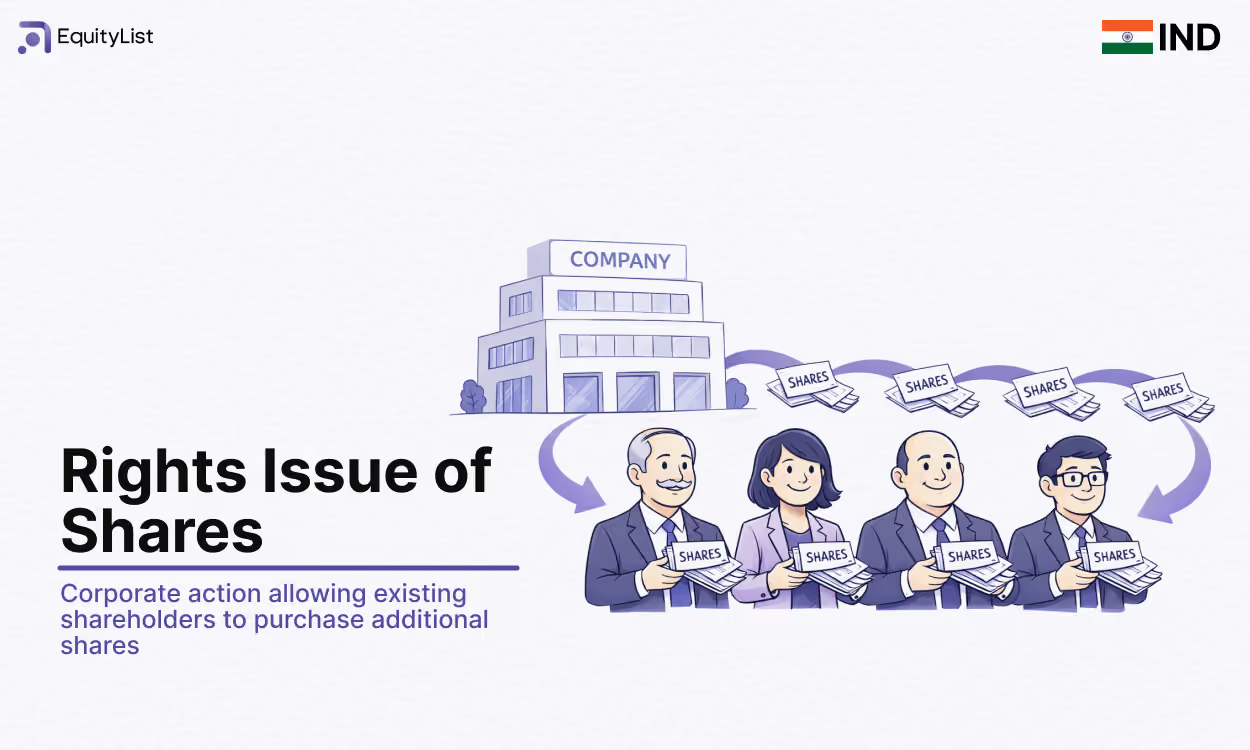
A rights issue is an offer of new shares or other securities by a company to its existing equity shareholders, in proportion to their current shareholding, before those shares or securities are offered to anyone else.
It is based on the principle of pre-emptive rights, where existing equity shareholders have the first right to subscribe to new shares issued by the company.
The offer works through a fixed ratio. The company sets this ratio when it approves the issue. For example, a 1:5 ratio means one new equity share for every five existing equity shares. A shareholder with 500 shares gets the right to buy 100 new shares; a shareholder with 1,000 shares gets 200. The entitlement scales directly with existing ownership.
For unlisted companies, rights issues are governed by Section 62(1)(a) of the Companies Act, 2013. Listed companies must additionally comply with the Securities and Exchange Board of India (Issue of Capital and Disclosure Requirements) Regulations, 2018 ("SEBI ICDR Regulations").
Each shareholder receiving a rights offer has a few choices:
- Subscribe: Buy all or part of the shares offered to them.
- Renounce: Transfer the entitlement to another person, subject to the provisions of the Articles of Association (AOA).
- Let it lapse: Decline to act, in which case the offer expires and the board decides how to handle the unsubscribed shares.
- Apply for additional shares: Request shares beyond their entitlement. These are allocated only if other shareholders do not subscribe in full, at the board's discretion.
Why companies use a rights issue
A rights issue is not the only way to raise capital. Companies can also raise capital through preferential allotment, private placement, or a public offering. So why choose a rights issue?
- It requires less compliance than other routes: A rights issue does not require a special resolution from shareholders. The board can approve and execute it on its own authority, provided two conditions are met: the company's AOA permits the issuance, and the authorized share capital is sufficient to cover the proposed issue. If either condition is not met, a general meeting is required to amend the AOA or increase authorized capital before the rights issue can proceed.
- It is faster: Without a shareholder meeting to convene and a valuation report to commission, the timeline from board approval to allotment is significantly shorter.
- It gives existing shareholders the option to minimize dilution: Shareholders who subscribe fully maintain their proportional ownership. Partial participation reduces the degree of dilution compared to not participating at all. Either way, the rights issue ensures every existing shareholder gets the pre-emptive opportunity to protect their stake.
- It is typically offered at a discount. Shares in a rights issue are usually priced below the current market price (for listed companies) or below the company's fair market value (FMV) (for unlisted companies), making participation financially attractive for existing shareholders.
How a rights issue works
Announcement
A rights issue begins when the company's board of directors formally approves and announces it, inviting existing shareholders to purchase additional shares. For listed companies, key details, including the issue ratio, price, and record date, are filed with the stock exchanges (NSE/BSE) and communicated to shareholders through the company's Registrar and Transfer Agent (RTA). For unlisted companies, communication goes directly to shareholders.
Record date
The company fixes a record date. Only shareholders whose names appear in the Register of Members as of that date are eligible to participate in the rights issue. For listed companies, eligible shareholders receive tradable Rights Entitlements (REs) in their demat accounts, which they can use to subscribe or sell on the stock exchange before the offer closes.
Discounted price
The issue price is set below the prevailing market price (for listed companies) or or, for unlisted companies, at a price determined by the board that is not less than the face value of the shares. The discount is the financial incentive for shareholders to subscribe rather than let the offer lapse.
Voluntary participation
Participation in a rights issue is voluntary. Shareholders can choose how much, if anything, they want to subscribe to. The consequence of not participating is dilution: their ownership percentage falls when new shares are issued to subscribing shareholders.
Step-by-step process for a rights issue
Step 1: Issue notice for the board meeting
Under Section 173(3) of the Companies Act, 2013, a written notice must be sent to all directors at least 7 days before the board meeting.
A board meeting may be called at shorter notice to transact urgent business, provided that at least one independent director, if any, is present at the meeting. If no independent director is present, the decisions taken at such a meeting must be circulated to all directors and become final only on ratification by at least one independent director, if any.
Step 2: Convene the first board meeting
The board meets and passes a resolution approving the rights issue. No shareholder approval is required. The offer must be made by notice specifying the number of shares offered to each shareholder and the time limit for acceptance.
Note: The notice must be sent to all existing shareholders at least three days before the rights issue opens. It can be dispatched via registered post, speed post, courier, electronic mode, or any other method that provides proof of delivery.
Step 3: Issue the letter of offer
For unlisted companies, once the resolution is passed, the letter of offer is sent to all eligible shareholders via registered post or speed post. The offer must remain open for a minimum of 15 days and a maximum of 30 days. If a shareholder does not respond within the offer period, the offer is treated as declined.
For listed companies, the process is governed by SEBI ICDR Regulations, 2018. The company must file a draft letter of offer with SEBI and the stock exchanges before dispatch. SEBI may issue observations within 30 days of filing. The 30-day clock starts from whichever of the following occurs last: the date SEBI receives the draft letter of offer; the date it receives satisfactory responses to any clarifications sought from the lead manager; the date it receives information sought from any other regulator or agency; or the date it receives the in-principle approval letter from the stock exchanges.
The letter of offer is dispatched to shareholders only after SEBI's observations are incorporated. The offer period for listed companies must be open for a minimum of 7 days and a maximum of 30 days from the date of opening.
Step 4: File Form MGT-14
A company must file Form MGT-14 with the Registrar of Companies (ROC), in accordance with Section 117(1) of the Companies Act, 2013, within 30 days of passing the board resolution. A certified true copy of the board resolution must be attached. The form is mandatory for public listed companies.
Step 5: Collect application money
Shareholders who wish to subscribe must submit their acceptance along with the application money before the offer period closes.
Step 6: Convene the second board meeting
The company issues a fresh notice at least 7 days before the meeting and convenes a second board meeting to pass the allotment resolution. Shares must be allotted within 60 days of receiving the application money.
Step 7: File Form PAS-3 with the ROC
Form PAS-3 must be filed with the ROC within 30 days of allotment of shares. A certified true copy of the board resolution and the list of allottees must be attached. For public companies, form MGT-14 must also be filed for the allotment resolution.
Step 8: Issue share certificates
If shares are held in demat form, the company must inform the depository immediately upon allotment. If shares are held in physical form, share certificates in Form SH-1 must be issued within 2 months of allotment, signed by at least 2 directors.
What happens to the share price after a rights issue?
For listed companies, the share price typically adjusts downward after a rights issue. This is because new shares are issued at a discount to the market price, which reduces the average value of all shares. The adjusted price is calculated as the Theoretical Ex-Rights Price (TERP), also referred to as the ex-rights price.
For example, if a company's shares are trading at ₹100 and it issues new shares at ₹70 through a 1 for 4 rights issue, the TERP would be calculated as:
TERP = ((Existing shares x market price) + (New shares x issue price)) / Total shares after issue
((4 x ₹100) + (1 x ₹70)) / 5 = ₹94
So the share price would theoretically adjust to ₹94 after the rights issue. Shareholders who subscribed are not worse off in theory, because the discount on the new shares offsets the fall in price of their existing shares.
In practice, the actual post-issue price depends on how the market receives the news. If investors view the capital raise as a sign of financial stress, the price may fall further. If the capital is being raised to fund growth, the market may respond positively, and the price may hold or recover.
For unlisted companies, there is no traded market price, so the impact is reflected in the FMV of the company at the next valuation event, such as a funding round or a buyback.
Rights issue vs. preferential allotment vs. private placement
Choosing between a rights issue, preferential allotment, and private placement is a strategic decision as much as a compliance one.
- A rights issue offers new shares or other securities to existing shareholders in proportion to their current holding.
- A preferential allotment targets a specific person or group, typically a new investor or strategic partner, on a preferential basis. Under this, the company can only issue equity shares and equity-convertible securities only.
- A private placement raises capital from a select group of investors identified by the board, across various instrument types, including non-convertible instruments. The offer must be made solely through a board-approved offer letter, without any public advertisements, marketing, or media outreach.
Each mechanism serves a different purpose depending on who you want to raise from, how quickly you need capital, whether you are bringing in a new investor or working with existing ones, and how much compliance overhead you can absorb.
Use a rights issue when raising capital from existing shareholders, keeping compliance light, and preserving ownership proportions.
Use preferential allotment when bringing in a specific new investor, like a strategic partner, a new VC, or a promoter.
Use private placement when raising from a broader group of select investors across different instrument types, including preference shares and debentures.
Risks of rights issue
- Shareholders who do not participate will see their ownership percentage fall as new shares are issued to subscribing shareholders.
- If the company is under financial stress, new shares may decline in value after the issue closes. A discounted price does not guarantee returns.
- A poorly priced rights issue, where the discount is insufficient, can result in low subscription rates and leave the board to decide how to handle the remaining unallotted shares under Section 62(1)(a)(iii) of the Companies Act, 2013.
FEMA compliance when non-resident shareholders are involved
Companies with foreign investors on the cap table must comply with FEMA requirements in addition to the Companies Act process. The governing rules are the Foreign Exchange Management (Non-debt Instruments) Rules, 2019 ("NDI Rules"), read with the RBI Master Direction on Foreign Investment in India.
Who can participate
A person resident outside India who holds equity instruments in an Indian company is permitted to subscribe to a rights issue in that company, subject to the following conditions under Rule 7 of the NDI Rules:
- The rights issue complies with the Companies Act, 2013.
- The issue does not breach the sectoral cap applicable to the company.
- The original shareholding against which the rights are being issued was acquired and held in accordance with the NDI Rules.
- The nature of the investment, whether FDI or FPI, remains the same as the original investment against which the rights are issued.
Pricing
Pricing norms differ depending on whether the company is listed or unlisted.
- For listed Indian companies, the rights issue price for non-residents is determined by the company, in line with SEBI guidelines.
- For unlisted Indian companies, the price offered to non-residents cannot be lower than the price offered to resident shareholders.
Mode of payment
Payment can be made through money transferred from abroad via banking channels, or from repatriable foreign currency or rupee account maintained under the Foreign Exchange Management (Deposit) Regulations, 2016. If the original investment was on a non-repatriation basis, payment may also be made from an NRO account.
Note: Repatriation refers to the ability to transfer money earned or invested in India back to a foreign country. When a foreign investor invests in an Indian company, there are two bases on which they can hold that investment:
- Repatriable basis: The investor can freely send the money back to their home country, including any returns, dividends, or sale proceeds.
- Non-repatriation basis: The money must stay within India and cannot be sent back abroad. The investor can use or reinvest the funds in India, but cannot transfer them out of the country.
Repatriation
The equity instruments acquired through a rights issue carry the same repatriation conditions as the original holding against which the rights were issued. If the original shares were held on a non-repatriation basis, the rights shares are also held on a non-repatriation basis.
Renunciation to a non-resident
A resident shareholder can renounce their rights entitlement, in full or in part, in favour of a non-resident. Under Rule 7A of the NDI Rules, the non-resident acquiring rights through renunciation must do so in accordance with the pricing guidelines specified under Rule 21 of the NDI Rules. If the non-resident uses non-repatriable funds to make this investment, the shares acquired are held on a non-repatriation basis.
Note: This facility is not available to investors who were originally allotted shares as Overseas Corporate Bodies (OCBs).
Applying for additional shares
Both residents and non-residents can apply for shares over and above their rights entitlement. The same conditions, including pricing, repatriation, and sectoral cap compliance, apply to any additional shares allotted.
FC-GPR filing
Once shares are allotted to a non-resident investor, the company must file Form FC-GPR within 30 days of allotment via the RBI's FIRMS portal. Missing this deadline is a FEMA contravention and can attract penalties.
Closing thoughts
A rights issue gives existing shareholders the first opportunity to subscribe to new equity at a fixed price, preserves ownership for those who participate, and imposes a lighter compliance burden than most other fundraising routes.
The concept is simple, but executing a rights issue requires careful attention to legal and compliance requirements. The company must check the AOA and confirm sufficient authorized capital before designing the offer. FEMA requirements must be mapped for every non-resident shareholder on the cap table. Filing deadlines are strict.
As cap tables grow more complex with multiple share classes, foreign investors, and pre-emptive right clauses, tracking the impact of each issuance manually becomes error-prone. Platforms like EquityList help founders and finance teams model issuance scenarios, maintain accurate cap table records, and stay on top of post-allotment compliance across every round.
FAQs on rights issue
Can a company do a rights issue without shareholder approval?
Yes. For unlisted companies, a rights issue under Section 62(1)(a) of the Companies Act, 2013 does not require a special resolution. The board can approve and execute it on its own authority, which is one of the key advantages of this route over preferential allotment or private placement.
However, the company's AOA must permit the issuance and the authorized share capital must be sufficient. If either condition is not met, a general meeting is required first
What is the minimum and maximum offer period for a rights issue?
The letter of offer must remain open for a minimum of 7 days and a maximum of 30 days from the date of the offer, as required under Section 62(1)(a) of the Companies Act, 2013.
What is a 1 for 4 rights issue?
A 1 for 4 rights issue means the company is offering 1 new share for every 4 shares a shareholder currently holds. If a shareholder holds 400 shares, they are entitled to buy 100 new shares at the rights issue price. The ratio is set by the board and determines the total number of new shares the company issues. This ratio expands the company's total share capital by 25%.
What happens to unsubscribed shares after the offer period closes?
Under Section 62(1)(a)(iii) of the Companies Act, 2013, the board can dispose of unsubscribed shares in a manner that is not disadvantageous to the company or its shareholders. If unsubscribed shares are offered to a non-resident, FMV pricing guidelines under the NDI Rules apply.



.svg)
.svg)
.svg)

