
Key takeaways
- Share capital is the total amount a company raises by issuing shares to shareholders. It is recorded at the face value (nominal value) of those shares, not at the market or issue price.
- Share capital has a defined hierarchy: authorized capital (the legal ceiling), issued capital (shares allotted), subscribed capital (shares agreed to be purchased), and paid-up capital (money actually received).
- Face value, issue price, and share premium are distinct concepts. When shares are issued above face value during a funding round, the excess is recorded as securities premium reserve.
- Share capital is different from shareholders' equity. Shareholders' equity includes share capital, securities premium, retained earnings, and other reserves.
- In India, the Companies Act, 2013 governs share capital. There is no minimum paid-up capital requirement for private companies after the 2015 amendment. Authorized capital is specified in the Memorandum of Association and determines filing fees.
- Founders must increase authorized capital before issuing new shares that would exceed the existing limit. This requires a shareholder resolution and a filing with the Registrar of Companies (Form SH-7).
- Accurate share capital records are the foundation of a clean cap table. Errors in tracking face value, premium, or authorized limits create compliance and fundraising issues downstream.
What is share capital?
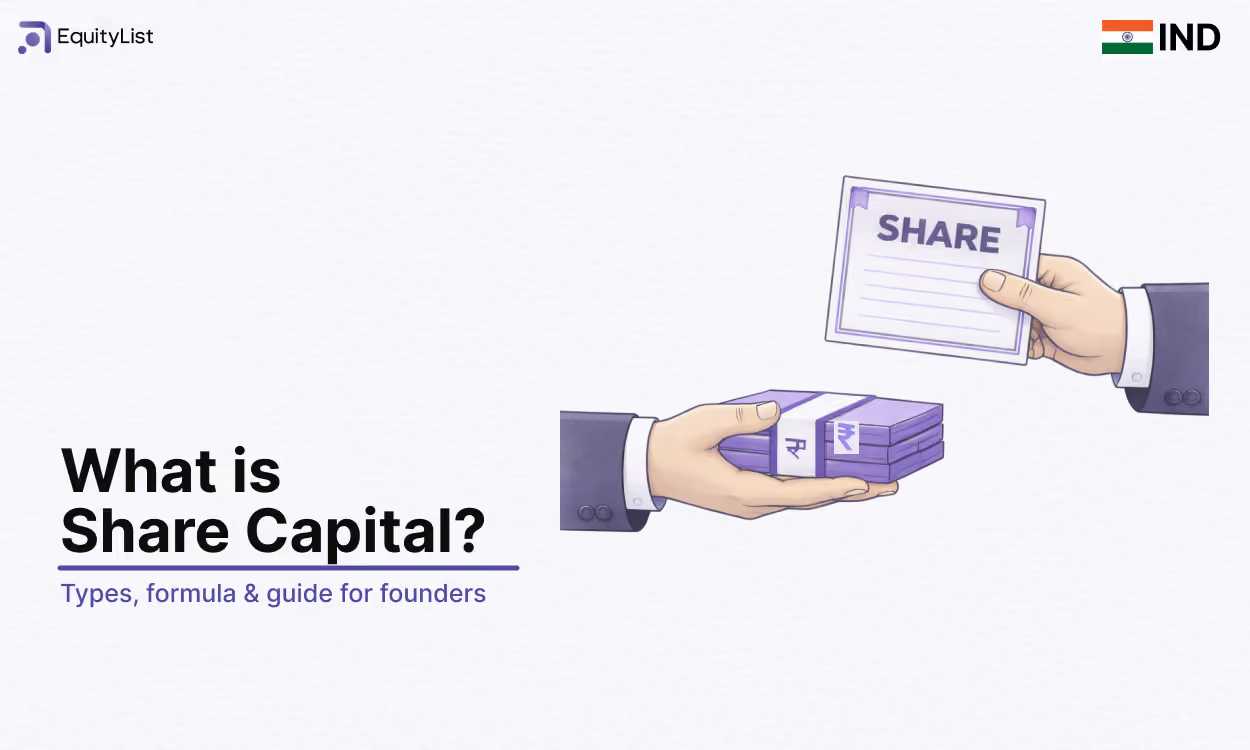
Share capital is the amount a company raises by issuing shares to shareholders, representing their ownership in the company. It is recorded at the nominal (face) value of the shares issued. Any amount received above face value is recorded separately as securities premium, and is not part of share capital.
For example,
- Face value per share = ₹10
- Issue price per share = ₹100
- Number of shares issued = 1,000
Total money raised = ₹1,00,000
Breakdown:
- Share capital = ₹10 × 1,000 = ₹10,000
- Securities premium = ₹90 × 1,000 = ₹90,000
Face value and issue price
Face value (also called nominal value or par value) is the base value assigned to each share in the company's charter documents. In India, a common face value for startup shares is ₹10 or ₹1 per share. The face value is an accounting reference point. It does not reflect the actual worth of the share.
Issue price, on the other hand, is the price at which shares are sold to shareholders. It is higher than the face value, and the difference between the issue price and the face value is called the share premium.
For example, if a company has shares with a face value of ₹10 and issues them to an investor at ₹500 per share, the share premium is ₹490 per share. The share capital recorded at face value would be ₹10 per share, while the ₹490 premium is recorded separately as securities premium reserve on the balance sheet.
Why this matters for founders: When investors discuss valuation, they are pricing your shares well above face value. But on the company's books, the share capital line item reflects only the face value component. The premium sits in a different account. This distinction is important when reading your company's financial statements or filing regulatory documents.
Types of share capital
Share capital is not a single number. It is divided into several categories, each representing a different stage in the lifecycle of a company's equity. These categories exist in a hierarchy, where each one is a subset of the one above it.
1. Authorized share capital
Authorized share capital (also called registered capital or nominal capital) is the maximum total value of shares that a company is legally permitted to issue. This ceiling is defined in the company's Memorandum of Association (MoA) at the time of incorporation and can be increased later through a shareholder resolution and regulatory filing.
For example, if a company's MoA states an authorized capital of ₹10,00,000 (approximately $12,000) divided into 1,00,000 shares of ₹10 each, the company cannot issue shares worth more than ₹10,00,000 in face value terms without first increasing its authorized capital.
Authorized capital functions as a legal ceiling, not an operational figure. It does not represent money the company has received or even shares it has issued. It represents the upper boundary of what the company is allowed to issue.
2. Issued share capital
Issued share capital is the portion of authorized share capital that the company has actually allotted to shareholders. A company typically does not issue all its authorized shares at once. Some are held in reserve for future fundraising, ESOP pools, or other purposes.
If a company with 1,00,000 authorized shares has issued 60,000 shares to founders and investors, its issued share capital is the face value of those 60,000 shares, and 40,000 shares remain unissued.
3. Subscribed share capital
Subscribed share capital is the portion of issued capital that investors or shareholders have agreed to purchase. In most private company transactions, issued and subscribed capital are identical because shares are allotted only after a subscription agreement is in place. The distinction becomes more relevant in public offerings, where some shares offered may not be fully subscribed.
4. Paid-up share capital
Paid-up share capital is the amount the company has actually received from shareholders for the shares issued to them. Under Section 2(64) of the Companies Act, 2013, paid-up share capital is the total amount a company has actually received from shareholders for the shares it has issued.
For most private companies, paid-up capital equals issued capital because shareholders pay in full at the time of allotment. The two figures diverge only when shares are issued on a partly-paid basis, which is uncommon in the startup context.
5. Called-up capital
Called-up capital is the portion of issued capital that the company has requested shareholders to pay. If shares are issued with a provision that only part of the face value is payable immediately and the rest on a future call, the called-up capital is the amount demanded so far. Like subscribed capital, this distinction matters more for listed companies issuing partly-paid shares and is rarely relevant for private startups.
How they relate to each other
These categories form a nested hierarchy:
Authorized capital ≥ Issued capital ≥ Subscribed capital ≥ Called-up capital ≥ Paid-up capital
Each layer is a subset of the one above. For most private startups, the practical figures that matter are authorized capital (the ceiling) and paid-up capital (the actual money received). The intermediate layers collapse into the same value because shares are typically fully paid on issuance.
Share capital vs shareholders' equity
Founders sometimes use "share capital" and "shareholders' equity" interchangeably. They are related but not identical.
Share capital refers specifically to the funds raised by issuing shares, measured at face value. Shareholders' equity is a broader accounting term that includes share capital plus all other equity components on the balance sheet.
Shareholders' equity typically includes:
- Paid-up share capital (face value of all shares issued)
- Securities premium reserve (the premium paid above face value)
- Retained earnings or accumulated losses
- Other reserves (such as general reserve, capital reserve, or share options outstanding account)
A company that raised ₹10,00,000 in share capital (at face value) but has accumulated ₹5,00,000 in losses would show shareholders' equity of ₹5,00,000. The share capital figure on the balance sheet would remain ₹10,00,000, but the net equity reflects the impact of operations.
For founders, this distinction matters when reviewing financial statements or discussing capitalization structure with investors, because investors evaluate equity holistically, not just the share capital line.
How share capital changes during a funding round
Share capital does not stay fixed. It changes every time a company issues new shares. Here is a simplified example of how this works during a seed round.
Before the round:
A startup is incorporated with authorized capital of ₹10,00,000 (1,00,000 shares at ₹10 face value). The two founders are issued 50,000 shares each at face value. The paid-up capital is ₹10,00,000 (50,000 shares × ₹10 × 2 founders). All 1,00,000 authorized shares have been issued.
The seed round:
An investor agrees to invest ₹2,00,00,000 (approximately $240,000) at a pre-money valuation of ₹8,00,00,000. The price per share is calculated as the pre-money valuation divided by the total pre-money shares: ₹8,00,00,000 ÷ 1,00,000 = ₹800 per share.
At this price, the investor receives 25,000 new shares (₹2,00,00,000 ÷ ₹800).
What changes:
- The company needs to issue 25,000 new shares, but its authorized capital allows only 1,00,000 shares in total, all of which have already been issued. The company must first increase its authorized capital.
- After the increase (say, to ₹15,00,000 or 1,50,000 shares at ₹10 each), the new shares are issued to the investor.
- Paid-up capital increases by ₹2,50,000 (25,000 shares × ₹10 face value).
- Securities premium reserve increases by ₹1,97,50,000 (25,000 shares × ₹790 premium per share).
- The cap table reflects the new ownership split, with founders diluted proportionally.
How to set share capital at incorporation
When founders register a company in India, they are required to specify the authorized share capital and the initial paid-up capital in the Memorandum of Association.
1. Choosing authorized capital
Authorized capital should be set high enough to cover the company's near-term share issuance plans without requiring an immediate increase, but not so high that it incurs unnecessary registration fees. The MCA (Ministry of Corporate Affairs) charges fees based on the authorized capital bracket at the time of incorporation.
Most early-stage Indian startups incorporate with an authorized capital between ₹1,00,000 and ₹10,00,000. The choice depends on how many shares the founders plan to issue initially and whether an ESOP pool will be created early.
2. Choosing face value
Face value is a nominal figure. Common choices for Indian startups are ₹10 per share or ₹1 per share. A lower face value allows the company to authorize a larger number of shares within the same authorized capital amount, which provides more flexibility for future allotments and smaller equity grants.
For example, with authorized capital of ₹10,00,000, a face value of ₹10 gives 1,00,000 shares, while a face value of ₹1 gives 10,00,000 shares.
3. Regulatory context
Under the Companies Act, 2013, there is no longer a minimum paid-up capital requirement for incorporating a private limited company. The Companies (Amendment) Act, 2015, removed the earlier minimum of ₹1,00,000 for private companies. Founders can now register a company with as little as ₹1,000 in paid-up capital, though a practical minimum is typically higher to cover initial expenses and signal seriousness to prospective investors.
Companies must file Form INC-32 (SPICe+) with the Registrar of Companies to incorporate, and the authorized capital chosen at this stage determines the filing fees payable.
How to increase share capital
As a company grows and raises successive funding rounds, its authorized capital often needs to be increased. This is because new shares cannot be issued beyond the authorized limit.
The process for increasing authorized share capital in India involves:
- Passing an ordinary resolution at a general meeting of shareholders, approving the increase.
- Filing Form SH-7 with the Registrar of Companies within 30 days of the resolution.
- Paying the prescribed fees based on the increase amount.
- Amending the capital clause in the Memorandum of Association.
FAQs
1. What do you mean by share capital?
Share capital is the money a company raises by issuing shares to its shareholders. It represents the money received from shareholders in exchange for ownership in the company. On the balance sheet, share capital is recorded at the face value (nominal value) of the shares issued, not at the price investors actually paid. Any amount paid above face value is recorded separately as securities premium. Share capital forms the foundation of a company's equity structure and determines how ownership is distributed among shareholders.
2. What are the 4 types of share capital?
The four main types of share capital are authorized, issued, subscribed, and paid-up. Authorized share capital is the maximum value of shares a company is legally permitted to issue, as stated in its constitutional documents (such as the Memorandum of Association in India or the Articles of Incorporation in the US). Issued share capital is the portion of authorized capital that has actually been allotted to shareholders. Subscribed share capital is the portion of issued capital that shareholders have agreed to purchase. Paid-up share capital is the amount the company has actually received from shareholders for the shares allotted to them.
These four types form a hierarchy: authorized ≥ issued ≥ subscribed ≥ paid-up. For most private companies, issued, subscribed, and paid-up capital are identical because shares are typically paid in full at the time of allotment.
3. What is the share capital formula?
Share capital is calculated as the number of shares issued multiplied by the face value per share. For example, if a company issues 1,00,000 shares with a face value of ₹10 ($0.12) each, the share capital is ₹10,00,000 ($12,000). This formula captures only the face value component. The total amount received from shareholders also includes any share premium, which is the difference between the issue price and the face value. So the total funds raised from issuing shares equals the number of shares issued multiplied by the issue price per share, but the share capital recorded on the balance sheet reflects only the face value portion.
4. Who pays share capital?
Shareholders pay share capital. When a company issues shares, the individuals or entities receiving those shares pay the company in exchange for ownership.

.svg)
.svg)
.svg)

