




What Are Authorized Shares?

Learn what authorized shares and authorized share capital are, and whether they can be changed. We also explain how it differs from issued and outstanding shares.

Author
EquityList Team

Team, EquityList

Aug 6, 2026

8 min read

Modern Architecture

If you've ever looked at a cap table or gone through the process of incorporating a company, you've likely come across the term authorized shares. 

What are authorised shares?

Authorized shares are the maximum number of shares a company is legally permitted to issue, as outlined in its charter document (often called the Articles of Incorporation/Memorandum of Association). This number is approved by the company’s founders and, in many cases, its board or shareholders.

Think of authorized shares as your company’s total inventory of potential shares. 

However, this doesn’t mean all of them are in use. 

Only a portion of authorized shares may actually be issued to founders, employees, or investors. The rest remain unissued and can be allocated in the future for new financing rounds or employee stock options (ESOPs).

For example:

Let’s say your company has 1,000,000 authorized shares. At the time of incorporation, you issue:

500,000 shares to the founders

100,000 shares to employees (via an ESOP pool)

200,000 shares to early investors

That means you’ve issued 800,000 shares, and you still have 200,000 authorized but unissued shares. These remaining shares can be used in the future for another funding round.

Can you change the number of authorized shares?

Yes.

To change the number of authorized shares, whether increasing or decreasing, your company must obtain approval from both the board of directors and the shareholders.

Once approved, you’ll need to file an amendment to your company's charter document (such as the Articles of Incorporation or Memorandum of Association, depending on your jurisdiction).

For many companies, it’s common to begin with a modest number of authorized shares and increase the count as the company grows and raises capital.

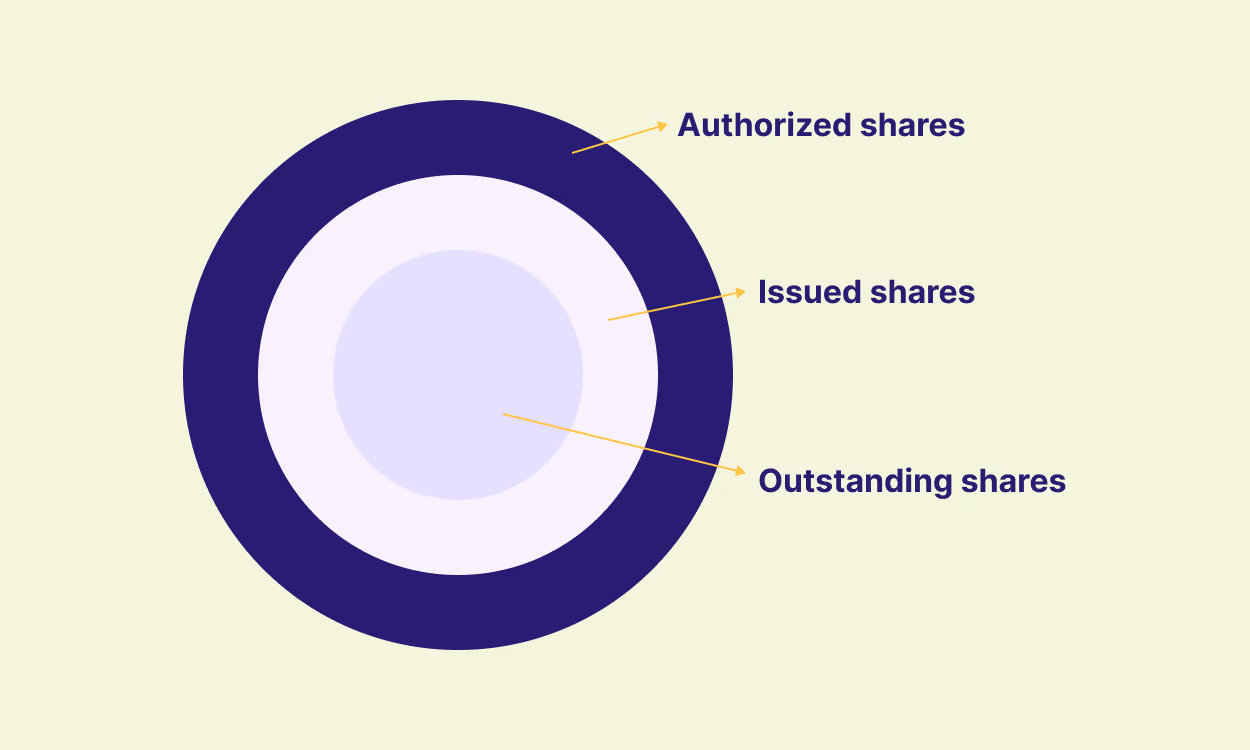
How are authorised shares different from issued and outstanding shares?

Term
What it means
Example
Authorized shares The maximum number of shares a company is permitted to issue The company has authorized 10Mn shares
Issued shares Shares that have been allocated to shareholders like founders, investors and employees Out of the 10Mn authorised shares, 6Mn have been issued to shareholders
Outstanding shares Shares that are issued and currently held by shareholders. It excludes treasury shares (repurchased by the company) The company repurchased 500,000 shares, so 5.5Mn shares are outstanding

What are authorized shares?

Authorized shares refer to the total number of shares a company is allowed to issue. This is the maximum "inventory" of shares the company can distribute, though it doesn’t mean all of them are actually in circulation. 

What are issued shares?

Issued shares are a subset of authorized shares that have been allocated to shareholders, including founders, investors, and employees (through exercised ESOPs). 

While the number of issued shares can increase over time, it cannot exceed the total number of authorized shares.

What are outstanding shares?

Outstanding shares are issued shares that are currently held by shareholders. It excludes:

- Treasury shares – shares that were issued but later repurchased by the company.

- Unexercised ESOPs – even if options have been granted or vested, they don’t count as outstanding until the employee actually exercises their options.

So, while all outstanding shares are issued, not all issued shares are outstanding.

What is authorised share capital?

Authorised share capital is the maximum value of share capital that a company is legally permitted to issue to shareholders. This limit is defined at the time of incorporation and can be increased later as the company grows.

For example, a company may be incorporated with an authorised share capital of $10,000, divided into 10,000 authorised shares with a face value of $1 each. 

The face value (or nominal value) represents the base value of the share, but it is not necessarily the price investors pay. In most cases, shares are issued at a premium based on the company’s current valuation or market worth.

In some jurisdictions, companies are required to maintain a minimum authorised or paid-up share capital.

{{cta-form}}

How is authorised share capital different from issued and paid-up share capital?

Share capital refers specifically to the nominal (or face) value of the shares issued by a company.

There are three types of share capital:

a. Authorized share capital is the maximum amount of share capital that a company is allowed to issue.

b. Issued share capital is a subset of authorised share capital. It refers to the portion of shares that the company has actually issued to shareholders.

c. Paid-up share capital, on the other hand, is the amount of money the company has actually received from shareholders in exchange for the shares they hold.

In many cases, especially for private companies, the issued and paid-up capital are the same because shares are typically paid for in full when issued. However, if shareholders haven’t paid the full amount for their shares (in jurisdictions where partial payment is allowed), the paid-up capital may be lower than the issued capital.

FAQs

1. How can I find a company’s authorised shares?

You can find a company’s authorised shares in its Memorandum of Association (MoA) or Articles of Incorporation, depending on the jurisdiction. These documents specify the maximum number of shares the company is allowed to issue.

For public listed companies, this information is typically available in regulatory filings, annual reports, or on the stock exchange’s website. 

2. What is the authorised share limit?

The authorised share limit is the maximum number of shares a company is permitted to issue, as defined in its charter documents (e.g., MoA or Articles of Incorporation). It acts as a legal cap on the total number of shares the company can create and distribute.

3. Can a company change its authorised shares?

Yes, a company can increase or decrease its authorised share capital. This typically requires:

- Board and shareholder approval

- A formal resolution

- Regulatory filings with the relevant authority 

The process varies by jurisdiction but usually involves updating the company’s constitutional documents.

ON THIS PAGE

FAQs

How can I find a company’s authorised shares?

You can find a company’s authorised shares in its Memorandum of Association (MoA) or Articles of Incorporation, depending on the jurisdiction. These documents specify the maximum number of shares the company is allowed to issue.

For public listed companies, this information is typically available in regulatory filings, annual reports, or on the stock exchange’s website.

What is the authorised share limit?

The authorised share limit is the maximum number of shares a company is permitted to issue, as defined in its charter documents (e.g., MoA or Articles of Incorporation). It acts as a legal cap on the total number of shares the company can create and distribute.

Can a company change its authorised shares?

Yes, a company can increase or decrease its authorised share capital. This typically requires board and shareholder approval, a formal resolution, and regulatory filings with the relevant authority. The process varies by jurisdiction but usually involves updating the company’s constitutional documents.
Disclaimer

The information provided by E-List Technologies Pvt. Ltd. ("EquityList") is for informational purposes only and should not be considered as an endorsement or recommendation for any investment, product, or service. This communication does not constitute an offer, solicitation, or advice of any kind. Any products, or services referenced will only be undertaken pursuant to formal offering materials, agreements, or letters of intent provided by EquityList, containing full details of the risks, fees, minimum investments, and other terms associated with such transactions. Please note that these terms may change without prior notice.‍EquityList does not offer legal, financial, taxation or professional advice. Decisions or actions affecting your business or interests should be made after consulting with a qualified professional advisor. EquityList assumes no responsibility for reliance on the information/services provided by us.

Get started with EquityList today

Join 600+ companies managing 50,000+ stakeholders and $4B in securities with EquityList.

Get started
No items found.

Need help managing your cap table?

Answer 3 quick questions and we'll help you get compliant.

Need help with your next fundraise?

Answer 3 quick questions and we'll get in touch.

Need help with compliance?

Tell us which filing you're dealing with and our team will reach out.

Need help with equity grants, scheme design, or valuation?

Answer a couple of quick questions and we'll point you to the right team.

Need help with shareholder agreements, transfers, or consents?

Select what applies and we'll point you to the right team.

Need help managing your cap table?

Tell us where you're at and our team will show you how EquityList can help.

share-purchase-agreement-vs-share-transfer-agreement

Share Purchase Agreement

Record the transfer of new shares between parties with a clean, auditable agreement.
cap-table-template-and-example, cap-table-management

Cap Table Template

Model your ownership structure before your next round. Track founders, investors, and option pools in one clear, investor-ready sheet.
founders-agreement-india

Founders Agreement (India)

Align co-founders on roles, equity splits, and exit terms before the hard conversations become urgent.
share-transfer-agreement, share-purchase-agreement-vs-share-transfer-agreement

Share Transfer Agreement

Record the transfer of shares between parties with a clean, auditable agreement.
board-resolution-format

Board Resolution

Document key company decisions in a format that banks, auditors, and regulators accept.
valuation-report-india

Valuation Report

Document the valuation process, methodology, and conclusion in one professional report.
esop-grant-letter-format

ESOP Grant Letter

Issue stock options to employees with a clear, customisable grant letter covering vesting terms.

Investor Agreement

Define the rights and obligations of incoming investors before funds are transferred.
share-subscription-agreement

Share Subscription Agreement

Document the sale of shares to new investors with a customisable, well-structured agreement.
term-sheet-format-india

Term Sheet

Anchor your round with a clean, investor-ready term sheet that covers the terms that matter.
due-diligence-report-format

Due Diligence Report

Present your company structure and documentation in the format investors expect.
founders-agreement-for-us-companies

Founders Agreement (U.S.)

Align co-founders on roles, equity splits, and exit terms before the hard conversations become urgent.

First, a few quick details

How many shareholders are on your cap table?

What stage is your company at?

Where is your company incorporated?

Got it Thanks

Our team will reach out at the email you shared
Oops! Something went wrong while submitting the form.

First, a few quick details

What do you need help with? (select all that apply)

How many shareholders does your company have?

Where is your company incorporated?

Got it Thanks

Our team will reach out at the email you shared
Oops! Something went wrong while submitting the form.

First, a few quick details

What are you looking for?

What stage is your company at?

Where is your company incorporated?

Got it Thanks

Our team will reach out at the email you shared
Oops! Something went wrong while submitting the form.

First, a few quick details

Which filing do you need help with?

Got it Thanks

Our team will reach out at the email you shared
Oops! Something went wrong while submitting the form.

First, who should we get back to?

What stage is your company at?

Are you actively raising, or just exploring?

Where is your company incorporated?

Got it Thanks

Our team will reach out at the email you shared
Oops! Something went wrong while submitting the form.

First, who should we get back to?

How many shareholders does your company have?

Do you already have a Depository Participant (DP) tied up?

Any compliance deadline you're working against?

Got it Thanks

Our team will reach out at the email you shared
Oops! Something went wrong while submitting the form.

83(b) Election Checklist

Manage 83(b) elections effectively, avoid IRS compliance issues, and provide employees with a smooth process for filing.

PAS-4 Filing Checklist

Get a step-by-step checklist to make sure your documentation, approvals, and investor list are in order.

Cap Table Software Checklist

Evaluate a cap table software based on core functionality, compliance, scalability, and real-time collaboration.

Ind AS 102, Share-Based Payments Checklist

Download our free Ind AS 102 Disclosure Checklist to ensure your company meets all regulatory requirements.

Upcoming Office Hours on 7th September 2026
RSVP
Arrow
Close notification