




Valuation of Unlisted Shares in India: Rule 11UA, Companies Act, and FEMA Compliance

Learn how unlisted shares are valued under Rule 11UA of the Income Tax Rules, the Companies Act, and FEMA regulations. Covers NAV method, DCF valuation, and when each law applies.

Author
Farheen Shaikh

Content Marketer, EquityList

Jun 13, 2026

8 min read

Modern Architecture

Key takeaways

  • Unlisted shares are equity shares not listed on a recognised stock exchange; tax rules refer to them as "unquoted equity shares" for valuation purposes.
  • Three regulatory frameworks govern unlisted share valuation: the Income Tax Act (Rule 11UA), the Companies Act (Sections 62, 42, Rule 13), and FEMA regulations.
  • Rule 11UA prescribes the NAV (net asset value) formula for computing fair market value based on adjusted balance sheet figures; no external professional is required for NAV, but a SEBI-registered merchant banker is required to certify DCF valuations.
  • The Companies Act requires valuations for corporate actions (preferential allotments, sweat equity, non-cash consideration, acquisitions/mergers, buybacks) to be conducted by an IBBI-registered valuer.
  • FEMA regulations require that cross-border share transfers meet arm's-length pricing: at or above FMV when residents sell to non-residents, at or below FMV when non-residents sell to residents; pricing must be certified by a SEBI-registered merchant banker or CA with certificate of practice.

What valuation of unlisted shares means under Indian law

Unlisted shares are equity shares of a company that are not listed on any recognised stock exchange. Tax rules often refer to them as "unquoted equity shares," which include shares that are not regularly quoted on a recognised stock exchange.

Unlike listed shares, where the market price on a stock exchange provides an observable fair market value (FMV), unlisted shares have no publicly available price. The valuation must therefore be computed using prescribed methods.

Three distinct regulatory frameworks govern unlisted share valuation in India. Each law applies to specific types of transactions. Most founder transactions trigger only one law. Some trigger two. All three apply only in specific cross-border scenarios.

Rule 11UA of the Income Tax Act: Valuation of unquoted shares for tax purposes

Rule 11UA of the Income Tax Rules provides the mechanism for determining the FMV of unquoted equity shares for income tax purposes. It does not determine the transaction price but prescribes the FMV used for tax computation under the Income Tax Act.

During share transfers, this FMV may be used under provisions such as Section 50CA and Section 56(2)(x). If the agreed sale price is below the Rule 11UA FMV, Section 50CA may require the seller's capital gains to be calculated as though the shares had been sold at the FMV. Similarly, Section 56(2)(x) may tax the buyer on the difference between the FMV and the price paid if the statutory threshold (₹50,000) is exceeded.

How share valuation works under Rule 11UA

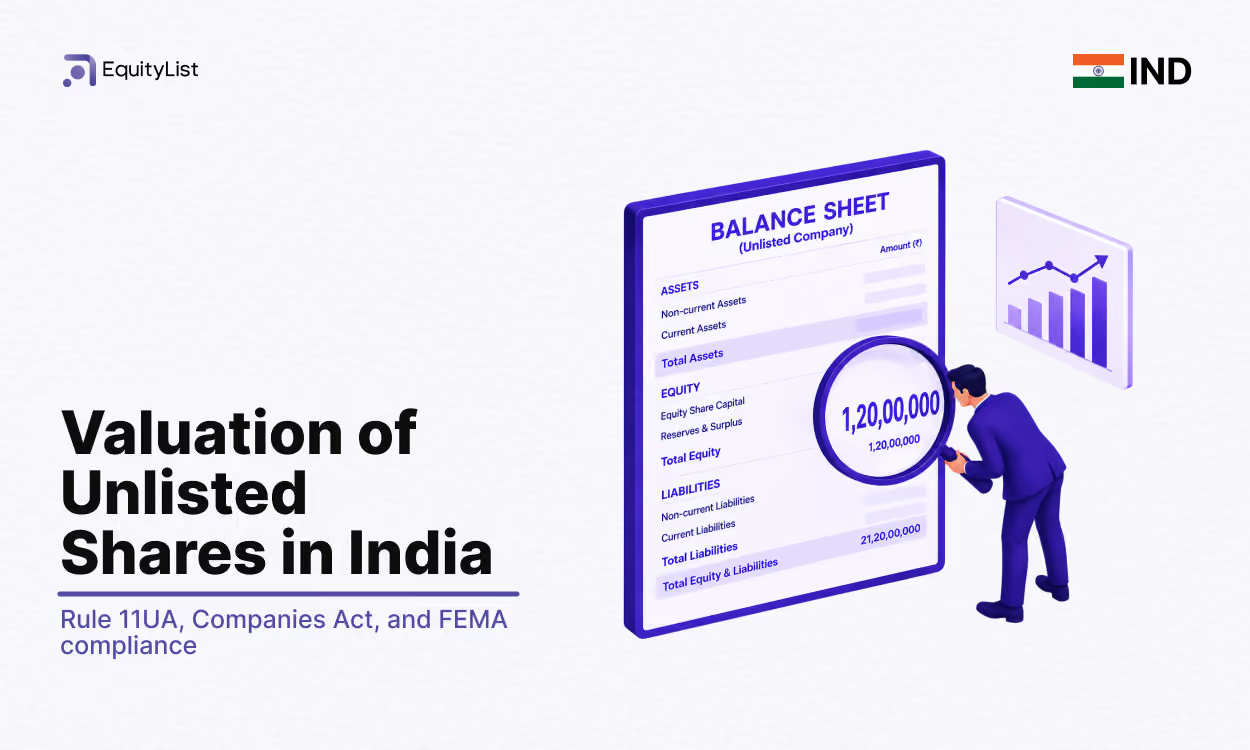
Rule 11UA lays down a balance-sheet formula (called the NAV method) that computes FMV based on adjusted book values of assets and liabilities. For the NAV method, no external valuation report is legally required; your accountant can compute it from audited financials. However, many transactions obtain a CA valuation report for documentation purposes.

For the DCF (Discounted Cash Flow) method, the valuation must be certified by a SEBI-registered Category I Merchant Banker. Chartered accountants could certify DCF valuations until a 2018 amendment to Rule 11UA restricted this role to merchant bankers. 

Companies Act, 2013: Valuation requirements for share issuance and related transactions

When issuing shares in certain cases, the Companies Act, 2013 sets pricing and compliance requirements under provisions such as Sections 62 and 42. In these cases, valuation is used as part of the compliance process to determine or justify the issue price.

When is valuation required?

Valuation requirements typically arise under Sections 62 and 42 of the Companies Act, 2013, read with the Companies (Share Capital and Debentures) Rules, 2014, depending on the nature of the transaction.

Common scenarios include:

  • Preferential allotment – When shares are issued to selected investors at a negotiated price, valuation is used to ensure compliance with prescribed pricing norms and justify the issue price.
  • Sweat equity shares – When shares are issued to employees or founders for non-cash consideration such as services rendered, valuation helps determine the value of such contribution.
  • Mergers and acquisitions – Valuation is used to determine share exchange or swap ratios between companies.
  • Buybacks – Valuation may be used to support pricing decisions.

Who conducts the valuation

Where valuation is required under the Companies Act framework, it is generally carried out by a registered valuer, registered with the Insolvency and Bankruptcy Board of India (IBBI).

Registered valuers use recognised methodologies such as DCF, NAV, comparable company multiples, or other accepted approaches depending on the nature of the business and transaction.

FEMA: Valuation for cross-border issuance and transfers

When unlisted shares or other capital instruments are issued or transferred between a resident and a non-resident, pricing is governed by the Foreign Exchange Management (Non-Debt Instruments) Rules, 2019.

  1. When a resident transfers or issues shares to a non-resident, the price cannot be lower than FMV.
  2. When a non-resident transfers shares to a resident, the price cannot be higher than FMV.

Thus, FMV acts as a regulatory floor or ceiling depending on the direction of the transaction.

FMV is generally determined using a valuation report issued by a SEBI-registered Category I merchant banker or a chartered accountant holding a valid certificate of practice.

ON THIS PAGE

FAQs

No items found.

Disclaimer

The information provided by E-List Technologies Pvt. Ltd. ("EquityList") is for informational purposes only and should not be considered as an endorsement or recommendation for any investment, product, or service. This communication does not constitute an offer, solicitation, or advice of any kind. Any products, or services referenced will only be undertaken pursuant to formal offering materials, agreements, or letters of intent provided by EquityList, containing full details of the risks, fees, minimum investments, and other terms associated with such transactions. Please note that these terms may change without prior notice.‍ EquityList does not offer legal, financial, taxation or professional advice. Decisions or actions affecting your business or interests should be made after consulting with a qualified professional advisor. EquityList assumes no responsibility for reliance on the information/services provided by us.

Get started with EquityList today

Join 600+ companies managing 50,000+ stakeholders and $4B in securities with EquityList.

Get started
No items found.

Need help managing your cap table?

Answer 3 quick questions and we'll help you get compliant.

Need help with your next fundraise?

Answer 3 quick questions and we'll get in touch.

Need help with compliance?

Tell us which filing you're dealing with and our team will reach out.

Need help with equity grants, scheme design, or valuation?

Answer a couple of quick questions and we'll point you to the right team.

Need help with shareholder agreements, transfers, or consents?

Select what applies and we'll point you to the right team.

Need help managing your cap table?

Tell us where you're at and our team will show you how EquityList can help.

share-purchase-agreement-vs-share-transfer-agreement

Share Purchase Agreement

Record the transfer of new shares between parties with a clean, auditable agreement.
cap-table-template-and-example, cap-table-management

Cap Table Template

Model your ownership structure before your next round. Track founders, investors, and option pools in one clear, investor-ready sheet.
founders-agreement-india

Founders Agreement (India)

Align co-founders on roles, equity splits, and exit terms before the hard conversations become urgent.
share-transfer-agreement, share-purchase-agreement-vs-share-transfer-agreement

Share Transfer Agreement

Record the transfer of shares between parties with a clean, auditable agreement.
board-resolution-format

Board Resolution

Document key company decisions in a format that banks, auditors, and regulators accept.
valuation-report-india

Valuation Report

Document the valuation process, methodology, and conclusion in one professional report.
esop-grant-letter-format

ESOP Grant Letter

Issue stock options to employees with a clear, customisable grant letter covering vesting terms.

Investor Agreement

Define the rights and obligations of incoming investors before funds are transferred.
share-subscription-agreement

Share Subscription Agreement

Document the sale of shares to new investors with a customisable, well-structured agreement.
term-sheet-format-india

Term Sheet

Anchor your round with a clean, investor-ready term sheet that covers the terms that matter.
due-diligence-report-format

Due Diligence Report

Present your company structure and documentation in the format investors expect.
founders-agreement-for-us-companies

Founders Agreement (U.S.)

Align co-founders on roles, equity splits, and exit terms before the hard conversations become urgent.

First, a few quick details

How many shareholders are on your cap table?

What stage is your company at?

Where is your company incorporated?

Got it Thanks

Our team will reach out at the email you shared
Oops! Something went wrong while submitting the form.

First, a few quick details

What do you need help with? (select all that apply)

How many shareholders does your company have?

Where is your company incorporated?

Got it Thanks

Our team will reach out at the email you shared
Oops! Something went wrong while submitting the form.

First, a few quick details

What are you looking for?

What stage is your company at?

Where is your company incorporated?

Got it Thanks

Our team will reach out at the email you shared
Oops! Something went wrong while submitting the form.

First, a few quick details

Which filing do you need help with?

Got it Thanks

Our team will reach out at the email you shared
Oops! Something went wrong while submitting the form.

First, who should we get back to?

What stage is your company at?

Are you actively raising, or just exploring?

Where is your company incorporated?

Got it Thanks

Our team will reach out at the email you shared
Oops! Something went wrong while submitting the form.

First, who should we get back to?

How many shareholders does your company have?

Do you already have a Depository Participant (DP) tied up?

Any compliance deadline you're working against?

Got it Thanks

Our team will reach out at the email you shared
Oops! Something went wrong while submitting the form.

83(b) Election Checklist

Manage 83(b) elections effectively, avoid IRS compliance issues, and provide employees with a smooth process for filing.

PAS-4 Filing Checklist

Get a step-by-step checklist to make sure your documentation, approvals, and investor list are in order.

Cap Table Software Checklist

Evaluate a cap table software based on core functionality, compliance, scalability, and real-time collaboration.

Ind AS 102, Share-Based Payments Checklist

Download our free Ind AS 102 Disclosure Checklist to ensure your company meets all regulatory requirements.

Upcoming Office Hours on 7th September 2026
RSVP
Arrow
Close notification