







Key takeaways
- A buy-back of shares occurs when a company repurchases its own equity shares from shareholders under Section 68 of the Companies Act, 2013. Indian company law does not permit a company to hold its own shares as treasury stock, so the repurchased shares must be cancelled within seven days.
- India has operated under three distinct buy-back tax regimes since 2024. Each regime reflects a different policy position on who bears the tax and how the taxable amount is computed. The applicable regime depends on the date the buy-back payment is made to the shareholder.
- Until 30 September 2024, the company paid buy-back tax under Section 115QA of the Income Tax Act, 1961 at a rate of 20% on the distributed income, with surcharge and cess applicable in addition. Shareholders received the buy-back proceeds tax-free.
- From 1 October 2024 to 31 March 2026, buy-back proceeds were treated as deemed dividend income and taxed at the shareholder's slab rate. No deduction for cost of acquisition was allowed against this income.
- From 1 April 2026 onward, the Finance Act 2026 restored capital gains treatment for buy-backs. Shareholders are taxed on the gain after deducting the cost of acquisition. For listed shares, LTCG is taxed at 12.5% and STCG at 20%. For unlisted shares, LTCG is taxed at 12.5%, while STCG is taxed at the shareholder's applicable slab rate.
- Promoters, defined to include shareholders holding 10% or more of the equity share capital in unlisted companies, face an additional tax.
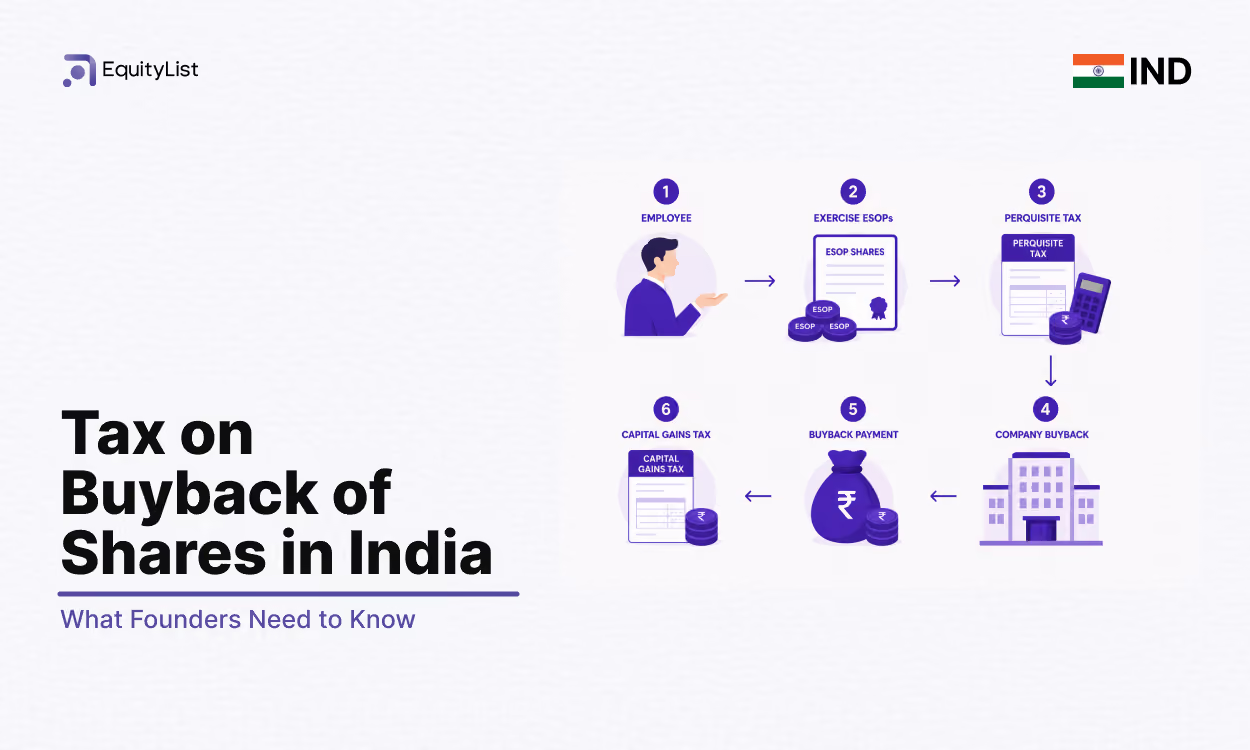
- When employees sell ESOP shares back to the company in a buy-back, they have already paid perquisite tax at exercise. Their cost of acquisition for capital gains purposes is the fair market value at the date of exercise, not the original exercise price.
What is a buy-back of shares
A buy-back of shares is a corporate action in which a company repurchases its own equity shares from existing shareholders. The primary legal framework for buy-backs is set out in Section 68 of the Companies Act, 2013. Listed companies must also comply with the SEBI (Buy-Back of Securities) Regulations, 2018, which prescribe the permitted buy-back routes, pricing norms, disclosure requirements, and other procedural obligations.
The company can fund the buy-back from three sources:
- its free reserves (reserves available for distribution as dividend, as defined in Section 2(43) of the Companies Act, 2013, excluding share premium and revaluation reserves)
- its securities premium account (the excess received over par value when shares were originally issued, maintained under Section 52 of the Companies Act, 2013), or
- the proceeds of an earlier issue of a different kind of shares or securities. The law prohibits a company from buying back shares using the proceeds of an earlier issue of the same kind of shares.
Indian company law does not permit a company to hold its own shares as treasury stock. Once repurchased, the shares are permanently cancelled. They cease to exist on the company's cap table, reducing total outstanding shares. The company must extinguish the repurchased shares within seven days of completing the buy-back and file Form SH-11 with the Registrar of Companies within 30 days of completion.
Companies conduct buy-backs for several reasons. Returning surplus cash to shareholders without the recurring obligation of dividends is one common reason. Offsetting dilution caused by ESOPs or convertible securities is another. Some companies buy back shares to consolidate ownership before a major funding round or exit.
How buy-back of shares is taxed in India
The income tax treatment of share buy-backs in India has changed twice since October 2024, first with the Finance (No. 2) Act, 2024 effective 1 October 2024 and again with the Finance Act, 2026 effective 1 April 2026.
The regime that applies to any specific buy-back depends on the date the buy-back payment is made to the shareholder. Each regime reflects a different policy position on who should bear the buy-back tax and how the taxable amount should be computed.
Regime 1: Company-level buy-back tax (until 30 September 2024)
Under the framework that applied until 30 September 2024, the company bore the entire tax liability on the buy-back. The shareholder received the buy-back proceeds completely free of tax.
The company paid a special buy-back distribution tax under Section 115QA of the Income Tax Act, 1961 at the rate of 20% on the "distributed income," with surcharge and cess applicable in addition. Distributed income was defined as the buy-back consideration paid to shareholders minus the amount originally received by the company when it issued those shares (the issue price).
The entire buy-back consideration received by shareholders was exempt from income tax under Section 10(34A).
Why this regime was changed: After the abolition of the Dividend Distribution Tax (DDT) in 2020, dividends became taxable at the shareholder's slab rate. Buy-backs, by contrast, continued to attract a flat company-level tax. For shareholders in the highest tax bracket, a buyback was significantly more tax-efficient than receiving the same amount as a dividend. The government moved to close this gap.
Regime 2: Deemed dividend treatment (1 October 2024 to 31 March 2026)
The Finance (No. 2) Act, 2024 changed buy-back taxation so that shareholders, rather than companies, became responsible for paying the tax.
Three changes took effect simultaneously:
- Section 115QA was abolished for buy-backs on or after 1 October 2024, so the company no longer paid any buyback distribution tax.
- The definition of "dividend" under Section 2(22) of the Income Tax Act was expanded through a new clause (f) to include consideration received by shareholders on buy-back. The entire buy-back consideration, not just the gain, was classified as deemed dividend income and taxed at the shareholder's applicable slab rate.
- No deduction for cost of acquisition was allowed against the deemed dividend income.
The government also amended Section 46A as a partial workaround. For capital gains purposes, the consideration received on the buy-back was deemed to be nil. As a result, the shareholder recognised a capital loss equal to the cost of acquiring the bought-back shares. This loss could be set off against eligible capital gains in accordance with the normal tax rules or carried forward for up to eight assessment years.
The company was required to deduct TDS at 10% on the buy-back consideration under Section 194, where the total dividend (including deemed dividend) paid to a resident shareholder during the financial year exceeded ₹10,000.
The problem this created for shareholders: Consider a long-term investor who purchased a share at ₹800 and tendered them in a buy-back at ₹1,000. The taxable income was ₹1,000 (the entire buy-back amount), not ₹200 (the actual gain). The ₹800 cost was available only as a capital loss to offset other capital gains. If the shareholder had no other capital gains, this capital loss could be carried forward for up to eight years, but it could not reduce the slab-rate tax on the ₹1,000 deemed dividend. The result was often a higher effective tax rate.
Regime 3: Capital gains treatment (from 1 April 2026)
Recognising that the deemed dividend treatment created structural problems, the Finance Act, 2026 restored capital gains treatment for share buy-backs, reversing the regime introduced by the Finance (No. 2) Act, 2024. The revised rules apply to buy-backs where the consideration is paid on or after 1 April 2026.
Under the Income Tax Act, 2025 (the new consolidated income tax statute that replaced the Income Tax Act, 1961, effective 1 April 2026), the buy-back consideration is taxable under the head "Capital Gains" instead of being treated as dividend income. The deemed dividend provision under Section 2(22)(f) has been removed for buybacks falling under the new regime. The gain is computed as the difference between the buy-back consideration and the shareholder's cost of acquisition of those shares.
For listed companies, shares held for more than 12 months attract LTCG (long-term capital gains) at 12.5%, with the standard exemption of up to ₹1.25 lakh per financial year. Shares held for 12 months or less attract STCG (short-term capital gains) at a flat rate of 20%.
For unlisted companies, shares held for more than 24 months attract LTCG at 12.5%, without indexation. Shares held for 24 months or less attract STCG at the shareholder's applicable slab rate.
What "promoter" means for startup founders
The Finance Act 2026 levies additional tax on "promoters" who participate in buybacks.
Under Section 69 of the Income Tax Act, 2025, the additional promoter tax applies to buybacks conducted under Section 68 of the Companies Act, 2013.
For unlisted companies, the definition of promoter includes any shareholder holding 10% or more of the company's equity share capital. For listed companies, the definition follows the SEBI (Issue of Capital and Disclosure Requirements) Regulations, 2018, which identifies promoters based on disclosure filings.
{{cta-form}}
Tax on ESOP buybacks: How perquisite tax and buy-back tax interact
Employees who participate in an ESOP buy-back are shareholders who acquired their shares by exercising stock options. Unlike ordinary investors, they may already have paid perquisite tax at the time of exercise. The buy-back therefore creates a second tax event that must be considered alongside the earlier perquisite taxation.
At the time of exercise, the employee paid a perquisite tax on the difference between the fair market value (FMV) of the shares on the exercise date and the exercise price. This perquisite was treated as salary income and taxed at the employee's slab rate, with TDS deducted by the employer.
When those shares are subsequently tendered in a buy-back, the employee's cost of acquisition for capital gains purposes is the FMV on the exercise date. Accordingly, only the appreciation in value above that FMV is subject to capital gains tax.
The holding period for ESOP shares is computed from the date of exercise (when the shares were allotted to the employee), not from the date of grant.
Worked example: Total tax burden across both events
Consider a senior engineer at an unlisted Series B startup who earns a salary of ₹35 lakh per year. She holds 2,000 ESOP shares with an exercise price of ₹10 per share. The FMV on the date she exercises is ₹300 per share. Thirty months after exercise, the company conducts a buy-back at ₹500 per share.
At exercise: The perquisite is ₹290 per share (₹300 FMV minus ₹10 exercise price), totalling ₹5.8 lakh across 2,000 shares. This is added to her salary income and taxed accordingly. Assuming a 30% tax rate, she would pay approximately ₹1.74 lakh.
At buy-back (Regime 3, from 1 April 2026): The capital gain is ₹200 per share (₹500 buy-back price minus ₹300 FMV at exercise), totalling ₹4 lakh across 2,000 shares. She held the shares for 30 months, which exceeds the 24-month threshold for unlisted shares, so the gain qualifies as LTCG at 12.5%. Tax on the capital gain: ₹50,000.
Total tax across both events: Approximately ₹2.24 lakh on a total economic gain of ₹9.8 lakh.
How the same example plays out under Regime 2
If the same employee's buy-back had fallen between 1 October 2024 and 31 March 2026, the outcome would have been materially worse.
The perquisite tax at exercise remains the same: approximately ₹1.74 lakh on the ₹5.8 lakh perquisite.
At buy-back, the full ₹10 lakh (₹500 per share multiplied by 2,000 shares) would have been classified as deemed dividend and taxed at her slab rate. Assuming a 30% tax rate, she would pay ₹3 lakh.
Her ₹6 lakh cost of acquisition (₹300 FMV multiplied by 2,000 shares) could not be deducted against the deemed dividend, because dividend income under the Income Tax Act does not have a cost-of-acquisition mechanism. The cost was instead recognised as a capital loss under Section 46A, available to offset other capital gains.
Total tax across both events (without capital loss offset): Approximately ₹1.74 lakh (perquisite tax) plus ₹3 lakh (deemed dividend tax) = ₹4.74 lakh, on a total economic gain of ₹9.8 lakh.
Most startup employees do not have substantial capital gains from other sources against which to set off the capital loss. If the employee did have other long-term capital gains of ₹6 lakh or more, the offset would save approximately ₹75,000 (₹6 lakh multiplied by 12.5%), reducing the total tax to approximately ₹3.99 lakh.
This is why Regime 2 was particularly punitive for ESOP holders and one of the reasons the government restored capital gains treatment under Regime 3.
FAQs
1. Is tax applicable on buy-back of shares?
Yes. In India, a buy-back of shares is a taxable event. For employees holding ESOP shares, this tax applies in addition to the perquisite tax that was already paid when the stock options were exercised.
For buybacks on or after 1 April 2026, shareholders are taxed on the capital gain, calculated as the buy-back price minus the cost of acquisition.
Promoters are subject to an additional tax on top of the regular capital gains tax, resulting in a higher effective tax rate than that applicable to other shareholders.
2. How is a share buy-back taxed?
From 1 April 2026, a share buy-back is taxed as a capital gains event under Section 69 of the Income Tax Act, 2025. The buy-back tax is separate from the perquisite tax that arose when the stock options were exercised.
The shareholder computes the capital gain as the buy-back consideration received minus the cost of acquisition (FMV at exercise) of the tendered shares. If the shares were held for more than 12 months (listed) or 24 months (unlisted), the gain qualifies as long-term capital gains and is taxed at 12.5%. Shares held for shorter periods attract short-term capital gains tax at 20% (listed) or at the shareholder's slab rate (unlisted). Promoters, defined as shareholders holding 10% or more in unlisted companies, pay an additional tax on top of these rates.
.avif)
.svg)
.svg)