







Key takeaways
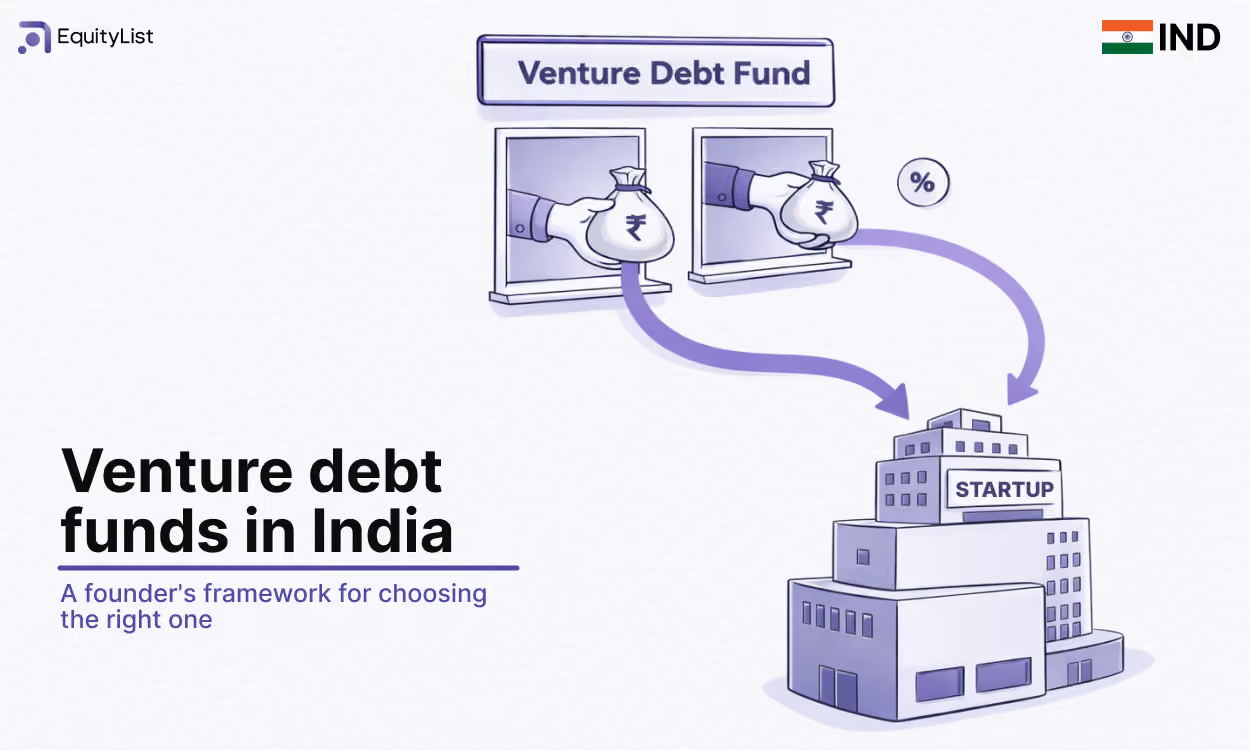
- Venture debt is a form of debt financing for VC-backed startups in India. It supplements equity capital and is structured as a term loan repaid over 18 to 36 months, with interest and warrants.
- India's venture debt market reached approximately ₹10,300 crore ($1.23 billion) in 2024 and has grown at a 58% CAGR since 2018, according to Stride Ventures' Global Venture Debt Report 2025.
- Interest rates for venture debt in India typically range from 13% to 15% per annum. Warrants give lenders a small equity stake (usually 0.1% to 2% on a fully diluted basis) to compensate for the higher lending risk.
- Deals include warrants because interest income alone does not compensate lenders for the risk of lending to pre-profit startups without traditional collateral. Warrants provide equity upside that makes the lending model viable.
- The major venture debt funds in India include Trifecta Capital, Alteria Capital, Stride Ventures, InnoVen Capital, and BlackSoil Capital. Each operates at different stages and sectors.
- Venture debt funds in India operate as SEBI-registered Category II AIFs or RBI-registered NBFCs. The structure affects deployment flexibility, product range, and turnaround speed.
- The best time to raise venture debt is during or immediately after an equity round — not because you need capital urgently, but because your strong cash position gives you the best negotiating leverage and terms.
- Founders should evaluate venture debt funds across four dimensions: stage fit, sector expertise, ticket size alignment, and value beyond capital.
Venture debt funds in India: A founder's framework for choosing the right one
Most founders evaluate venture debt as an alternative to equity fundraising. That framing is incomplete. Venture debt does not replace equity rounds — it works alongside them, providing additional capital that extends a startup's cash runway without requiring a new priced round. The trade-off is straightforward: instead of selling more ownership, you take on a repayment obligation with interest. A small equity component (in the form of warrants) is part of most deals, but the dilution is a fraction of what a typical equity round creates.
India's venture debt market reached approximately ₹10,300 crore ($1.23 billion) in 2024, according to Stride Ventures' Global Venture Debt Report 2025 published in collaboration with Kearney. The number of deals hit a record 238, up from 56 in 2018. The market has grown at a compound annual growth rate of 58% since 2018.
This post does not rank venture debt funds. Ranking implies a universal hierarchy, and venture debt does not work that way. The right fund for a Series A SaaS company with 18 months of runway is not the same as the right fund for a Series D consumer brand preparing for an IPO. What follows is a framework for evaluating venture debt funds based on your stage, your sector, and the specific capital problem you are solving.
What is venture debt?
Venture debt is a form of debt financing designed for startups that have already raised institutional venture capital. Unlike traditional bank loans, venture debt does not require hard collateral such as property or fixed assets. Instead, lenders underwrite the loan based on the startup's growth trajectory, the strength of its VC backers, and its ability to raise follow-on equity.
Venture debt is structured as a term loan, typically with a repayment period of 18 to 36 months. Most deals also include an equity component in the form of warrants, which give the lender the right to purchase a small percentage of equity at a pre-agreed price. This combination of interest income and potential equity upside is what makes the risk profile viable for lenders, given that their borrowers are often pre-profit companies.
Note: A startup that has not raised any venture capital will find it nearly impossible to access venture debt, because lenders rely on the implicit endorsement of VC investors as part of their underwriting process.
Why venture debt deals include warrants
Lending to pre-profit, high-growth startups is inherently risky. Interest income alone does not adequately compensate the lender for this risk, especially when the borrower lacks traditional collateral. Warrants solve this problem. They give the lender the right to purchase a small equity stake at a predetermined price, allowing the lender to participate in the startup's upside if it succeeds. This equity upside is what makes the unit economics work for venture debt providers — it supplements the interest income and compensates for the occasional borrower that defaults. For founders, warrants mean that venture debt is "less dilutive" rather than entirely "non-dilutive." The dilution from warrants (typically 0.1% to 2% of equity on a fully diluted basis) is, however, far smaller than the 15% to 25% dilution of a typical equity round.
How venture debt works in India
The mechanics of a venture debt deal in India follow a broadly consistent pattern, though terms vary across lenders.
1. Loan structure
Most venture debt in India is structured as a term loan with an amortising repayment schedule. Loan durations (referred to as "tenors" in lending terminology) typically range from 18 to 36 months. Some lenders offer an initial interest-only period (usually 3 to 6 months) before the borrower begins repaying both principal and interest.
2. Interest rates
According to Stride Ventures' India Venture Debt Report 2024, interest rates for venture debt in India typically range from 13% to 15% per annum. The exact rate depends on the startup's risk profile, stage, the strength of its VC backing, and the prevailing interest rate environment. These rates are higher than traditional bank lending rates because venture debt borrowers typically lack profitability and conventional collateral.
3. Warrants and equity kickers
Nearly all venture debt deals in India include warrants. The warrant coverage varies by deal, but it allows the lender to participate in the startup's upside if the company succeeds, and they are the reason venture debt is described as "less dilutive" rather than "non-dilutive."
4. Regulatory structure
Venture debt funds in India operate under two primary structures. Some are registered as Alternative Investment Funds (AIFs) under SEBI's Alternative Investment Funds Regulations, 2012, typically as Category II AIFs. Others operate through Non-Banking Financial Companies (NBFCs) registered with the Reserve Bank of India. Some funds use both structures to offer different products. The distinction matters to founders because AIF-structured funds have different capital deployment timelines, reporting requirements, and fee structures compared to NBFC-based lenders.
5. Covenants
Venture debt deals in India tend to have lighter covenants than traditional bank debt. Most lenders do not impose financial covenants tied to EBITDA or revenue ratios. Common covenants include minimum cash balance requirements, restrictions on additional indebtedness, and information rights (regular financial reporting to the lender).
Major venture debt funds in India
The following profiles cover the most active venture debt providers in India. Each is presented with the information founders need to assess fit — not as a ranking.
Trifecta Capital
Trifecta Capital launched India's first dedicated venture debt fund in 2015. According to BusinessWire India, the firm has deployed over ₹7,200 ($860 million) crore across more than 180 startups across debt and equity. Over 50 of these have achieved unicorn or near-unicorn status, including Zepto, BigBasket, Urban Company, Cars24, Infra.Market, and Meesho.
Trifecta's fourth and largest fund — Trifecta Venture Debt Fund IV — targets a corpus of ₹2,000 crore ($240 million) (with a ₹500 crore ($60 million) greenshoe option) and announced its first close in January 2025. The firm operates as a Category II AIF registered with SEBI. As reported by Moneycontrol, typical cheque sizes range from ₹10 crore to ₹15 crore ($1.2 - 1.8 million) and the fund's total write-off rate across all three funds has been under 0.6%.
What founders should know: Trifecta's stated focus is on early-growth and growth-stage startups backed by institutional VC with sound unit economics. Its target sectors (per its Fund IV announcement) include fintech, EV, consumer, logistics, manufacturing, and renewable energy. If your startup is post-Series A with strong VC backing and needs ₹10–15 crore ($1.2 - 1.8 million) in debt capital, Trifecta's profile aligns with that requirement.
Alteria Capital
Founded in 2017 by Ajay Hattangdi and Vinod Murali (both former senior leaders at the erstwhile SVB India Finance), Alteria Capital manages an AUM of approximately ₹4,500 crore ($540 million), as reported by Marca Money. The firm has backed over 200 startups including Rebel Foods, OneCard, BlueStone, Ather Energy, Mensa Brands, and Country Delight.
In 2024, Alteria deployed ₹1,670 crore ($200 million) in debt to Indian startups, according to co-founder Vinod Murali's statement to YourStory. Its Fund III closed at ₹1,550 crore ($186 million) and includes a twin-scheme structure: a standard venture debt scheme (18–36 month tenor) and a shorter duration scheme for working capital needs. In March 2025, the IFC anchored Alteria's Shorter Duration Scheme, marking IFC's first investment in India's innovative SME credit segment.
Alteria operates as a SEBI-registered AIF. The firm also runs Alteria Activate, a platform connecting portfolio companies with potential partners, corporates, and investors.
What founders should know: Alteria is sector-agnostic, with cheque sizes up to ₹150 crore ($18 million) (per its Fund III documentation). Its twin-scheme structure makes it relevant for founders who need both medium-term venture debt and short-duration working capital solutions. Its stated focus areas include consumer, fintech, healthcare, and D2C.
Stride Ventures
Stride Ventures was founded in 2019 by Ishpreet Singh Gandhi. According to Business Standard, the firm surpassed ₹8,350 crore ($1 billion) in venture debt commitments in December 2024, becoming the first Indian fund to reach that scale. Its portfolio includes over 150 startups such as Zepto, SUGAR Cosmetics, Spinny, Zetwerk, BlueStone, Upstox, and Ather. The firm launched its fourth fund in December 2024, targeting a corpus of ₹2,500 crore ($300 million).
Stride operates across India, the Gulf Cooperation Council (GCC), the United Kingdom, and Southeast Asia. Per its website, the firm has enabled over ₹13,300 crore ($1.6 billion) in credit globally.
What founders should know: Stride's stated focus sectors include consumer, fintech, cleantech, agritech, B2B ecommerce, and healthcare. Its cross-border presence (GCC and Southeast Asia) may be relevant for startups with international operations or expansion plans.
InnoVen Capital
InnoVen Capital has been operating in India since 2008 (originally as SVB India Finance before being acquired and rebranded in 2015). It is a joint venture between Seviora (a subsidiary of Temasek) and United Overseas Bank (UOB). According to its India website, InnoVen has lent to over 235 companies in India, whose portfolio companies have collectively raised over ₹2.5 lakh crore ($30 billion) in equity funding. Nearly a third of its borrowers have returned for follow-on rounds of debt.
InnoVen operates as an NBFC, which provides flexibility in product structure and deployment speed. Its product page describes its core offering as a medium-term loan to VC-backed companies, with interest rates and fees fixed for the tenor of the loan.
What founders should know: InnoVen's stated willingness to lend at the seed stage differentiates it from most other funds profiled here. Founders raising their first institutional round may find InnoVen more accessible than AIF-structured funds that focus on later stages. The NBFC structure also allows InnoVen to offer multiple debt products beyond standard term loans.
BlackSoil Capital
BlackSoil was founded in 2016 as an alternative credit platform. In November 2025, BlackSoil Capital and Caspian Debt completed their merger, creating an NBFC with combined assets under management of ₹1,900 crore ($228 million). The combined entity has cumulatively disbursed debt capital to over 550 companies.
BlackSoil operates as both an NBFC and an AIF, offering venture debt alongside structured credit and supply chain financing. Its startup portfolio includes OYO, Zetwerk, Upstox, Purplle, BluSmart, mCaffeine, and HomeLane. Post-merger, BlackSoil has expanded its addressable borrower base significantly, covering startups, financial institutions, and priority-sector SMEs.
What founders should know: BlackSoil's dual NBFC + AIF structure and its merger with Caspian (which had a strong presence in impact-focused and priority-sector lending) give it a broader product range than pure-play venture debt funds. Founders looking at structured credit, supply chain financing, or priority-sector lending alongside traditional venture debt may find this breadth useful. Its stated focus sectors include consumer, logistics, healthtech, enterprise SaaS, and fintech.
Other notable players
Northern Arc Investments. A subsidiary of Northern Arc Capital, focused on credit solutions across multiple sectors including microfinance, SME lending, and startup financing. Northern Arc applies a data-driven underwriting approach and is relevant for startups with exposure to financial services, affordable housing, or agribusiness.
Anicut Capital. A Chennai-based credit fund that provides structured debt to growth-stage companies. Focuses on startups with predictable cash flows and applies a conservative underwriting standard.
Lighthouse Canton. A Singapore-based global investment firm that announced the first close of its India-focused venture debt fund in January 2023. Brings a global investor perspective to the Indian venture debt market.
AIF vs NBFC
Funds operating as AIFs pool capital from Limited Partners and deploy it over a fixed investment period. This means they have a defined pool of capital and may be more selective about deployment timing. NBFC-structured lenders can raise capital on an ongoing basis and tend to have more flexibility in deployment cadence. For founders, the practical difference is that NBFC lenders may move faster on repeat transactions and offer a broader range of debt products (term loans, working capital lines, revenue-based financing). AIF-structured funds may offer more customised, larger-ticket solutions.
When venture debt makes sense (and when it does not)
Venture debt is not universally appropriate. Its value depends on timing, stage, and what problem you are solving with the capital.
1. Extending runway between equity rounds
The most common use case. If you have raised a Series A and expect your Series B to take 6 to 9 months longer than planned, venture debt can bridge that gap without forcing a premature or unfavourable equity raise. This is particularly relevant during periods of depressed VC activity, when equity rounds take longer to close.
2. Funding specific capital expenditures
If your startup needs capital for a defined, revenue-generating expenditure — purchasing equipment, expanding warehouse capacity, or funding inventory for a seasonal surge — venture debt can finance this more efficiently than equity. You are borrowing against a specific economic return, not permanently diluting your ownership.
3. When venture debt is the wrong choice
If your startup has not yet demonstrated product-market fit, venture debt adds repayment pressure without a clear growth engine to sustain it. If your burn rate is high relative to your revenue trajectory and you lack a credible path to your next equity round, taking on debt accelerates the risk of running out of capital. Venture debt should amplify momentum, not substitute for it.
The optimal time to raise venture debt is during or immediately after an equity round, when your cash position is strong and your negotiating leverage with debt providers is at its highest. Waiting until your runway is short weakens your terms and increases your risk.
What venture debt lenders evaluate
Understanding what lenders look for helps you assess whether you are a strong candidate and which funds are most likely to engage with your profile.
1. Quality of VC backing
Venture debt lenders treat the reputation and track record of your equity investors as a primary signal. A startup backed by a well-known, active VC fund is more likely to raise follow-on equity — and follow-on equity is, in most cases, the ultimate source of repayment for venture debt.
2. Revenue and unit economics
Lenders evaluate your revenue growth trajectory and whether your unit economics are positive or trending positive. A startup with ₹18 crore ($2 million) in annual recurring revenue growing at 80% year-over-year presents a different risk profile than one with flat revenue and high cash burn.
3. Cash runway and burn rate
How many months of cash do you have? What is your monthly burn? Lenders want confidence that you will not default before your next equity raise or before reaching profitability. A startup with 12+ months of runway post-debt is a significantly better candidate than one with 6 months.
4. Stage and sector
Most Indian venture debt lenders focus on post-Series A startups, though some (like InnoVen Capital) lend from the seed stage. Certain sectors — fintech, SaaS, consumer brands, logistics — have well-understood risk profiles that lenders are comfortable with. More capital-intensive or regulatory-heavy sectors may face additional scrutiny.
5. Pathway to profitability or next round
Lenders want to see a credible plan. Either you become profitable during the loan tenor, or you raise another equity round that allows you to continue servicing and repaying the debt.
A framework for evaluating venture debt funds
Rather than asking "which fund is the best?", ask yourself four questions.
1. Does the fund lend at my stage?
Some funds focus on Series A and B startups. Others concentrate on growth-stage and pre-IPO companies. Approaching a fund that does not operate at your stage wastes time for both parties. Match your stage to the fund's stated investment focus.
2. Does the fund have experience in my sector?
A lender that has financed 20 SaaS companies understands subscription revenue dynamics, churn risk, and appropriate debt-to-ARR ratios. A lender with deep consumer brand experience understands inventory cycles and working capital seasonality. Sector expertise translates into faster underwriting, more reasonable covenants, and a lender who will not panic at the first sign of normal business volatility.
3. Does the fund's ticket size match my requirement?
Venture debt ticket sizes in India range from ₹2 crore to ₹200 crore ($240k to 24 million)or more, depending on the fund and your stage. There is no point approaching a fund whose minimum cheque is ₹50 crore ($6 million) when you need ₹10 crore ($1.2 million), and vice versa.
4. What does the fund offer beyond capital?
Some funds provide introductions to potential customers, partners, or follow-on investors. Others offer structured advisory on financial planning. The value of these extras depends on your specific needs, but they can meaningfully differentiate funds that otherwise look similar on paper.
How venture debt affects your cap table
Venture debt introduces two types of cap table impact that founders should model before signing a term sheet.
Warrant dilution. Warrants issued alongside venture debt convert into equity at a predetermined price. While the dilution from warrants is significantly smaller than a typical equity round, it is not zero. Founders should model the fully-diluted impact of warrants on their cap table before committing to a deal.
Interaction with future equity rounds. When you raise your next equity round, your cap table will reflect both the existing equity structure and the outstanding warrants from your venture debt deal. Investors in the new round will evaluate ownership on a fully-diluted basis, including those warrants. Understanding this interaction helps you negotiate both your debt terms and your future equity terms more effectively.
Founders raising venture debt should use scenario modelling tools to project the combined impact of warrant conversions and future equity issuances on their ownership. A clean, updated cap table is not optional when managing multiple financing instruments; it is a prerequisite for making informed decisions.
Maintaining clear records of all securities — equity shares, convertible notes, SAFEs, warrants, and debt instruments — in a single system reduces the risk of errors during due diligence for your next round. EquityList tracks all these instruments on a single platform, giving founders and their finance teams a unified view of ownership, dilution, and outstanding obligations across equity and debt.
FAQs
1. What are venture debt funds?
Venture debt funds are specialised lending firms that provide debt financing to startups that have already raised venture capital. They are structured either as SEBI-registered Alternative Investment Funds (Category II AIFs) or as RBI-registered Non-Banking Financial Companies (NBFCs). These funds pool capital from institutional investors and deploy it as term loans to VC-backed startups. Unlike banks, venture debt funds underwrite based on the startup's growth trajectory and VC backing rather than profitability or hard collateral. Most deals include warrants, which give the fund a small equity stake alongside the interest income.
2. What is the interest rate for venture debt?
Interest rates for venture debt in India typically range from 13% to 15% per annum, according to Stride Ventures' India Venture Debt Report 2024. The exact rate depends on the startup's risk profile, stage, sector, the quality of its VC backing, and the prevailing interest rate environment. These rates are higher than traditional bank lending rates because venture debt borrowers typically lack profitability and conventional collateral. In addition to interest, most deals include warrants, which give the lender a small equity stake as additional compensation for the lending risk.
.svg)
.svg)