

Key takeaways
- An ESOP policy is a board-approved framework that governs employee stock options within a company. It sets out the ESOP pool size, eligibility criteria, grant philosophy, vesting schedule, exercise mechanics, and treatment upon separation.
- The policy must comply with Section 62(1)(b) of the Companies Act, 2013 and Rule 12 of the Companies (Share Capital and Debentures) Rules, 2014.
- The minimum vesting period under Rule 12 is one year from the grant date.
- Public companies must approve ESOP schemes through a special resolution. For private companies, MCA notification G.S.R. 464(E) dated 5 June 2015 permits approval by ordinary resolution. However, because Rule 12 still refers to a special resolution, many companies continue to use one as a matter of best practice.
- Form MGT-14 must be filed within 30 days of passing the shareholder resolution approving the ESOP scheme. Grants issued before the filing may not have legal validity.
- Under the Companies (Share Capital and Debentures) Amendment Rules, 2019, DPIIT-recognised startups can grant ESOPs to promoters and directors holding more than 10% equity for up to 10 years from incorporation.
- ESOP policies should be reviewed at every funding round, major hiring strategy change, or relevant regulatory amendment.
What is an ESOP policy?
An ESOP policy (also called an Employee Stock Option Plan) is the board-approved framework that governs employee stock options within a company. It records the pool size, the categories of employees eligible to receive grants, the vesting and exercise structure, the rules for treatment on separation, and the administrative process by which grants are approved and recorded.
The policy is the company's articulation of its equity compensation philosophy.
Section 62(1)(b) of the Companies Act, 2013 and Rule 12 of the Companies (Share Capital and Debentures) Rules, 2014 set the outer boundary of what is permitted. The policy operates within those boundaries and makes the choices the law leaves open.
For example, Rule 12 requires at least one year to pass from the date of grant before any options can vest. Beyond that minimum cliff, the policy determines whether vesting takes place over three years, four years, or longer, and whether it occurs monthly, quarterly, or in tranches. Rule 12 defines eligible recipients broadly as employees and directors other than independent directors. The policy narrows this further by deciding which employees receive grants and on what criteria, such as role, seniority, or performance.
Why a deliberate ESOP policy matters
Many disputes about ESOPs trace back to a thin or poorly considered policy. A grant letter alone cannot address every situation that may arise over the life of an ESOP programme.
Three patterns recur.
a. First, founders often make informal promises of equity to early employees before adopting a formal scheme, only to later discover that those promises do not align with the terms ultimately approved. For instance, an employee may have been verbally promised “1% of the company,” but the eventual ESOP pool and dilution mechanics make that impossible to deliver in the expected form.
b. Second, companies that adopt template policies without developing a clear grant philosophy frequently make inconsistent grant decisions, which later surface as questions of fairness. A senior engineer hired early may receive fewer options than a later hire in a comparable role simply because grants were negotiated ad hoc rather than against a consistent framework.
c. Third, companies that draft the policy once and never revisit it may find that its original assumptions, such as pool size, exercise windows, or change-of-control treatment, no longer suit the company’s stage or capital structure. A 90-day exercise window that seemed reasonable at incorporation, for example, may become impractical once exercise costs and tax liabilities increase after multiple funding rounds.
The legal framework governing ESOP policies in India
For Indian companies, ESOP policies operate within multiple layers of regulation. This section covers what the policy designer needs to know; the detailed statutory walkthrough sits in the ESOP scheme post.
The primary statute is the Companies Act, 2013. Section 62(1)(b) authorises a company with share capital to issue further shares to employees under an ESOP scheme. The procedural detail is set out in Rule 12 of the Companies (Share Capital and Debentures) Rules, 2014. Rule 12 prescribes who qualifies as an “employee” eligible to receive options, requires a minimum one-year period between grant and vesting, specifies the disclosures required in the explanatory statement to the shareholder resolution, and mandates maintenance of the Register of Employee Stock Options in Form SH-6.
Listed companies face an additional layer, the SEBI (Share Based Employee Benefits and Sweat Equity) Regulations, 2021, which prescribes disclosure, accounting, and compensation committee requirements.
Two regulatory points commonly trip up policy drafters.
The first concerns the shareholder resolution required for private companies. Under Section 62(1)(b), ESOP schemes ordinarily require shareholder approval by special resolution. However, MCA Notification G.S.R. 464(E) dated 5 June 2015, issued under Section 462 of the Companies Act, 2013, grants private companies an exemption by substituting “ordinary resolution” for “special resolution.” Rule 12 of the Companies (Share Capital and Debentures) Rules, 2014, however, continues to refer to a special resolution and has not been correspondingly amended. In practice, many companies therefore continue to pass a special resolution as a matter of caution.
The second is the startup exemption. Under the proviso to Rule 12, inserted by the Companies (Share Capital and Debentures) Amendment Rules, 2019, DPIIT-recognised startups can grant ESOPs to promoters and to directors holding more than 10% equity for 10 years from the date of incorporation. This was 5 years in the original Rule 12 and was extended to 10 years in the 2019 amendment.
Core components of an ESOP policy
A complete ESOP policy addresses ten components. Each requires a deliberate decision; defaults from a template usually mean the policy has not been thought through.
1. Plan objectives
The policy should state, in two or three sentences, why the company is offering stock options and what it expects the programme to achieve. Common objectives include attracting talent that the company cannot afford to compensate fully in cash, retaining critical employees through long-term vesting, and aligning employees with shareholders so that decisions are made with an ownership lens.
The objective is not boilerplate. It governs every downstream design choice. A policy designed for retention uses longer vesting and tighter exercise windows. A policy designed to attract senior hires at low cash compensation uses larger grants with acceleration clauses on change of control. A policy designed to give the wider employee base a stake in the company favours broader eligibility and a longer post-termination exercise window. Stating the objective explicitly prevents internal drift when individual grant decisions get made later.
2. Pool size and authorisation
The policy specifies the total number of options the company is authorising under the plan, expressed both as an absolute number and as a percentage of fully diluted capital. This is the ESOP pool.
Most companies allocate between 10% and 15% of fully diluted equity to the pool at the seed stage and top up at subsequent rounds. The right number depends on hiring plans for the next 18 to 24 months, the seniority of the hires being planned, and investor expectations.
What the policy must establish, independent of the number itself, is the authorisation mechanism. The policy must reference the shareholder resolution under which the pool was approved and the date on which the authorisation was filed with the RoC via Form MGT-14. Any grant issued in excess of the authorised pool is legally invalid, regardless of board approval. This is one of the most common compliance failures uncovered during fundraising diligence.
3. Eligibility and exclusions
The policy must define which employees, directors, and (where permitted) consultants are eligible to receive grants. Rule 12 sets the outer limits: permanent employees of the company or its subsidiary or holding company, and whole-time or part-time directors other than independent directors, are eligible. Promoters, members of the promoter group, and directors holding more than 10% of outstanding equity are excluded, except in the case of DPIIT-recognised startups within the 10-year window described above.
The policy can be narrower than the statutory ceiling. Many companies restrict eligibility to permanent employees who have completed a defined probation period, or to employees above a particular grade. The narrowing should be principled (linked to the plan objective) rather than arbitrary, because employees who consider themselves arbitrarily excluded are a source of disputes.
The policy should also state whether consultants and advisors can receive options. Under the Companies Act, consultants are generally outside the definition of "employee," which means they cannot receive ESOPs directly. Companies that want to compensate consultants with equity typically use Stock Appreciation Rights (SARs) or phantom stock instead, which sit outside the ESOP framework but achieve a similar economic outcome.
4. Grant philosophy
Grant philosophy covers the rules that determine how the company makes individual grants over time, not the legal terms of any one grant.
The policy should address four grant categories. Joining grants are made to new hires at the time of offer. Performance grants are made at review cycles based on contribution. Refresh grants are made to long-tenured employees whose original grants have largely vested. Promotion grants are made when employees move to higher bands.
For each category, the policy should state who approves grants (typically the board or a delegated authority), what factors inform the grant size, and whether grants are formulaic or discretionary. Companies that document grant philosophy explicitly tend to have fewer disputes during exits and fewer queries from investors during due diligence, because every grant can be traced back to a documented decision rule.
5. Vesting structure
Vesting is the schedule under which options accrue to the employee over time. The policy must specify the vesting period, the cliff, the vesting frequency, and any performance-linked conditions.
Rule 12(6)(a) prescribes a minimum vesting period of one year between the grant date and the first vesting event. Below this, the law does not allow options to vest at all. Most companies adopt a four-year vesting schedule with a one-year cliff, followed by monthly or quarterly graded vesting.
The policy can layer performance conditions on top of time-based vesting. Performance vesting is most common in senior or sales roles, where vesting can be tied to revenue milestones, individual ratings, or project completions. The policy must specify how performance conditions are assessed, who certifies them, and what happens if a milestone is missed in one period (does it carry forward, does the option lapse, does it convert to a time-based schedule).
6. Exercise mechanics
Once options vest, the employee must exercise them to convert them into shares. The policy must specify the exercise price, the exercise window during employment, and the exercise window after separation.
The exercise price (or strike price) is set at the time of grant. Indian law gives companies significant flexibility on pricing: the exercise price may be at face value, at a discount to fair market value, at fair market value, or at a premium. Most unlisted Indian companies set the exercise price at face value (typically ₹1 or ₹10), which maximises the employee's economic upside but creates the largest perquisite tax exposure at the time of exercise.
The exercise window during employment usually runs until the option's expiry date, which is set in the scheme document. The post-termination exercise window is a policy choice with significant downstream consequences. A 90-day window forces the employee to find the cash for the exercise and the perquisite tax within three months of leaving, which often means letting vested options lapse. Some companies extend the post-termination window to one year, five years, or ten years to give departing employees a fair chance of capturing the value of vested options. The choice should be made deliberately and stated explicitly.
7. Treatment on separation
The policy must specify what happens to vested and unvested options when an employee leaves the company. The treatment varies by reason for separation.
For voluntary resignation, the standard treatment is that all unvested options lapse and vested options remain exercisable for the post-termination window specified in the policy. For termination for cause, the standard treatment is that both vested and unvested options lapse immediately. For retirement, death, or permanent disability, most policies provide for accelerated vesting of unvested options and an extended exercise window, often to the option's full expiry date, so that the employee or their nominees can capture the full economic benefit.
The policy should also address what happens to lapsed options. Under most schemes, lapsed options return to the unallocated pool and become available for future grants.
8. Treatment on liquidity and change of control
The policy must specify how vested and unvested options are treated on change of control (acquisition or merger) and on IPO. These are the events at which the economic value of the ESOP actually crystallises.
For a change of control, the policy typically addresses whether unvested options accelerate, whether they convert into options of the acquirer, and whether the board has discretion to vary the treatment. Acceleration is more common for senior employees and for transactions in which the acquirer terminates the role. Conversion is more common for transactions in which the acquirer retains the employee.
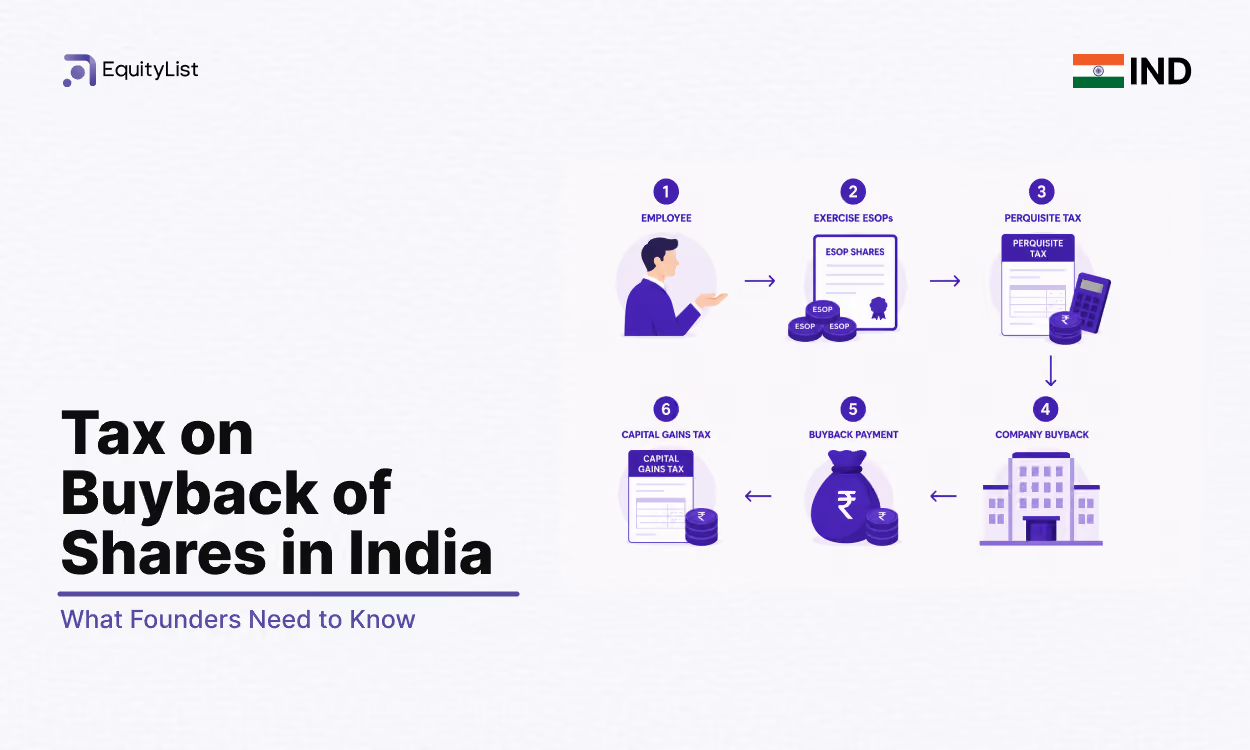
Buybacks and secondary sales are not typically addressed in advance in the policy. These are liquidity events the board initiates at a specific moment — when the company has capital to deploy, when founders or investors want to sell, or when employees request liquidity. The specific terms (who is eligible, what proportion can be sold, at what price) are decided by the board when the buyback is announced.
For an IPO, the policy should align with the SEBI requirements that will apply post-listing. Pre-listing grants typically continue to vest, but the scheme must be reviewed and amended where necessary to comply with the SEBI (SBEB & SE) Regulations, 2021 ahead of filing the DRHP.
9. Administration and governance
The policy must identify who administers the plan. In larger or listed companies, this is the Compensation Committee (or Nomination and Remuneration Committee), which must include independent directors. In smaller unlisted companies, the board itself usually administers the plan, sometimes through a delegated authority.
The administering body is responsible for approving individual grants, interpreting the scheme in edge cases, recommending variations, and signing off on annual reconciliation. The policy should set out the body's decision-making authority and the limits beyond which board or shareholder approval is required.
The policy should also specify the record-keeping requirements: maintenance of the Register of Employee Stock Options in Form SH-6, retention of board and shareholder resolutions, signed grant letters and acceptances, and the annual reconciliation of pool utilisation.
10. Variation and amendment
The policy must state how it can be amended and who has the authority to do so. Rule 12(5) of the Companies (Share Capital and Debentures) Rules, 2014 permits the company to vary the terms of an ESOP scheme through a special resolution, provided the variation is not prejudicial to existing option holders. Variations that are prejudicial require fresh shareholder approval and may also require employee consent.
Common variations include pool top-ups at funding rounds, extension of exercise windows for departing employees, and adjustments for stock splits or bonus issues. The policy should anticipate these and state the process for approving them.
How EquityList supports ESOP policy administration
Designing an effective ESOP policy requires thinking through strategic choices that most founders haven't made before.
EquityList's ESOP advisory team works with you to establish the framework: plan objectives, pool size, grant philosophy, vesting structure, treatment on separation. This happens before the legal scheme document is drafted.
Once you've made these choices and the policy is approved, EquityList's platform administers it consistently. It stores the scheme, applies vesting logic automatically to each grant, generates grant letters with e-signature support, and maintains the Register of Employee Stock Options in line with Rule 12(10).
When circumstances change at each funding round or major hiring shift, the advisory team revisits the policy with you, supports pool top-ups, and handles the board and shareholder approvals.
Talk to the EquityList advisory team.
FAQs on ESOP policy
1. What is the ESOP policy of the company?
A company's ESOP policy is its board-approved framework for granting employee stock options. It sets out the pool size, the categories of employees eligible to receive grants, the vesting and exercise schedule, the treatment on separation, and the administrative process.
2. Is ESOP better than salary?
ESOPs and salary serve different purposes and are not directly comparable. Salary provides immediate, guaranteed cash income; ESOPs provide a deferred, conditional claim on equity that has value only if the company grows and a liquidity event occurs. ESOPs typically offset some portion of cash compensation at early-stage companies that cannot match market salaries, and they create concentrated upside if the company performs well. Whether ESOPs are "better" depends on the employee's cash needs, risk tolerance, and assessment of the company's prospects.
3. Is 1 ESOP equal to 1 share?
Not necessarily. An ESOP unit represents the right to acquire a specified number of shares, and the conversion ratio is determined by the company when structuring the grant.
In practice, most companies use a simple 1 option = 1 share ratio because it is easier for employees to understand and administer. However, companies can adopt different ratios (for example, 1 option = 2 shares or 2 options = 1 share) depending on how the ESOP scheme is designed.
Regardless of the ratio, the option holder does not become a shareholder until the option is exercised and shares are allotted. Until exercise, the ESOP remains a contractual right to purchase shares at the exercise price specified in the grant letter, subject to vesting and the applicable exercise window.
4. What is an ESOP and how does it work?
An ESOP (Employee Stock Option Plan) is a programme through which a company grants employees the right to purchase company shares at a pre-determined exercise price after a defined vesting period. The ESOP lifecycle has four stages: grant (the company issues options to the employee with a vesting schedule), vesting (the employee earns the right to exercise the options over time, subject to a minimum one-year cliff under Indian law), exercise (the employee pays the exercise price and receives shares), and sale or liquidity (the employee monetises the shares through a buyback, secondary sale, or post-listing trade).
.avif)
.svg)
.svg)
.svg)

