







Key takeaways
- Authorised share capital is the maximum equity a company can issue, recorded in Clause V of the MoA. A company cannot allot shares beyond this limit without first increasing it.
- The increase in authorised share capital is governed by Section 61(1)(a) of the Companies Act, 2013 and requires an ordinary resolution passed by shareholders at a general meeting; a simple majority suffices.
- If the Articles of Association (AoA) do not contain an enabling clause, the AoA must be amended first by special resolution under Section 14, which triggers a separate MGT-14 filing.
- Form SH-7 must be filed with the ROC within 30 days of passing the general meeting resolution. MGT-14 is not required for the capital increase resolution itself, only for the AoA amendment if applicable.
- Stamp duty on the MoA alteration is state-specific, assessed on the incremental increase in authorised capital, and payable through the MCA portal at the time of SH-7 filing.
- Late or missing SH-7 filing attracts a penalty of ₹500 per day, subject to a maximum of ₹5,00,000 for the company and ₹1,00,000 for each officer in default, applied separately.
- Increasing authorised capital under Section 61 increases the authorised limit but does not issue shares. Actual allotment requires a separate Section 62 process.
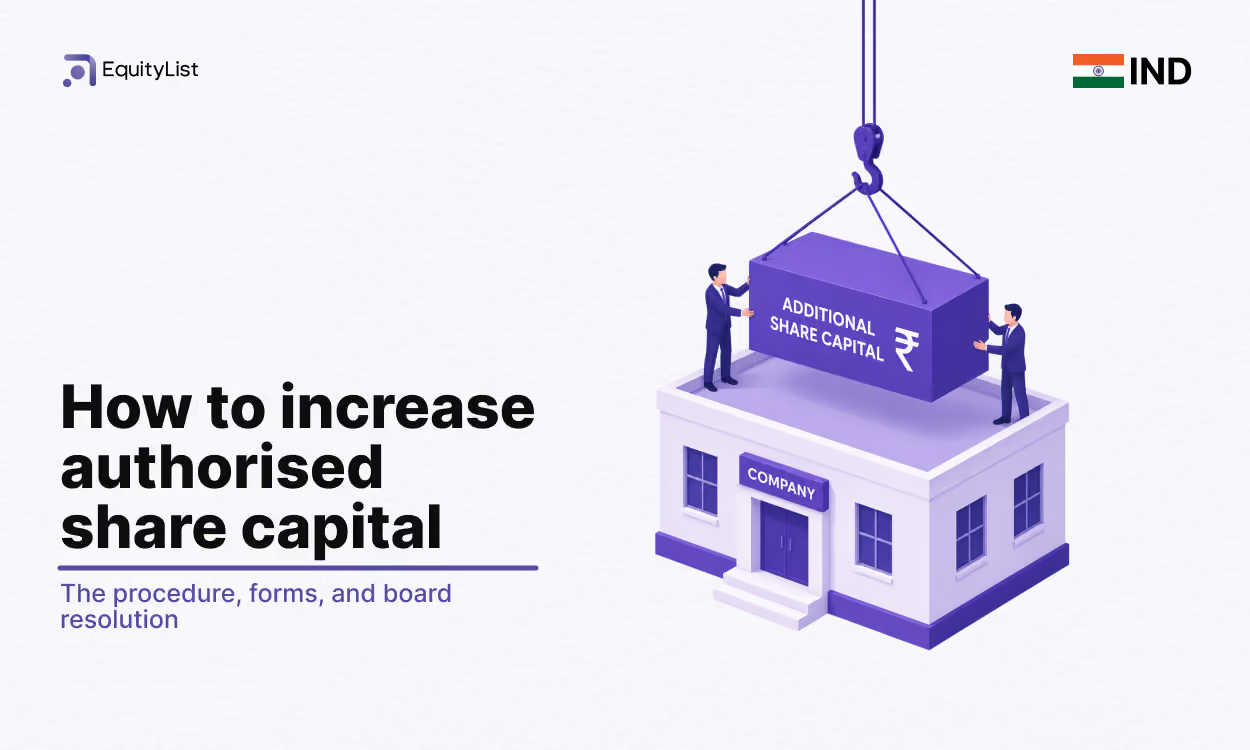
Authorised share capital is the maximum value of equity a company is legally permitted to issue to shareholders, recorded in Clause V of the Memorandum of Association (MoA). Before a company can allot new shares, the proposed allotment must fit within this limit. When it does not, the company must first increase its authorised capital under Section 61(1)(a) of the Companies Act, 2013.
The process involves a board resolution, a shareholder vote at a general meeting, an amendment to the MoA, and the filing of Form SH-7 with the Registrar of Companies (ROC) within 30 days of the general meeting resolution.
When a company needs to increase its authorised share capital
A company cannot allot shares beyond its current authorised capital limit. The following situations require an increase, among others:
- Raising a new funding round, where the shares to be allotted to incoming investors would exceed the unissued headroom in the existing authorised capital.
- Expanding the ESOP pool before a new grant cycle when the existing pool is exhausted and a larger reserve is needed.
- Issuing bonus shares, which are created from retained earnings but still count against the authorised capital ceiling.
- Converting CCPS or CCDs into equity at a point where the conversion would generate more shares than the company is currently authorised to issue.
The authorised capital increase must be completed before the allotment, not concurrently with it.
Does your AoA already allow the increase?
Before beginning the procedure, verify whether the Articles of Association contain a provision permitting the company to increase its authorised share capital by ordinary resolution. Standard AoA templates prescribed under Table F of the Companies Act 2013 include this provision, but companies incorporated with bespoke articles should verify its presence before proceeding.
If the clause is present, the company proceeds directly to Step 2. If it is absent, an AoA amendment under Section 14 is required before any other step. The statutory detail for both paths is set out in Step 1 below.
Procedure for increasing authorised share capital
Step 1: Verify the AoA clause
Under Section 61(1) of the Companies Act, 2013, a limited company may increase its authorised share capital only if its Articles of Association authorise it to do so. The first step is to check whether the AoA contains a provision that expressly permits the company to increase its authorised capital by ordinary resolution.
If the AoA contains this clause, proceed to the steps below.
If the AoA does not contain this clause, it must be amended first under Section 14 of the Companies Act, 2013, which requires a special resolution. Under Section 117(1) read with Section 117(3)(a), a copy of every special resolution must be filed with the ROC in Form MGT-14 within 30 days of passing. Once the AoA has been amended to include the enabling clause, the company can proceed with the steps below and file Form SH-7 separately for the capital increase.
Step 2: Convene a board meeting
Issue notice of the board meeting to all directors at least seven days before the meeting date, as required under Section 173(3) of the Companies Act, 2013.
Step 3: Pass the board resolution
The board resolution at this meeting authorises four things: the proposed increase in authorised share capital and the resulting amendment to Clause V of the MoA; the draft notice of the general meeting along with the explanatory statement required under Section 102; the date, time, and venue of the meeting; and the authorisation of a director or company secretary to dispatch the meeting notice.
The board resolution is an internal document. It is not filed with the ROC.
Step 4: Issue general meeting notice
The general meeting notice, along with the explanatory statement, must reach all members, directors, and auditors at least 21 days before the meeting date under Section 101(1) of the Companies Act, 2013. A shorter notice period is permitted if consent is obtained from members holding at least 95% of the paid-up voting capital.
Step 5: Pass the ordinary resolution at the general meeting and amend Clause V of the MoA
Shareholders vote on the proposed increase. The resolution is an ordinary resolution under Section 61(1)(a), requiring a simple majority of votes cast. The resolution must state the revised authorised capital: total amount, number of shares, face value per share, and class of shares.
Once passed, Clause V of the MoA is amended to reflect the revised figures. Every copy of the MoA issued after this date must incorporate the amendment.
{{cta-form}}
Step 6: File Form SH-7 within 30 days
Form SH-7 is the statutory notice to the ROC that the company's share capital has been altered, prescribed under Section 64(1) read with Rule 15 of the Companies (Share Capital and Debentures) Rules, 2014. It is filed electronically on the MCA V3 portal within 30 days of passing the resolution, with the following attached:
- Certified true copy of the ordinary resolution with explanatory statement
- Copy of the altered MoA reflecting the revised Clause V
- Copy of the current AoA (where the AoA was also amended)
- ROC filing fees per the Companies (Registration Offices and Fees) Rules, 2014 (fees are tiered by authorised capital amount and increase with the authorised capital slab)
- Stamp duty (assessed on the incremental increase in authorised capital, not the post-increase total; rates vary by state, typically between 0.1% and 0.15% of the incremental amount, subject to state-specific caps; payable electronically through the MCA portal)
After ROC approval (typically within two to five working days of filing, subject to queue and query), the MCA master data is updated to reflect the new authorised capital.
MGT-14: when it is required and when it is not
MGT-14 is triggered by special resolutions. Under Section 117(3) of the Companies Act, 2013, a copy of every special resolution must be filed with the ROC within 30 days of passing.
The ordinary resolution passed at the general meeting to increase authorised share capital under Section 61(1)(a) is not a special resolution. Section 117(3)(a) does not apply to it. The filing obligation for this resolution is satisfied entirely through Form SH-7 under Section 64.
MGT-14 is required only where the AoA is first amended by special resolution under Section 14. That amendment is a special resolution and therefore falls squarely within Section 117(3)(a). It must be filed in Form MGT-14 within 30 days of passing.
Penalties for late or missing SH-7 filing
Under Section 64(2) of the Companies Act, 2013, failure to file Form SH-7 within 30 days results in a penalty of ₹500 per day for each day of default, subject to a maximum of ₹5,00,000 for the company and ₹1,00,000 for each officer in default. Directors are personally liable for the officer-in-default penalty.
After ROC approval: internal updates
Under Section 15(1) of the Companies Act, 2013, every alteration made in the memorandum must be noted in every copy of the memorandum. After ROC approval of Form SH-7, every physical and digital copy of the MoA must be updated to reflect the amended Clause V. Section 15(2) provides that failure to do so attracts a penalty of ₹1,000 for every copy of the memorandum issued without the alteration noted.
Section 61 vs Section 62: what the difference means
Increasing authorised share capital under Section 61 and issuing new shares under Section 62 are distinct processes. Completing the Section 61 procedure increases the authorised limit. It does not create or allot shares, and the company's paid-up capital does not change.
To actually issue shares within the new limit, the company must separately complete the Section 62 process, which governs further issue of share capital through rights issue, private placement, or ESOP grants. Each route has its own resolution requirements, timelines, and filings, including Form PAS-3 after allotment.
Summary of forms and timelines
PAS-3 filing deadlines vary by route. For private placements under Section 42, Rule 12 of the Companies (Prospectus and Allotment of Securities) Rules 2014 prescribes a 15-day window. For rights issues under Section 62(1)(a), 30 days applies.
FAQs on increasing authorised share capital
What are the requirements for increase in authorised share capital?
Three conditions must be met under the Companies Act, 2013. The AoA must contain an enabling clause permitting the company to increase its authorised capital; if it does not, the AoA must be amended by special resolution first. An ordinary resolution must be passed by shareholders at a general meeting, with a simple majority of votes cast in favour. Form SH-7 must be filed with the ROC within 30 days of the resolution, along with the altered MoA and payment of the applicable ROC fees and stamp duty under Section 64(1) and Rule 15 of the Companies (Share Capital and Debentures) Rules, 2014.
Does an increase in authorised share capital require MGT-14?
MGT-14 is triggered by special resolutions, which must be filed under Section 117(3) of the Companies Act, 2013. The ordinary resolution passed under Section 61(1)(a) to increase authorised share capital is not a special resolution, so it does not attract MGT-14. The filing obligation for this resolution is satisfied through Form SH-7 under Section 64. MGT-14 is required only if the AoA is first amended by special resolution under Section 14, since that amendment falls within Section 117(3)(a).
Can authorised shares be increased?
Yes. Under Section 61(1)(a) of the Companies Act, 2013, a limited company may increase its authorised share capital by any amount, provided the AoA authorises it to do so. The increase requires an ordinary resolution at a general meeting, an amendment to Clause V of the MoA, and filing of Form SH-7 with the ROC. There is no statutory ceiling on the amount of the increase or on how many times a company may increase its authorised capital.
What happens when share capital is increased?
The legal ceiling on the equity the company may issue rises to the new authorised figure. The MoA is amended to reflect this, and the ROC updates the MCA master data after SH-7 is approved. The company's paid-up capital does not change as a result. To issue shares within the new limit, the company must separately complete the allotment process under Section 62 of the Companies Act, 2013, which governs rights issues, private placements, and ESOP grants.


.svg)
.svg)