







Key takeaways
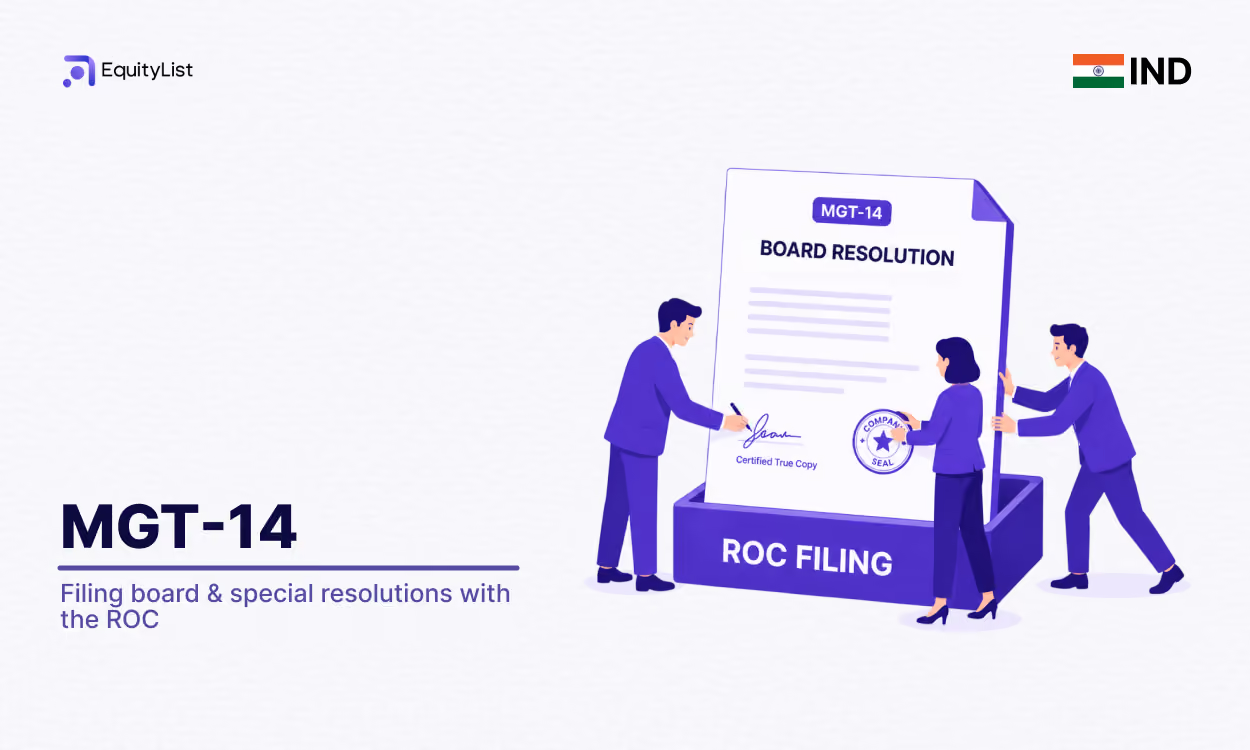
- MGT-14 is filed with the Registrar of Companies (ROC) under Section 117 of the Companies Act, 2013, within 30 days of a resolution being passed or an agreement being entered into.
- Special resolutions require MGT-14 for every company, public or private. This includes private placements, share capital reductions, and MOA or AOA alterations. ESOP approvals require a special resolution for public companies; private companies may use an ordinary resolution instead under an MCA exemption, though MGT-14 filing still applies either way.
- Specified board resolutions under Section 179(3) require MGT-14 only for public companies. Private companies are exempt from this specific category, but only if the company has no default in filing financial statements or annual returns.
- The exemption for private companies does not extend to special resolutions.
- Filing fees range from ₹200 to ₹600 based on nominal (authorised) share capital, under Rule 12 of the Companies (Registration Offices and Fees) Rules, 2014.
- Late filing attracts an additional fee, up to 12 times the normal fee beyond 180 days, separate from the Section 117(2) penalty of up to ₹2,00,000 for the company and ₹50,000 per officer in default.
- Filing MGT-14 well beyond the due date may require condonation of delay under Section 460 through Form CG-1, a discretionary process best handled with a company secretary.
What is form MGT-14
MGT-14 records specified resolutions and agreements with the ROC under Section 117 of the Companies Act, 2013, read with Rule 24 of the Companies (Management and Administration) Rules, 2014. The filing itself does not approve or validate the underlying decision. The board or shareholders have already approved it before MGT-14 is filed. What the filing does is place a certified copy of that decision on the government's public register, so that anyone checking the company's filings can see what was decided and when.
This matters operationally because a resolution that is valid internally but never filed still exposes the company to penalties, and in some cases creates friction later when investors or acquirers ask for proof that a change (an ESOP scheme, a capital increase, an altered AoA) was properly recorded with the ROC.
{{cta-form}}
Which resolutions and agreements require MGT-14
Section 117(3) of the Companies Act sets out which resolutions and agreements must be filed.
Special resolutions, under Section 117(3)(a), always require MGT-14, filed by every company regardless of whether it is public or private. A special resolution is one where the votes cast in favour are at least three times the votes cast against, whether by show of hands, poll, or postal ballot. For equity and cap table purposes, this covers events such as:
- Approving an ESOP scheme. Public companies approve this by special resolution under Section 62(1)(b). Private companies may approve it by ordinary resolution instead, under the MCA's exemption notification (GSR 464(E), 5 June 2015), though Rule 12 of the Companies (Share Capital and Debentures) Rules, 2014 still references a special resolution and many private companies pass one as a matter of caution. Either way, the resolution gets filed in MGT-14. See EquityList's guide to ESOPs under the Companies Act for the full approval process.
- A private placement or preferential allotment of securities under Section 42, where the special resolution authorises the offer before PAS-4 is issued. EquityList's preferential allotment guide covers the sequencing in detail.
- Reducing share capital under Section 66, which also requires NCLT confirmation after the special resolution and MGT-14 filing. See EquityList's guide to reduction of share capital.
- Altering the Memorandum or Articles of Association, including changes to authorised share capital or the object clause.
- A share buy-back under Section 68, where the resolution amount exceeds 10% of paid-up equity capital and free reserves and therefore needs shareholder approval rather than just board approval.
Specified board resolutions, under Section 117(3)(g), read with Section 179(3), require MGT-14 for public companies. These cover powers the board can only exercise through a formal board meeting resolution: authorising a buy-back under Section 68, issuing securities including debentures, borrowing funds, investing company funds, granting loans or giving guarantees, and approving the company's financial statements and board's report.
MGT-14 applicability for private companies
Section 117(3)(g) doesn’t exempt private companies from MGT-14 filing.
The exemption, granted by MCA notification GSR 464(E) dated 5 June 2015, applies only to clause (g), meaning the specified board resolutions under Section 179(3). It does not touch clause (a), special resolutions. So a private company still files MGT-14 for every special resolution it passes, including private placements, capital reductions, and AoA alterations, on exactly the same basis as a public company. ESOP approvals sit slightly apart from this: a private company may pass either an ordinary or a special resolution to approve the scheme (see above), but whichever type it passes still gets filed in MGT-14.
Where the exemption applies, it comes with a condition, added by an amendment dated 13 June 2017: it only protects a private company that has no default in filing its financial statements under Section 137 or its annual return under Section 92. This means a private company skipping MGT-14 for a Section 179(3) board resolution needs to confirm two things are true at the time: the resolution falls within clause (g), and the company's own annual filings are current. If either condition fails, if the resolution is actually a special resolution, or if the company has a filing default on its AOC-4 or MGT-7, the exemption does not apply and the filing is due. Where a company's filing history is unclear, a company secretary should confirm the default status directly rather than assuming the exemption holds.
Due date for filing MGT-14
MGT-14 is due within 30 days of the date the resolution is passed or the agreement is entered into. For a resolution passed at an extraordinary general meeting on a given date, the 30-day clock starts that day.
Documents required to file MGT-14
The MGT-14 e-form requires the resolution particulars (date, type, and section under which it was passed) along with supporting attachments uploaded as scanned PDFs. The mandatory attachments, per the MCA's instruction kit for the form, are:
- Certified true copy of the resolution/postal ballot resolution + explanatory statement under Section 102 (mandatory for every resolution filing)
- Copy of agreement (only if filing an agreement, not a resolution)
- e-MoA (linked form) only for: interstate change of registered office, MOA alteration (except name/registered office/object clause/authorised capital), name change, or object clause alteration
- e-AoA (linked form) only for: entrenchment of articles, alteration of articles, or name change
- Up to 5 optional attachments, if needed
Signatories:
- DSC of director/manager/company secretary/CEO/CFO
- If company is under CIRP/liquidation: IRP/RP/liquidator instead
- Separate mandatory certification by practicing CA/CS/cost accountant (except OPC and small companies)
{{cta-form}}
Filing fees for MGT-14
The filing fee for MGT-14 is set by Rule 12 of the Companies (Registration Offices and Fees) Rules, 2014 and scales with the company's nominal share capital, meaning the authorised capital stated in the Memorandum of Association, not the paid-up capital:
This slab structure was last substituted through the Companies (Registration Offices and Fees) Amendment Rules, 2026, though that amendment revised only the DIR-3 KYC fee item and left the MGT-14 filing fee slab unchanged from the figures above.
Penalties for late or non-filing of MGT-14
Filing MGT-14 after the 30-day window attracts an additional fee on top of the base fee, calculated as a multiple of the normal fee depending on how late the filing is:
Separately from the additional fee, Section 117(2) imposes a penalty for the failure itself. The company is liable for ₹10,000, plus ₹100 for each day the failure continues, capped at ₹2,00,000.
Every officer in default, including a liquidator where applicable, is liable for ₹10,000, plus ₹100 per day, capped at ₹50,000. These two consequences, the additional fee and the Section 117(2) penalty, apply independently: paying the higher fee for a late filing does not substitute for the statutory penalty on the company and its officers.
How to file MGT-14 on the MCA portal
Filing follows the standard MCA e-form workflow:
- Log in to MCA portal, go to E-Filing → Company Forms Download → Form MGT-14.
- Enter CIN, fill in the resolution particulars, attach e-MoA/e-AoA if the purpose needs it.
- Save as draft if needed, then submit to generate SRN (Service Request Number).
- Affix DSC and upload the signed PDF within 15 days of SRN generation.
- Pay the fee within 7 days of upload (or due date + 2 days, whichever's earlier).
- Once payment clears, an acknowledgment email lands in your inbox. If the purpose was altering the object clause, a Certificate of Registration follows as well.
- From here, what happens next depends on the purpose you filed for. Most filings go through STP mode, meaning the RoC takes it on record automatically with no manual review, and no option to resubmit if something's wrong.
- Not every filing gets treated the same way. Purposes like ESOP allotment, preferential/private allotment, or public↔private conversion involve bigger structural or ownership changes, so these go into Non-STP mode instead of being auto-approved, meaning an RoC official actually reviews the filing before it's taken on record.
- If the RoC finds something off, the form doesn't get rejected outright. It comes back marked "Resubmission required," and you get 15 days to fix the issue, reaffix the DSC, and resubmit, or the SRN lapses.
Condonation of delay beyond 300 days
Once a resolution passes the 300-day mark unfiled, the additional-fee route stops being available. The MCA portal itself enforces this: past 300 days, MGT-14 won't accept a filing unless the SRN of a condonation order (Form INC-28) is entered. This 300-day cutoff traces back to a "270-day immunity" window under Section 403 of the Companies Act.
Subject to that check, the process falls under Section 460 of the Companies Act, which allows the Central Government to condone delays in filing documents with the Registrar. It involves an application in Form CG-1 explaining the reason for the delay, followed by filing Form INC-28 once the condonation order is issued, and then filing the original MGT-14 referencing that order's SRN.
FAQs on form MGT-14
What is form MGT-14 used for?
Form MGT-14 is used to file certain board and shareholder resolutions and agreements with the Registrar of Companies under Section 117 of the Companies Act, 2013. It places the company's decision on the public record, which regulators, creditors, and investors can verify independently of the company's own representations.
What is the last date for filing MGT-14?
MGT-14 must be filed within 30 days of the date the resolution was passed or the agreement was entered into, not the date of the meeting notice. Filing beyond this window attracts an additional fee that scales with the length of the delay.
.svg)
.svg)