







Key takeaways
- Reduction of share capital under Section 66 of the Companies Act, 2013 permanently decreases a company's issued, subscribed, and paid-up share capital, and requires NCLT confirmation before it takes effect.
- Three modes are available: extinguish or reduce liability on unpaid share capital, cancel capital lost due to asset decline, and repay excess paid-up capital to shareholders.
- Before filing with the NCLT, the company's Articles of Association should authorise capital reduction. If they do not, practitioners consistently advise amending the AoA first. The Companies Act bars any capital reduction if the company is in arrears on deposit repayments or interest thereon.
- The NCLT process runs through seven prescribed forms (RSC-1 to RSC-7). Under Section 66(2), the Central Government, Registrar, and creditors have three months from receipt of the Tribunal's notice to submit representations; silence is treated as no objection.
What is the reduction of share capital?
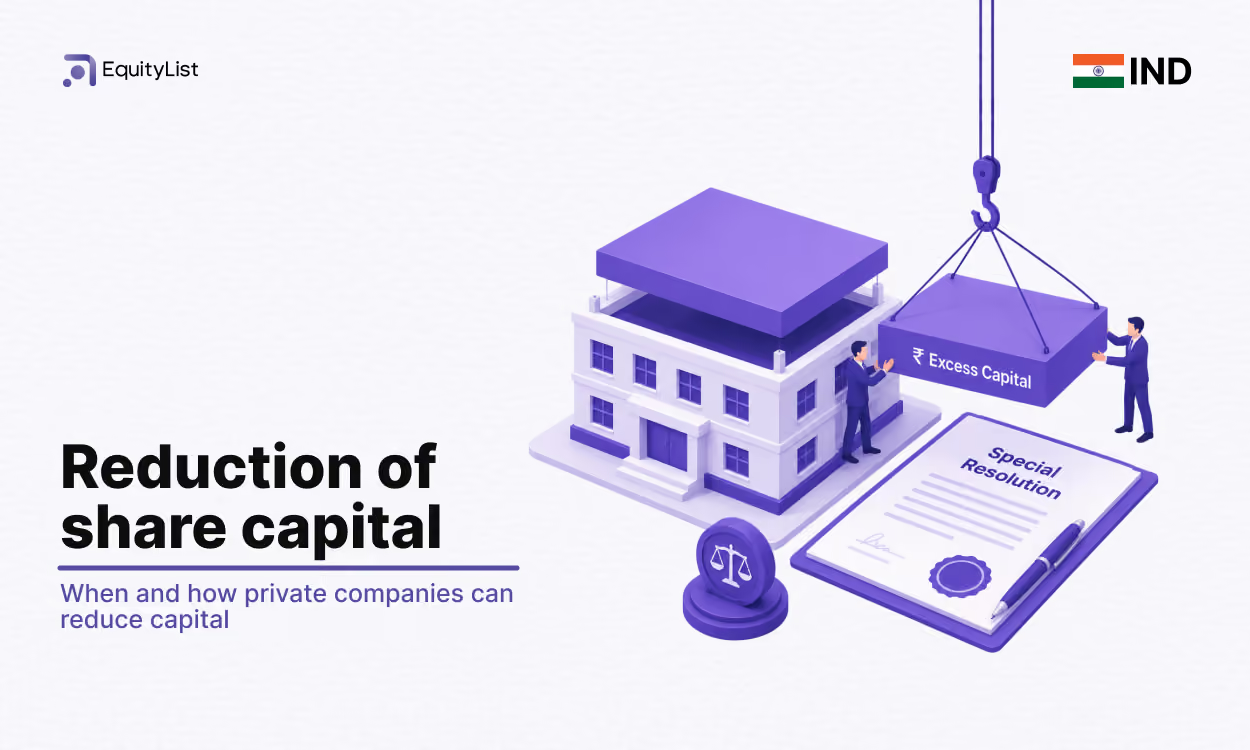
Reduction of share capital is the process of permanently decreasing a company's issued, subscribed, and paid-up share capital. Under Section 66 of the Companies Act, 2013, it requires a special resolution (one where votes cast in favour are not less than three times votes cast against) and confirmation from the National Company Law Tribunal (NCLT) before it takes effect.
How Section 66 differs from a buyback and a capital alteration
A buyback under Section 68 of the Companies Act, 2013 operates under constraints that Section 66 does not share: it can only be funded from free reserves, the securities premium account, or the proceeds of a fresh issue made for that purpose and it cannot exceed 25% of total paid-up capital and free reserves in a financial year. Section 66 carries none of these restrictions, which makes it the relevant route when a Section 68 buyback is structurally unavailable.
Three ways a company can reduce its paid-up capital under Section 66(1)
Section 66(1) permits capital reduction "in any manner" subject to NCLT confirmation, and identifies three specific ways to carry it out.
Extinguishing uncalled liability. Where shares were issued at a face value that has not been fully called up, the company can cancel the remaining unpaid liability.
Cancelling lost capital. Where assets have declined in value below recorded capital, the share capital no longer corresponds to anything real on the balance sheet.
Repaying excess capital. Where the company holds more paid-up capital than its operations require, this mode allows it to return that surplus to shareholders in cash.
Tax treatment of capital reduction payments
When a company reduces capital and pays shareholders, the Income Tax Act, 2025 looks through the form of the transaction. If the company has accumulated profits, payments to shareholders are treated as dividend up to the amount of those profits under Section 2(40)(d) of the Income Tax Act, 2025, and taxed in the shareholder's hands as income from other sources at applicable slab rates.
Amounts above accumulated profits, and above the shareholder's original cost, are taxed as capital gains on unlisted shares: at 20% for holdings under 24 months, or at 12.5% for holdings over 24 months.
Conditions that must be satisfied before filing with the NCLT
Two conditions must be met before the NCLT process can begin.
The company's Articles of Association must give it the power to reduce share capital. If the AoA is silent, it must be amended by special resolution first, which adds a separate general meeting and ROC filing. Companies revising their constitutional documents as part of any restructuring should confirm this power is included.
The company must not be in arrears on any deposit repayment or interest on deposits. This bar under the proviso to Section 66(1) is absolute. No waiver exists. Arrears must be cleared before the reduction can proceed.
{{cta-form}}
Step-by-step NCLT procedure for reducing share capital
Step 1: Board and shareholder approval
The board passes a resolution approving the proposed reduction. Shareholders then pass the special resolution at a general meeting. Form MGT-14 is filed with the ROC.
Step 2: Filing the application with the NCLT in Form RSC-1
The company files with the NCLT along with: a creditor list certified by the managing director (or two directors if there is no MD), prepared no more than 15 days before filing; an auditor's certificate confirming no deposit arrears; and an auditor's certificate confirming the proposed accounting treatment conforms with accounting standards under Section 133 of the Act. The filing fee is ₹5,000.
Step 3: NCLT notice to creditors, ROC, and Central Government
Within 15 days of filing, the NCLT issues notices to the ROC and Central Government (Form RSC-2) and to each creditor (Form RSC-3). The notice must also be published within 7 days in a leading English-language and vernacular newspaper in the state where the company's registered office is located (Form RSC-4), and uploaded on the company's website. The company files an affidavit (Form RSC-5) within 7 days of dispatch confirming the notices went out.
Where all creditors have consented or been paid off or secured, the NCLT may waive the notice requirement under Rule 3 of the NCLT (Procedure for Reduction of Share Capital of Company) Rules, 2016.
Step 4: Obtaining the NCLT order and registering with the ROC
The NCLT's confirming order is issued in Form RSC-6. The company delivers a certified copy of the order and the approved minute to the ROC by filing e-form INC-28 within 30 days of receipt, as required under Section 66(5). The ROC registers the order and issues the completion certificate in Form RSC-7, at which point the reduction takes legal effect.
FAQs on reduction of share capital
What is reduction of issued share capital?
Reduction of issued share capital is the permanent decrease in a company's issued, subscribed, and paid-up share capital. It is distinct from reducing authorised capital, which affects only the ceiling on shares a company may issue. Under Section 66 of the Companies Act, 2013, reducing issued and paid-up capital requires a special resolution and NCLT confirmation. The reduction can work by cancelling shares, reducing their face value, or extinguishing unpaid share liability, depending on the mode chosen.
What is an example of a share capital reduction?
Consider a private company whose shares have a face value of ₹100 each but whose assets have declined such that each share is backed by only ₹70 in assets. The company has ₹30 per share of capital on its books that no longer corresponds to anything real. Under Section 66(1), the company can write off ₹30 per share, reducing the face value to ₹70. No cash changes hands. The balance sheet now accurately reflects the asset base, which clears the path for future dividend distributions that accumulated losses would otherwise block. Separately, a company with surplus paid-up capital it no longer needs can return that capital to shareholders in cash by reducing the face value and paying out the difference.
How to reduce share capital?
Under Section 66 of the Companies Act, 2013, the steps are: confirm the AoA permits capital reduction (amend if not); pass a board resolution approving the proposed reduction; pass a special resolution in a general meeting and file Form MGT-14 with the ROC; apply to the NCLT in Form RSC-1 with a creditor list and auditor certificates; allow the NCLT's notice process to run (creditors have three months to object); obtain the NCLT's confirming order in Form RSC-6; file e-form INC-28 with the ROC within 30 days; receive the ROC's completion certificate in Form RSC-7, at which point the reduction is legally registered. The company must also update its MoA, Register of Members, and cap table to reflect the new capital structure.


.svg)
.svg)