
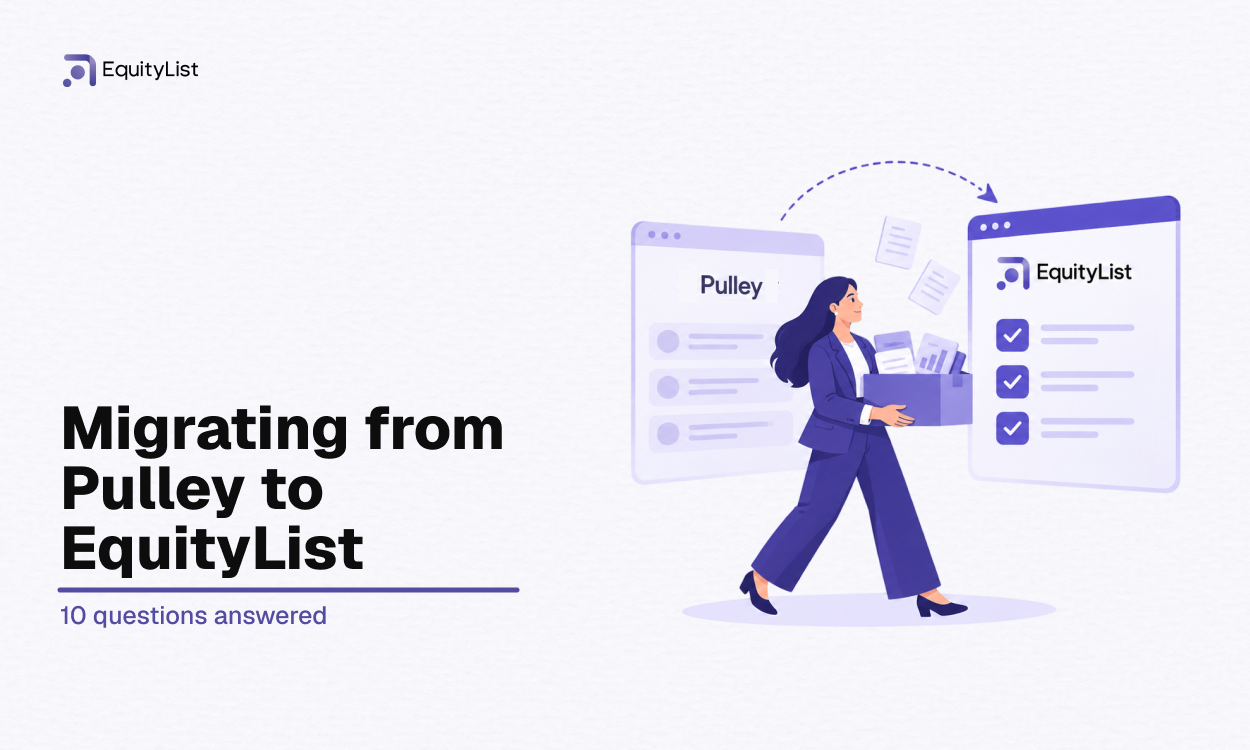
Pulley announced this week that it is shutting down. December 8 is the platform's last day of operation, and every company still using it now has a real decision to make: which platform to move to, what the genuine Pulley alternatives are, and what actually matters when weighing them.
Pulley's own answer is Carta, the rival it spent years competing against. For a lot of teams that will feel like the path of least resistance, since it is the option being handed to you. It does not have to be the only one you consider. Here are the questions that will actually help you decide, whichever way you land.
1. Why EquityList, not just Carta?
Carta is a reasonable default if the goal is the least possible friction. Pulley picked it for you, your pricing carries over for a year, and the path there is already paved. That is worth something. But a forced migration is also the one moment you get to fix things you were already living with, not just relocate them, and Carta is not the only platform built to make that trade worth it.
The real difference isn't the price, it's what's built into the platform. The AI Equity Agent reads your plan documents and acts on them directly. Ask it a question, like what's vested for someone who's leaving, and it answers from your actual data. Give it a task, like issuing a grant, raising an e-sign request, adding an employee, or pulling a report, and it does the work. Your cap table, equity grants, compliance, and investor updates also run on one record here.
The switch itself. When you migrate from Pulley: your contract term carries over, we rebuild your cap table in a sandbox before you commit to anything, and your account will be live in 12 hours.
2. What does EquityList actually do, beyond replacing the cap table?
A cap table on its own is a snapshot. EquityList is built as one system that your cap table, equity grants, compliance, and investor relationships all run through together, so an event in one place does not have to be re-entered somewhere else.
That includes:
- An AI Equity Agent that reads your plan documents and filings and can act on them directly, not just answer questions about them.
- Equity grants across options, RSUs, and SARs, with vesting, exercise requests, and payment reconciliation handled in the platform.
- Multi-entity support if you operate across more than one subsidiary or country.
- Investor dashboards and updates your investors can check themselves, instead of a new spreadsheet emailed out every quarter.
- Data rooms and one-click shareholder and board consents.
- The compliance work, dematerialisation, filings, and audit trails, running on the same record as everything else instead of a separate system you have to update by hand.
3. What does switching actually cost?
Pricing is listed on the site, not something you have to book a call to find out, and it scales with your stakeholder count, how much AI credits you use, and the different features you require. Exact numbers depend on your plan and your geography, so check the pricing page for what applies to you.
For teams moving off Pulley specifically, we match the remaining term of your current contract, so you're never paying for two platforms at once while you transition. On a multi-year plan? Tell us where you are and we'll work out something fair.
4. Who actually does the migration work?
An operator on our team works alongside you, not an automated import that dumps a CSV and hopes for the best. They bring your executed certificates, SAFEs, and grants across as-is, so nothing needs to be re-signed or re-executed. And before you commit to anything, you get a full sandbox rebuild of your cap table to review, so you're not taking our word for it.
5. How long does it actually take?
Live and reconciled on EquityList within 12 hours of us receiving your data, in most cases. It can take longer if you're running multiple entities across different countries, still have convertible notes or SAFEs that haven't converted, or have years of amendments and exercises that need to be reconciled by hand. When that's true for you, we'll give you the realistic timeline during the sandbox review, before you commit to anything.
6. What happens to our 409A?
Your first auditor-supported 409A is included at no cost as part of the move, and every valuation after that is 60% off from Series A onward. Beyond the migration itself, our standard annual Growth plan bundles a 409A valuation in every year, so you're always granting against a current price, not last year's number.
7. Is the AI actually useful, or is it a chatbot bolted on top of the platform?
Fair thing to be skeptical about. A few tools in this category now offer an MCP server, which sounds like AI but really means pulling your cap table out into Claude or ChatGPT and asking questions there. Your register leaves the system, and what you get back is still retrieval: fields that already exist in their database.
EquityList's AI Equity Agent works on the record itself. It reads your plan documents, grant letters, and filings directly, and it acts on them: issue a grant, raise an e-sign request, add an employee, run a dilution scenario, or return your fully diluted cap table from the actual register. You can also set an agent to run on a schedule, so "generate a report every Monday at 10 AM" just happens.
None of this needs your data to leave the platform. We don't ship MCP connectors that pipe your cap table into Claude or another external AI tool. E-signature is built in house for the same reason, so grant letters and consents never route through DocuSign. EquityList is SOC 2 and GDPR compliant.
8. What happens to our existing grants and agreements?
Nothing gets re-papered. Your existing grants, agreements, and consents move across as historical records exactly as they were executed, and everything new is issued on EquityList going forward.
9. What's the catch, why make it this easy?
There isn't one, and the logic is straightforward: if your company has to consolidate onto one platform eventually anyway, the version where switching costs you nothing extra is the version where you actually do it. Every term above reflects that bet, that the product holds up once you're in it, not a limited-time offer with a countdown timer.
10. We're not ready to decide yet. Can we still talk to someone?
Yes. Reach out with questions any time, even if you're only weighing options right now.
Why teams like yours end up here
EquityList runs equity for 650+ companies, 80,000+ stakeholders, and $20B+ in securities under management, across 16 countries, ISO 27001, SOC 2, and GDPR certified. 60% of the companies that migrate to EquityList are coming from Carta, so plenty of people who started on the default end up leaving it.
"The onboarding process was smooth, with the EquityList team efficiently managing the complete migration of our cap table (which includes over 20 investors) and ESOP data for nearly 600 employees."
Karan Vanwani, Strategy, Tabby
Still deciding where to move?
Talk to us directly, book a demo or just ask a question, no obligation if you decide to stay put.

.svg)
.svg)
.svg)

