







Key takeaways
- Cap table management software keeps the record of who owns what current, including every share, option and convertible instrument, with the approval and signed document behind each entry.
- Moving a cap table means reconciling the ledger against incorporation documents, financing agreements and grants, so the platform is hard to replace.
- Cap table platforms vary on the basis of few things like features, pricing, reporting, migration and onboarding.
- EquityList is an AI-native cap table and compliance platform. It covers cap table management, equity grants, shareholder management, valuations, advisory and secretarial compliance for 650+ companies across 16 countries.
- With an AI-native cap table management platform, you can ask its Agent to issue grants, schedule actions and prepare reports without navigating the platform. Every change needs approval before it is finalized.
- EquityList replaces names, tax identifiers and bank details with placeholders before a request reaches an AI model, and the data is not retained or used to train models.
- Carta, Ledgy, Qapita and Cake Equity differ on free tiers, where 409A and expense reporting start. Carta, Ledgy and Cake Equity offer MCP connectors that let outside AI assistants read cap table data.
A cap table changes with every round, grant, exercise, transfer and valuation, and each change needs an approval, a signed document and often a filing behind it.
The platform that holds this record is where founders, finance teams, employees, investors, the board and auditors go to see the company's ownership, so the data, documents and approvals all end up in one place. That makes it costly to reverse, because moving later means reconciling the ledger against incorporation documents, financing agreements and grants before the new platform goes live.
The routine work of issuing a grant, running an exercise or answering an investor's diligence request also happens inside the platform you pick.
This guide compares top 5 cap table management software on how easily each does that work, what each plan includes and costs, and how its AI connects to the record.
How to evaluate cap table management software
Features
Platforms cover different parts of the equity workflow, so list the features you need before comparing vendors. The table below sets out what a cap table management platform can cover, in seven areas.
Jurisdiction and entity coverage
Rules differ by country, so check the platform against where your entities and employees are. US option grants need a 409A valuation and, for incentive stock options, Form 3921 (the IRS statement issued when an employee exercises them). UK option schemes need HMRC filings, French employee share warrants need a BSPCE valuation, and Indian companies need convertible instruments and share dematerialisation (holding shares electronically with a depository).
If you have a parent company and subsidiaries in different countries, you also need a separate cap table and option pool for each entity, rolled up into one view. That is a multi-entity structure.
Pricing and free tiers
Vendors bill by stakeholder, meaning anyone who holds a security or grant on your cap table. The definition varies, so ask who counts (employees, investors, advisors, former employees with options), whether draft grants count, what the free tier is capped on, and what each extra stakeholder costs.
Price the plan at the stakeholder count you expect at your first renewal. Every new hire with a grant and every investor in a round adds one.
Migration and onboarding
Moving means reconciling your current ledger with your incorporation documents, financing agreements, option plans and grants before the new platform goes live. Ask who does that work (you or the vendor), whether transaction history and signed documents come across or only current balances, how long it takes and whether it costs extra, and whether you can check the result before you switch off the old platform.
Cap table management software comparison
Notes on the table: Prices are list prices for annual billing, in US dollars unless stated, as published on each vendor's pricing page on 7 October 2026. All prices are in US dollars so the vendors can be compared directly.
Spreadsheets vs software: what does your equity management cost?
Calculate what managing equity in spreadsheets costs compared with a cap table platform like EquityList.
Calculate your cost
1. EquityList
EquityList is an AI-native cap table and compliance operating system for private and public companies. Its core covers cap table management, equity grants (options, RSUs and SARs, from grant to exercise) and shareholder management. Around that sit 409A and other valuations, equity advisory and secretarial compliance.
Who it's for:
Built for founders, finance teams and HR teams, and for companies whose equity crosses borders. It serves 650+ companies and 80,000+ stakeholders across 16 countries, and manages $20B+ in securities. What you get depends on where you operate:
- India: An electronic share register, dematerialisation services, and valuation reports from registered valuers and merchant bankers.
- United States: 409A valuations, management of ISO, NSO and international grants, and federal exemption tagging.
- Southeast Asia and MENA: Tax slab integration and multi-entity management for holding structures.
- Listed companies: Trading windows, insider pre-clearance and registrar and depository reconciliation after listing.
Features:
- AI built into the register: The Equity Agent works directly on your live cap table. You can ask it questions, or have it issue grants, schedule actions and prepare reports. Every change needs approval before it is written (a maker-checker step: one person proposes, another approves). It reads your equity plans, grant deeds, board resolutions and valuation memos to answer, and replaces names, tax identifiers and bank details with placeholders before a request reaches a model. The data is not retained or used to train models, and the platform is independently audited for SOC 2 Type II and ISO 27001:2022.
- Cap table and instruments: Shares, SAFEs, warrants, debentures, convertible notes and grants all sit on one fully diluted cap table. On Growth and above, each parent and subsidiary keeps its own cap table and pool inside a consolidated view. Indian companies can also move physical share certificates into electronic form through dematerialisation.
- Equity awards and corporate actions: It runs stock options, SARs and RSUs from grant to exercise, covering vesting, exercise requests and payments. You can set post-termination exercise periods (how long a departing employee has to exercise vested options) that vary with tenure, and pause vesting across all of an employee's grants at once. Buyback and tender programmes, built by cohort and run on the live register, come with the Enterprise plan.
- Governance and reporting: The platform collects and tracks board and shareholder consents, and with full audit history available for rescinded or amended consents. Expense and disclosure reporting under Ind AS 102 and IFRS 2 is available with the Enterprise plan.
- Listed companies: After listing, the same register supports trading windows, insider pre-clearance, regulatory filings, and registrar and depository reconciliation.
Starter plan: EquityList is free for up to 10 stakeholders, with paid plans from $1,200/year for 35 stakeholders. Stakeholder billing counts people who hold a security or grant, and draft grants are excluded.
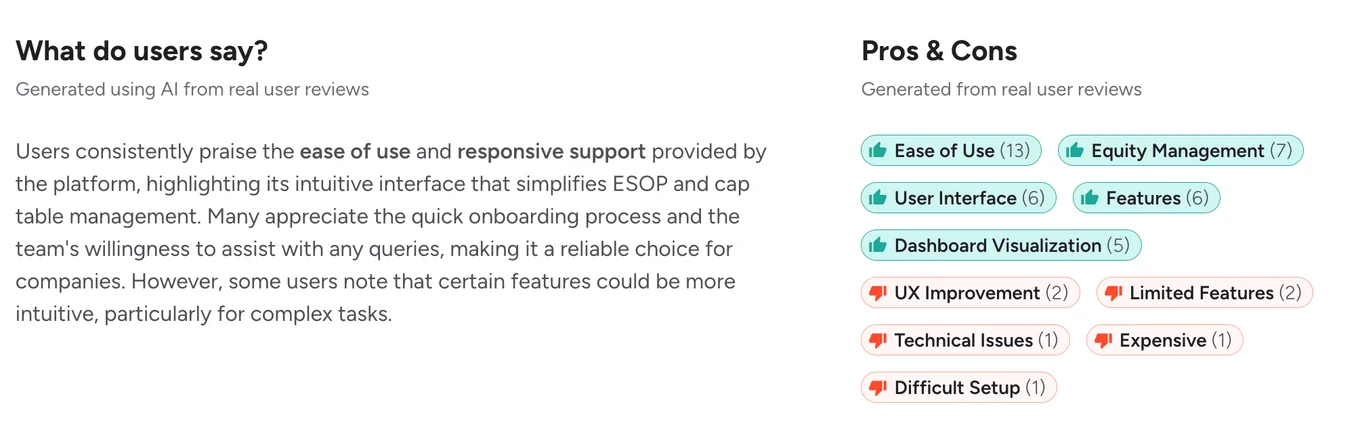
Some AI features depend on your plan: the Free plan answers questions only, and document-reading agents start on Growth. AI usage runs on credits. EquityList also ships often: its product updates page lists 110+ releases, the latest in October 2026.
2. Carta
Carta sells equity management for companies alongside fund administration, CRM and legal services for investors. It is also an SEC-registered transfer agent for US companies, so it can process exercises, repurchases and transfers on your register.
Who it's for:
US companies that want cap tables, 409A valuations, SAFE financings and liquidity from one vendor. It says it is trusted by over 50,000 companies in more than 160 countries. Its transfer agent role also lets it intermediate ACH or wire transfers for exercises and repurchases, and audit support, ASC 718 reporting and IPO advisory sit on the Grow and Scale plans. Those extras are built for larger US companies, and every paid plan is priced per stakeholder with a minimum annual fee, which a small team may not need.
Features:
- Cap table management: Plan page lists no multi-entity cap tables or listed-company administration.
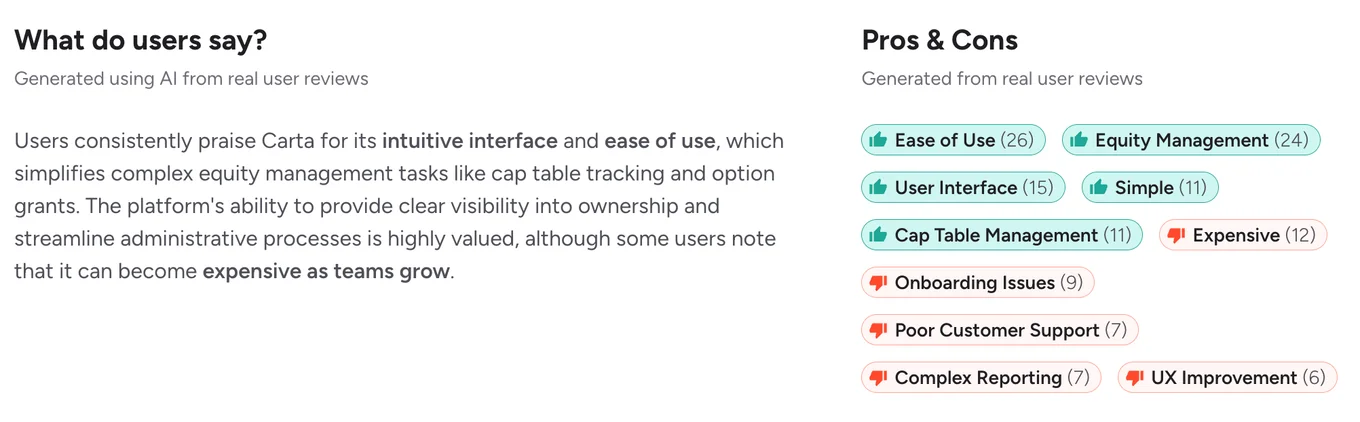
- AI approach: Claude plugin and MCP connector, but no agent inside Carta's own app, so your cap table data passes into your Claude environment. Because the work happens in the user's Claude environment, the records a query returns pass into that environment and are handled under the AI provider's terms.
- Valuations and reporting: 409A from Grow, but ASC 718, IFRS and Rule 701 only on Scale.
- Entities and listing: Pages list no multi-entity cap tables or listed-company administration.
- Price: Carta hasn’t mentioned its pricing on their website but it is known to be relatively expensive.
3. Ledgy
Ledgy's tools centre on UK and European share schemes. The Scale plan lists HMRC filings for UK Enterprise Management Incentive (EMI) option schemes (EMI1 and EMI40), UK Companies House reporting, and independent HMRC, 409A and BSPCE valuations.
Who it's for:
Companies with employees in the UK or Europe. If your main need is US filings, check the plan carefully, because Ledgy's pricing page lists 409A valuations but not Form 3921.
Features:
- Cap table management: Multi-entity is listed, but the data room and full transaction history start at Scale.
- Shareholder management: Pricing page lists no board or shareholder consent workflows.
- Reporting: Custom reporting is on Scale, but full transaction audit trails start at Enterprise, and IFRS 2, FRS 102 and ASC 718 reporting is a separate add-on.
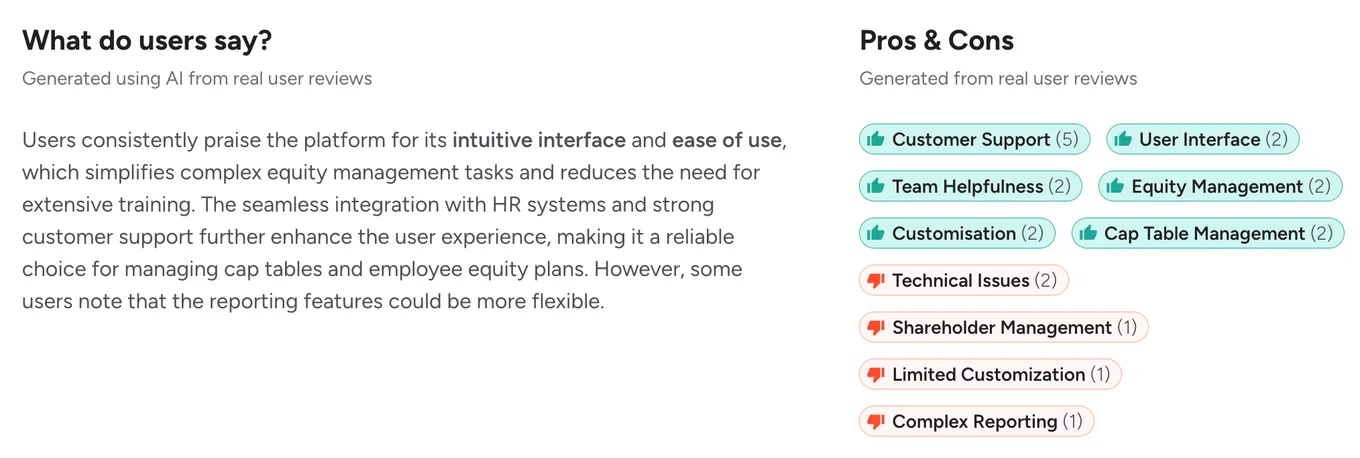
- AI approach: Ledgy Agent works inside the platform with your approval, but the MCP connector is read-only.
- US coverage: Lists 409A valuations, but no US filings such as Form 3921.
- Reporting: IFRS 2, FRS 102 and ASC 718 reporting is a separate add-on.
- Free plan: Pricing page states both 25 and 50 stakeholders.
Starter plan: Ledgy Launch is free, and the first paid plan, Scale, starts at about $5,630/year (€5,000).
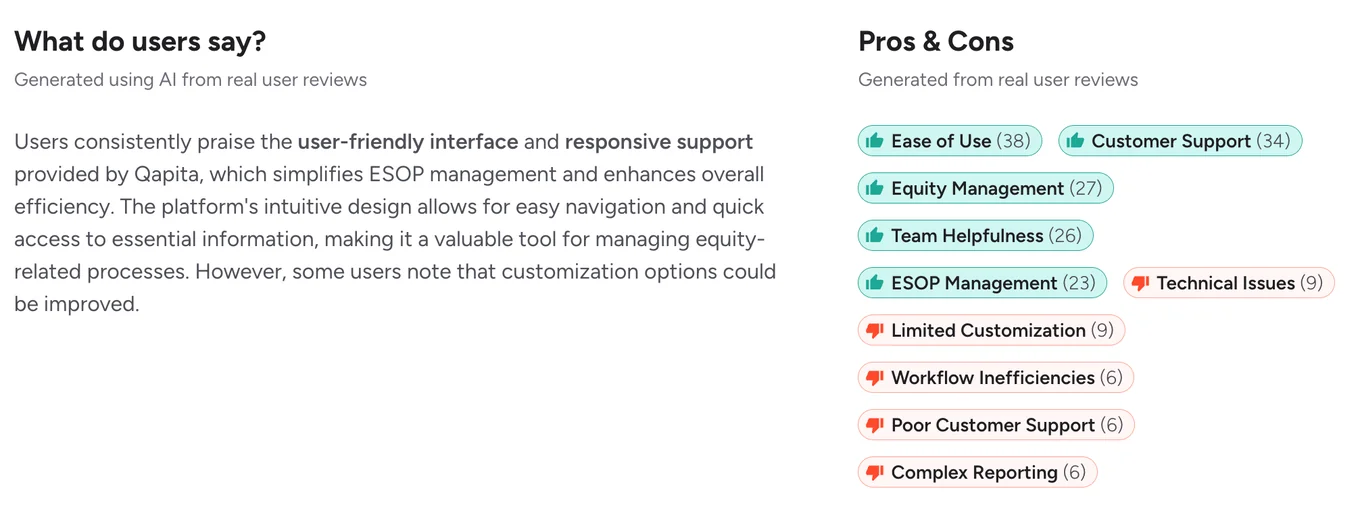
4. Qapita
Qapita's platform covers cap tables, ESOP management and valuations, with added tools for Indian companies.
Who it's for:
Companies in India and Southeast Asia, especially those setting up an ESOP trust in India or an ESOP SPV in Singapore.
Features:
- Cap table management: No multi-entity cap tables listed, and stock splits and other corporate actions are a paid, analyst-run add-on.
- AI approach: Only at onboarding, to parse and validate uploads. No agent or connector listed.
- Stock options management: Exercise and surrender workflows are add-ons on the free Spark plan. The exercise workflow lacks enterprise-level features, such as tax calculation for DPIIT-registered startups (startups recognised by India's DPIIT), which made it hard to run exercises end to end.
- Employee experience: Equity Payslips only on Enterprise, and an add-on on Growth.
- Valuations and reporting: 409A from Growth, ASC 718 and IFRS on Enterprise.
- Entities: No multi-entity cap tables listed.
Starter plan: Qapita Spark is free for up to 25 stakeholders and under $1M raised, and the first paid plan, Surge, is $1,600/year for 40 stakeholders.
5. Cake Equity
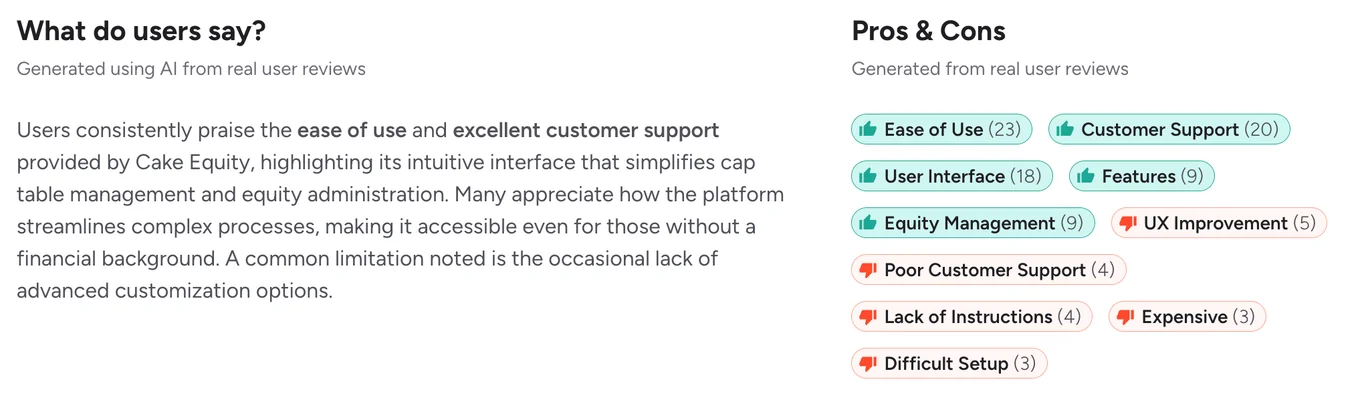
Cake Equity's platform includes cap table management, scenario modelling, an employee app and free migration. For US companies, it also supports 83(b) elections (a US tax election, due within 30 days of receiving restricted stock) and 409A valuations.
Who it's for:
Cake Equity suits pre-seed to Series A startups. It positions Build for pre-seed, Team for seed and Series A, and Pro for complex cap tables.
Features:
- Cap table management: No multi-entity cap tables listed, and SPVs, international option pools and date-based reporting only come with Pro.
- AI approach. Cake's MCP connector, included on Team and Pro, lets Claude, Codex, Cursor and other MCP clients query the live cap table on a read-only basis. Cake also lists an AI document scanner.
- Reporting: 409A on Team and Pro, but ASC 718 only on Pro.
- Scale: No multi-entity or listed-company workflows listed.
Starter plan: Cake Equity's Free plan covers up to 5 stakeholders, and the first paid plan, Build, is $1,000/year for 25 stakeholders.
Choosing the right cap table management software
Because a cap table platform is costly to replace, choose it against where the company is going, not only where its cap table stands today. Start with the jurisdictions and instruments you hold now, then check which plan includes the 409A valuations and expense reporting you need, how migration works, and what the plan costs at the stakeholder count you expect at your first renewal.
Then look at what the platform has to carry later: more entities, buybacks and tender offers, and for some companies a listing.
EquityList is built for that path, with multi-entity cap tables from the Growth plan, buyback and tender programmes on Enterprise, and trading windows and insider pre-clearance on the same register after listing. Its Equity Agent works on that register and requires approval before any change is written.
Want to get started? Load your own cap table and try the Equity Agent or book a demo with the EquityList team to understand the platform's capabilities before signing up.
FAQ on cap table management software
How to manage a cap table?
Managing a cap table means recording every ownership change as it happens (issuances, transfers, option grants, exercises, conversions and buybacks), together with the approval and signed document behind each change. The cap table should be reconciled against the company's statutory share register (the stock ledger for a US corporation, the register of members in India or the UK) after each transaction and before it is shared with investors or auditors. Cap table management software maintains this as a single ledger with an audit trail. EquityList's guide to cap table maintenance covers the routine step by step.
.svg)
.svg)