
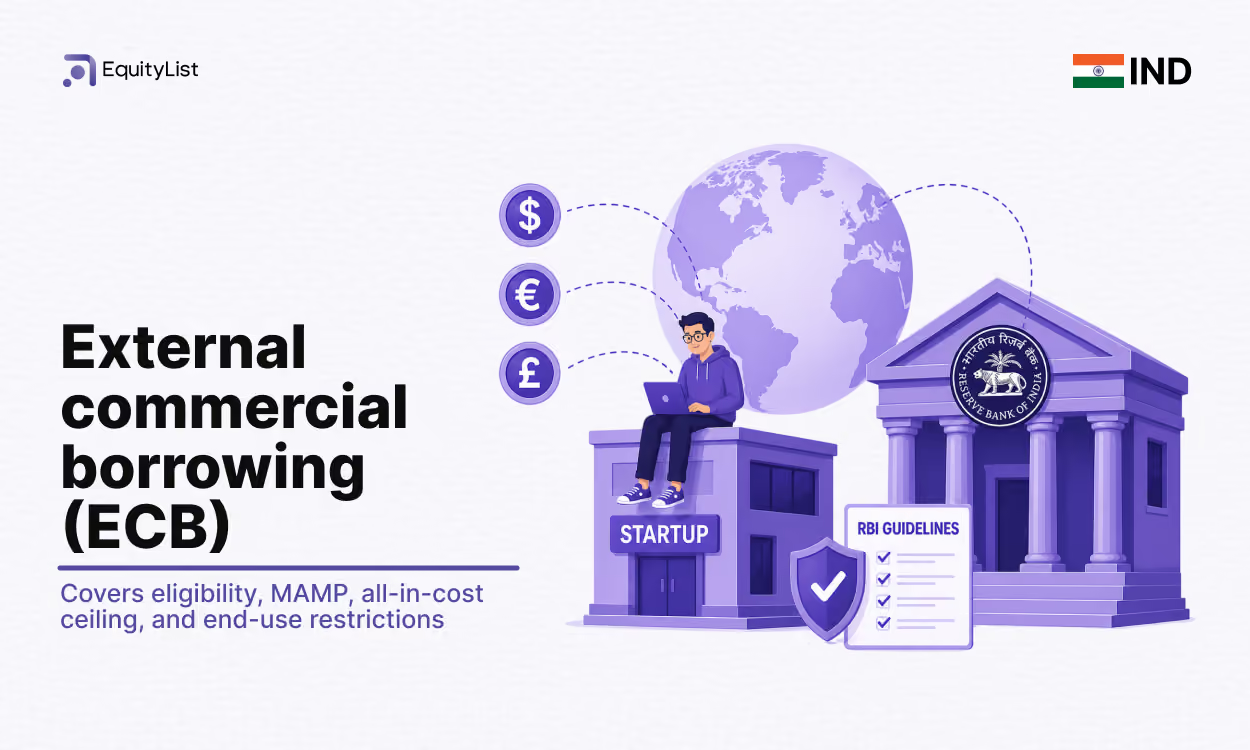
Key takeaways
- External commercial borrowing is a loan raised by an eligible Indian entity from a recognised non-resident lender, governed by the RBI's ECB Master Direction under FEMA, 1999.
- Every ECB is defined by four parameters: currency of borrowing, minimum average maturity period (MAMP), all-in-cost ceiling, and permitted end-uses.
- The general MAMP under the framework is three years, with shorter or longer MAMPs for specific borrower categories and end-uses.
- Earlier, the all-in-cost ceiling was linked to the relevant benchmark rate (RFR for foreign currency ECB and G-Sec yield for INR ECB) plus a prescribed spread. Following the 2026 amendments, ECB pricing has become more market-linked.
- Earlier, the automatic route limit was $750Mn per borrower per financial year. After the amendments, eligible borrowers may generally raise ECB up to the higher of $1Bn outstanding or 300% of net worth, subject to applicable conditions.
- DPIIT-recognised startups have a separate $3Mn annual borrowing limit, broader end-use, and no all-in-cost ceiling.
- ECB is debt and does not change the cap table; FDI is equity and does. The two regimes carry different reporting forms, end-use restrictions, and tax consequences.
What is External Commercial Borrowing (ECB)?
External commercial borrowings are commercial loans raised by eligible resident entities from recognised non-resident lenders, subject to parameters such as minimum average maturity period (MAMP), permitted and prohibited end-uses, and all-in-cost requirements prescribed under the RBI’s Master Direction – External Commercial Borrowings, Trade Credits and Structured Obligations.
The instrument can take several forms (a term loan, foreign currency convertible bonds, foreign currency exchangeable bonds, or trade credit beyond a defined tenor), but the regulatory treatment is broadly similar across them.
The term “non-resident” in this context is defined under FEMA and not under the Income Tax Act. The loan crosses a border and is therefore a capital account transaction, which is why RBI regulates it.
Why is External Commercial Borrowing (ECB) regulated in India?
India runs a managed capital account. Foreign equity inflows are generally treated more liberally because equity does not create a fixed repayment obligation. Foreign debt is treated more cautiously because every foreign-currency loan creates a future outflow of foreign exchange at a date the borrower does not always control.
If left unregulated, large volumes of short-term or high-cost foreign debt could expose both borrowers and the economy to refinancing risk and exchange-rate risk, which can contribute to balance of payments stress. The ECB framework exists to manage this exposure while still allowing Indian entities access to global capital markets.
The four key parameters (currency, maturity, cost, and end-use) are the tools through which the RBI manages India’s external debt profile and foreign exchange risk at a systemic level.
Forms of External Commercial Borrowing (ECB) recognised by RBI
The RBI framework broadly classifies ECBs into:
- Foreign Currency Denominated ECBs (FCY ECBs), and
- Indian Rupee Denominated ECBs (INR ECBs).
Within these categories, the RBI recognises several forms of ECB, including:
- Loans, such as bank loans, securitised instruments, and buyer’s credit beyond prescribed tenors.
- Foreign Currency Convertible Bonds (FCCBs), which are bonds issued in foreign currency that may be converted into equity shares of the Indian issuer at a pre-agreed price.
- Foreign Currency Exchangeable Bonds (FCEBs), which are bonds exchangeable into shares of another listed company within the issuer’s promoter group.
- Trade credits beyond three years for capital goods imports, and beyond one year for non-capital goods.
- Rupee-denominated bonds (Masala Bonds) issued overseas.
The two routes: Automatic and Approval
Every ECB transaction goes through one of two routes.
The Automatic Route allows the borrower to raise ECB without prior RBI approval, provided the transaction satisfies all conditions of the framework (eligible borrower, recognised lender, permitted end-use, prescribed MAMP, and within the all-in-cost ceiling). The borrower obtains a Loan Registration Number (LRN) from RBI through its Authorised Dealer (AD) Category-I bank before drawdown.
The Approval Route applies when the proposed borrowing falls outside the automatic route conditions but the borrower wishes to proceed. This requires a specific application to RBI through the AD bank, and approval is granted case by case.
Who can borrow under External Commercial Borrowing (ECB)
Under the RBI ECB framework, eligible borrowers include entities that are permitted to receive foreign direct investment (FDI), subject to sector-specific and ECB-specific conditions. As a broad rule, if an Indian entity is eligible to receive foreign investment, it will generally also be eligible to raise ECB.
In practice, eligible borrowers include:
- Private limited companies
- Public limited companies
- LLPs permitted to receive FDI
- SEZ units
- Port Trusts
- Small Industries Development Bank of India (SIDBI)
- Certain registered entities engaged in microfinance activities, subject to additional conditions
Certain categories of entities remain ineligible under the ECB framework. The applicable exclusions and conditions should always be checked against the latest RBI Master Direction before structuring a transaction.
Who can lend under External Commercial Borrowing (ECB)
A "recognised lender" under the ECB framework must be a resident of a country that is FATF-compliant and IOSCO-compliant. Recognised lenders include:
- International banks
- International capital markets
- Multilateral financial institutions such as IFC, ADB, and the World Bank
- Regional financial institutions and government-owned development financial institutions
- Export credit agencies
- Suppliers of equipment
- Foreign equity holders, subject to specific conditions on minimum equity holding and debt-equity ratio
- Foreign branches and subsidiaries of Indian banks (only for FCY ECB and only to specified borrowers)
A foreign equity holder may lend to its Indian investee company under the ECB framework if it satisfies RBI’s minimum equity participation requirements. Historically, this has generally required:
- at least 25% direct equity holding in the Indian borrower for ECBs up to $5Mn, and
- for ECBs above $5Mn, compliance with an additional prescribed debt-equity ratio requirement of 4:1.
This lender category is particularly important for startup and group-company financing structures, where foreign parents or investors provide debt funding to Indian subsidiaries alongside equity investment.
The four parameters that define every External Commercial Borrowing (ECB)
Every ECB transaction is defined by four parameters that must hold simultaneously.
1. Currency
ECB may be raised in any freely convertible foreign currency as well as in Indian rupees.
In an INR ECB, the loan is repaid in rupees rather than foreign currency. This means the foreign exchange risk is generally borne by the lender instead of the Indian borrower.
This is operationally significant because an Indian company may earn most of its revenue in rupees but borrow in dollars or another foreign currency. If the rupee weakens, the borrower would need more rupees to repay the same foreign-currency loan amount. An INR ECB avoids this currency mismatch because both the borrower’s revenue and loan repayment are in rupees.
2. Minimum Average Maturity Period (MAMP)
The Minimum average maturity period (MAMP) is the minimum weighted-average period for which the ECB must remain outstanding, calculated based on the timing and amount of principal repayments.
The general MAMP is three years. However, RBI prescribes shorter or longer MAMP requirements for certain categories of borrowers and end-uses. For example:
- ECB raised by manufacturing sector companies up to $50Mn per financial year may have a minimum maturity of one year; and
- ECB raised for working capital, general corporate purposes, or repayment of rupee loans from a foreign equity holder is typically subject to a longer MAMP.
3. All-in-cost ceiling
RBI has removed the earlier all-in-cost ceiling framework, and ECB pricing is now expected to reflect prevailing market conditions. However, for ECBs with a minimum average maturity period (MAMP) of less than three years, borrowing costs must continue to comply with the pricing limits applicable to trade credits (FCY ECB: benchmark + 300 basis points; INR ECB: benchmark + 250 basis points).
4. Permitted end-uses and the negative list
ECB proceeds may generally be used for any lawful purpose except those specifically prohibited under the RBI’s negative list.
Under the current ECB framework, restricted or prohibited end-uses generally include:
- Real estate activities (with defined exceptions for affordable housing and integrated townships)
- Investment in capital markets
- Equity investment
- On-lending for any of the activities above
- Working capital purposes
- General corporate purposes
- Repayment of rupee loans
RBI permits ECB for working capital, general corporate purposes, and repayment of rupee loans in certain cases, particularly where:
- the lender is a foreign equity holder, and
- the prescribed Minimum Average Maturity Period (MAMP) and other applicable conditions are satisfied.
Refinancing of existing ECB is also permitted subject to prescribed conditions.
External commercial borrowing limits: How much an Indian borrower can raise
Earlier, eligible borrowers could raise up to USD 750 million (or its equivalent) per financial year under the Automatic Route. However, the RBI revised this limit in 2026, and eligible borrowers may now raise ECB up to the higher of:
- $1Bn, or
- 300% of their net worth based on the latest audited standalone balance sheet
The borrowing limit applies at the borrower level, not the lender level. Accordingly, the total ECB raised by a borrower from all lenders is aggregated for determining compliance with the applicable limit.
External commercial borrowing framework for startups
The RBI provides a separate ECB framework for startups recognised by the Department for Promotion of Industry and Internal Trade (DPIIT). Under this framework:
- Eligible startups may raise up to $3Mn per financial year
- The minimum average maturity period is three years
- The all-in-cost is to be mutually agreed between the borrower and the lender
- ECB proceeds may generally be used for broad business-related expenditure, subject to applicable restrictions.
This startup framework is materially more flexible than the general ECB framework. However, the precise thresholds and conditions should always be verified against the latest RBI Master Direction before structuring a transaction.
For the specific eligibility criteria and process for DPIIT recognition, refer to EquityList's guide to Section 80-IAC and DPIIT recognition.
External commercial borrowing vs Foreign direct investment
Both ECB and FDI bring foreign capital into an Indian company, but they are regulatory opposites in their treatment.
ECB is debt. The Indian entity has a fixed obligation to repay the principal and interest under defined terms. The capital sits as a liability on the borrower's balance sheet. It does not change the cap table. Reporting is through Form ECB and Form ECB-2, and the loan is tracked through a Loan Registration Number.
FDI is equity. The foreign investor takes shares in the Indian entity. The capital sits as equity on the balance sheet. The cap table changes. Reporting is through Form FC-GPR for primary issuance and Form FC-TRS for secondary transfers, and the investment is tracked through the FIRMS portal of RBI.
FAQs
1. What is net external commercial borrowing?
Net external commercial borrowing is the net inflow of ECB into India over a specified period, calculated as gross ECB drawdowns minus principal repayments during that period. It is a macroeconomic measure used by the RBI in its balance of payments and external debt statistics.
2. What is the maximum ECB limit for Indian borrower?
Earlier, eligible Indian borrowers could raise up to $750Mn (or its equivalent) per financial year under the automatic route. However, the RBI’s 2026 amendments revised this framework, and borrowers may now raise ECB up to the higher of $1Bn outstanding or 300% of their net worth, subject to applicable conditions.

.png)
.svg)
.svg)
.svg)

