
Key takeaways
- The FLA return is a mandatory annual filing with the RBI for Indian entities that have received FDI or made ODI. It captures the foreign investment position of the company as of March 31 each year.
- The filing obligation is triggered by the presence of outstanding foreign assets or liabilities on the balance sheet. Accordingly, even in the absence of fresh FDI or ODI during the year, an entity with prior foreign investment or overseas investment on its books must file.
- The filing deadline is July 15 each year. If accounts are not audited by then, the return must still be filed using provisional figures by July 15 and revised with audited figures by September 30. Non-filing on account of pending audit is treated as a FEMA violation.
- Entities that have made ODI must also file the Annual Performance Report (APR) by December 31 each year. The FLA return and the APR are separate filings monitored by different RBI departments. Filing one does not satisfy the obligation for the other.
- Late filing attracts a flat Late Submission Fee (LSF) of ₹7,500 per return. For non-filing or false filing, penalties under Section 13 of FEMA can reach up to three times the amount involved, or ₹2,00,000 where the contravention amount is not quantifiable, plus ₹5,000 per day for continuing defaults.
What is the FLA return?
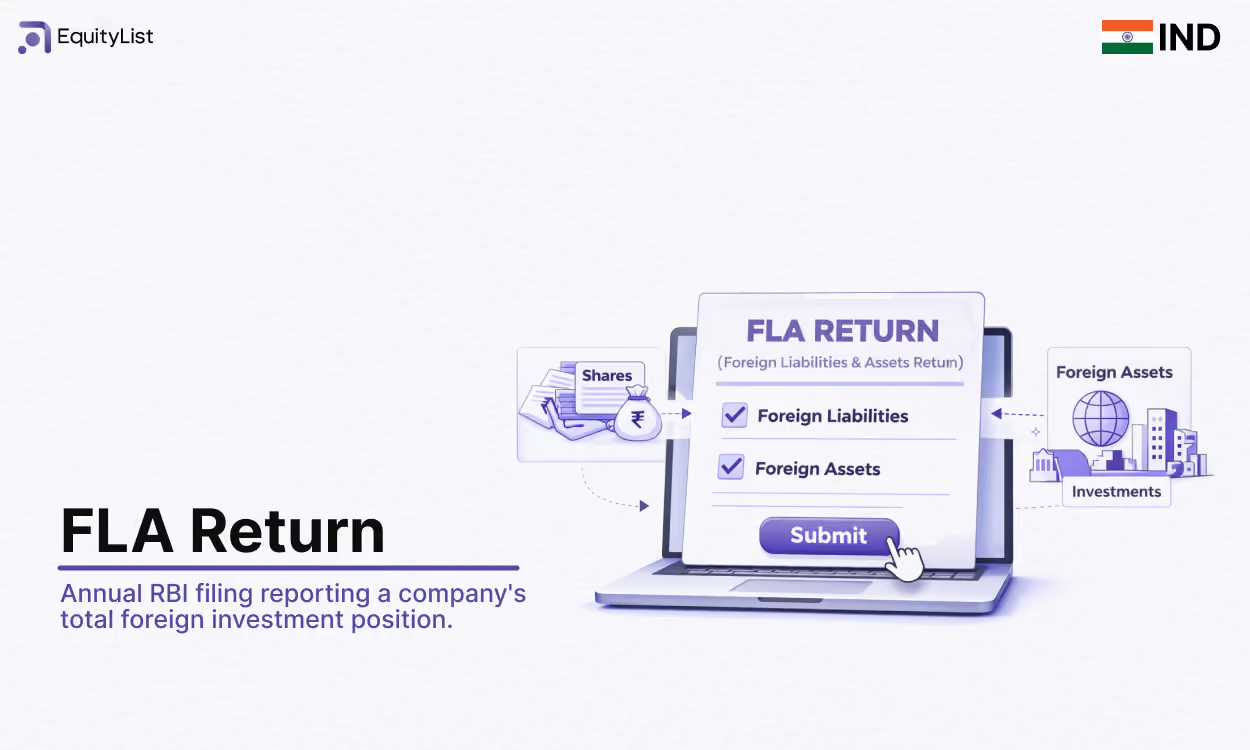
The FLA return is a mandatory annual report submitted to the Reserve Bank of India (RBI). Through it, Indian entities report the foreign liabilities and assets reflected in their balance sheets directly to the RBI. It is a position-based annual return that captures what exists on the balance sheet as on March 31 each year.
The filing obligation is not triggered by a new transaction but by the existence of outstanding foreign investment on the balance sheet at year-end. This is fundamentally different from event-based filings like FC-GPR, which is triggered by each new share allotment to a foreign investor, or FC-TRS, which is triggered by a share transfer.
An entity with no new foreign investment activity in a given year can still have a mandatory FLA filing obligation if outstanding investment from prior years remains on its books.
This return was introduced via A.P. (DIR Series) Circular No. 45 dated March 15, 2011 and is currently governed by the RBI under the Foreign Exchange Management Act, 1999.
The RBI uses the data to compile India's Balance of Payments (BoP) and International Investment Position (IIP), and to participate in the IMF's Co-ordinated Direct Investment Survey (CDIS) and Co-ordinated Portfolio Investment Survey (CPIS). Only consolidated aggregates are published in the surveys while the entity-level information is kept confidential.
Who must file the FLA return?
FLA return is required to be submitted by the following entities that have received Foreign Direct Investment (FDI) and/or made Overseas Direct Investment (ODI) abroad in the previous year(s) including the current year, as per RBI:
- Companies within the meaning of Section 1(4) of the Companies Act, 2013
- LLPs registered under the Limited Liability Partnership Act, 2008
- Others (SEBI-registered Alternative Investment Funds (AIFs) ,Partnership firms, Public-Private Partnerships (PPPs) etc.)
Entities exempt from filing FLA return
Three specific exemptions apply, as per RBI:
- Entities with no outstanding FDI or ODI as on March 31 of the reporting year
- Entities that received only share application money, with no shares allotted as on March 31
- Entities that issued shares to non-residents only on a non-repatriable basis (shares issued on a non-repatriable basis are not treated as foreign investment under FEMA, and entities with only such shares are not required to file)
If all non-resident shareholders have transferred their shares to residents during the reporting period and no outstanding FDI or ODI remains as on March 31, the entity is also exempt for that year.
Section-wise breakdown of FLA return form
The FLA return form is structured into five sections.
The reference period is always April 1 to March 31, regardless of the entity's internal accounting year. Entities whose account closing period differs from March must still report data based on March-end figures, using internal assessments where necessary.
Documents required for FLA return filing
The following documents and information should be available before starting the filing process:
- Audited financial statements as of March 31 of the reporting year. If accounts are not audited before the due date, the return must be submitted based on unaudited or provisional accounts, and a revised return must be filed after audit by September 30 of the same year.
- PAN card of the company and the authorised signatory.
- Certificate of incorporation / registration certificate of the entity.
- Signed authority letter and verification letter in the format prescribed by the RBI, uploaded during FLAIR portal registration.
- Previous year's FLA return, if filed, for reference and continuity.
- Foreign currency conversion data: all foreign currency values should be converted to USD using the RBI reference rate as of March 31 of the reporting year.
- Valuation of foreign securities: listed equity securities should be valued at market price as of March 31, while unlisted securities should be valued based on the latest available financial statements of the investee company.
How to file FLA return on the FLAIR portal
All FLA filings are submitted online through the FLAIR (Foreign Liabilities and Assets Information Reporting) system.
Step 1: Register and log in (first-time filers only)
Go to the FLAIR portal and select "New Entity User" (Company / LLP / Others). The registration process requires entity details and authorised person’s details. Then, there’s a mandatory requirement to upload a signed Authority Letter and a Verification Letter in PDF format, in RBI's prescribed format.
For SEBI-registered AIFs, use the SEBI registration number as the Unique Identification Number (UIN) in place of a CIN.
Login credentials are sent to the registered email address. The initial password must be changed within 24 hours of receipt. The authorised person can access the portal using the credentials (login id and password) along with an OTP sent to the registered email.
Note: Since partnership firms do not have a CIN, the RBI issues a dummy CIN on request, which is used solely for the purpose of FLA filing. Firms must request this dummy CIN from the RBI before registering on the FLAIR portal.
Step 2: Navigate to the form
Click "FLA Online Form" and then "Start Filing FLA Form." Section I identification fields are pre-filled from the registration data. For Section I, furnish details like:
- The nature of business, as per NIC-2008 code, corresponding to the entity's primary revenue-generating activity
- The identification of the reporting company (in terms of FDI)
Step 3: Enter capital and shareholding details
Section II moves into ownership and capital structure, which requires:
- Total paid-up capital
- Number of shares
- Foreign shareholding %
If the entity has selected foreign holding above 50%, the paid-up capital and shareholding figures in Section II must reflect that consistently. The section also requires the following data from the entity's financial statements:
- Profit before tax
- Profit after tax
- Dividends (if any)
- Reserves and surplus
- Sales and purchase during the year
- Number of employees
If the balance sheet is not finalised by 31 March, then the authorised person can:
- File on a provisional basis, and
- Later revise the return once accounts are finalised
All amounts must be entered in ₹ lakh. For example, ₹29,00,000 should be entered as 29, not 29,00,000. Entering full numbers instead of lakhs can create huge errors, so double-check this before proceeding.
Step 4: Add foreign investor(s) details
Section III asks for details of foreign investors where the authorised person needs to specify:
- Number of foreign investors
- Date of first investment
- Name of investor
- Country
- % shareholding
- Type of capital
If there’s one foreign investor, enter 1, and if there are multiple investors, enter the total number and provide details for each accordingly.
Step 5: Fill other relevant details
Depending on the company, the authorised person may need to fill:
- ODI (Overseas Direct Investment)
- External borrowings
- Trade credits
If something is not applicable, they can skip or mark it accordingly. For example, if there is no overseas investment, then no ODI details are needed.
Step 6: Validate and submit
After completing all sections, a summary page appears. It’s the final checkpoint, where the authorised person will:
- Cross-check all numbers
- Confirm shareholding
- Verify financial data
The system will also ask for confirmation, so don’t rush this step. Once everything looks correct, click “Submit”.
Step 7: Revise (if needed)
If the return was filed with provisional data, or if an error needs to be corrected, a revision can be requested. The authorised person needs to:
- Enable multiple-year option
- Enter previous return reference number
- Raise a revision request
This request goes to the Reserve Bank of India for approval. Once approved, the authorised person can edit and refile.
FLA filing deadlines
The July 15 deadline is fixed. It applies to all eligible entities, regardless of whether their accounts have been audited by that date.
How to handle unaudited filing
If the audit is complete before July 15, file with audited figures.
If the audit is pending, file with provisional or unaudited figures by July 15, and flag them as provisional within the portal. Once the audit is complete, file a revised return by September 30.
Non-filing on the grounds that accounts are not yet audited is treated as a FEMA violation.
Penalty for non-filing of FLA return
Non-filing of the FLA return is a violation of FEMA 1999. For FLA returns, the LSF is a flat fee of ₹7,500 per return, as prescribed under A.P. (DIR Series) Circular No. 16 dated September 30, 2022 and other penalties apply as per Section 13, FEMA 1999.
The following additional conditions apply:
- The option to pay LSF is available only up to three years from the original due date of filing.
- If an advice for payment of Late Submission Fee (LSF) is issued and the fee is not paid within 30 days, the advice becomes null and void, and any payment made after this period will not be accepted.
- If a person neither files the return within time nor regularises the delay through LSF, the matter may be liable for penal action under Section 13 of the Foreign Exchange Management Act, 1999.
How the FLA return fits within the FEMA reporting framework
The FLA return is one of several mandatory FEMA filings applicable to entities with foreign investment. Each filing has a distinct purpose, portal, deadline, and trigger.
Common mistakes in FLA filing and how to avoid them
Not filing because no new investment occurred this year
The obligation is based on outstanding FDI or ODI as on March 31, not on new transactions. Entities that received FDI in any prior year and still hold foreign shareholders must file every July 15 until that investment is fully divested.
Skipping filing because accounts are not yet audited
Filing with provisional figures by July 15 and revising by September 30 is the prescribed approach under RBI. Non-filing is a FEMA violation regardless of audit status.
Not reporting indirect foreign investment
Where a foreign investor holds shares in an Indian entity through another Indian entity (downstream investment), the investment is still treated as foreign investment and must be reported. Indirect foreign holdings are a common omission.
Filing FLA without filing APR
Entities that have made ODI must file both the FLA return and the Annual Performance Report. These are separate filings with separate deadlines (July 15 and December 31 respectively) and are monitored by different departments within the RBI.
Closing thoughts
The FLA return is straightforward in principle: report what FDI and ODI exists on the balance sheet as on March 31, file by July 15, repeat every year. But the gaps show up because investor-wise shareholding data is scattered, ODI positions are not tracked centrally, and the July deadline arrives before the audit is complete.
Entities that maintain structured investment records throughout the year file accurately, on time, and have fewer revisions to chase. For companies managing multiple rounds of foreign investment or cross-border positions, this means having a live record of foreign shareholding by investor, instrument, and country that maps directly to what the FLA return asks for.
EquityList helps companies maintain accurate cap tables and investment records, including investor-wise foreign shareholding history, that make annual FLA filing effortless.
FAQs for FLA return
What is the cost of filing the FLA return?
There is no government fee for filing the FLA return. The FLAIR portal is free to use. The only cost that arises is in the case of late filing.
What is the due date for filing FLA?
The FLA return must be filed annually by 15th July of each year, reporting the position of foreign liabilities and assets as on 31st March of the relevant financial year. If the accounts are not audited before the due date, the return must be submitted based on unaudited or provisional accounts. Once the accounts are audited, a revised FLA return should be submitted by 30th September of the same year.
Is the FLA return required if the foreign investor has exited?
It depends on the March 31 position. If a foreign investor has transferred all their shares to an Indian resident during the reporting period and no outstanding FDI or ODI remains on the balance sheet as on March 31, the entity is not required to file the FLA return for that year.
If the exit happened after March 31, the investment is still outstanding as on the reference date and the FLA return must be filed for that year. The obligation ends only when the balance sheet as on March 31 reflects no outstanding foreign investment.
Can the FLA return be revised after submission?
Yes. If the return was filed using provisional or unaudited figures, a revision must be submitted by September 30 of the same year once audited accounts are finalised.

.png)

.svg)
.svg)
.svg)


