
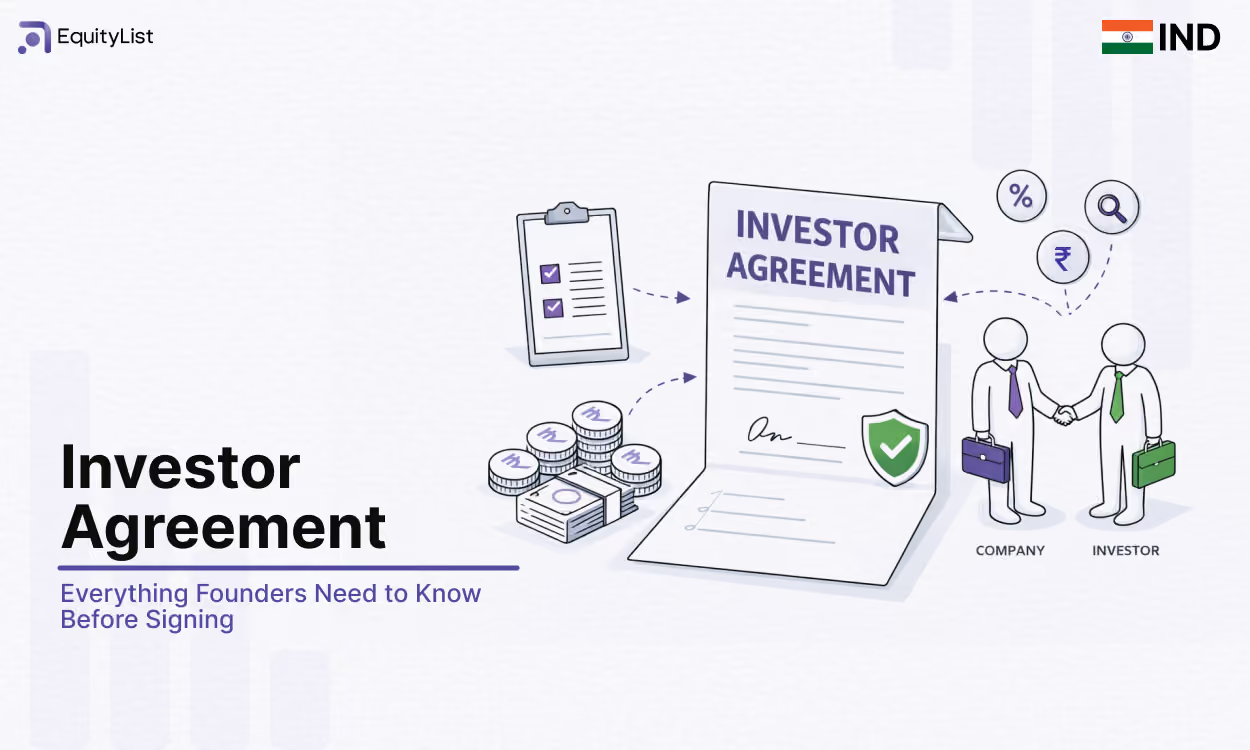
What is an investor agreement?
An investor agreement is a contract that formalizes an investor’s rights in a company.
In India, it is not a single, standardized document with a fixed format. Instead, the term “investor agreement” is commonly used by founders and investors to describe the set of contractual rights an investor receives when investing in a company.
It is neither a statutory document prescribed under the Companies Act nor a standard form used across all transactions. These rights are usually recorded in:
- A Share Subscription Agreement (SSA), which documents the investment itself, and
- A Shareholders’ Agreement (SHA), which governs ongoing rights, control, and exit mechanisms.
Together, these documents are commonly referred to as the investor agreement.
Is an investor agreement the same as a shareholders’ agreement?
No.
An investor agreement is not a specific document defined under Indian law. It is an umbrella term used to describe the set of rights an investor receives when they invest in a company.
A Shareholders’ Agreement (SHA), on the other hand, is a specific legal contract. In most Indian startup transactions, it is the document where those investor rights are actually written and enforced.
In practice, when founders and investors refer to the “investor agreement”, they usually mean the Shareholders’ Agreement, often read together with the Share Subscription Agreement (SSA) that records the investment itself.
Types of investor agreements used by companies
The term “investor agreement” is often used broadly to refer to the way an investment is structured, with each type of investment accompanied by investor rights that are documented in formal agreements.
The most common ways companies structure investments include:
1. Equity investment agreements
In an equity investment, the investor purchases shares directly in the company at an agreed valuation. The investment terms are recorded through a Share Subscription Agreement (SSA), while ongoing rights and protections are typically documented in a Shareholders’ Agreement (SHA).
This structure is common in priced funding rounds and institutional investments.
2. Convertible note agreements
A convertible note starts as debt and converts into equity at a later stage, usually during a future funding round. While the note governs the conversion mechanics, rights related to information access or consent are often addressed through separate agreements.
Convertible notes are frequently used in early-stage or bridge rounds.
3. SAFE (Simple Agreement for Future Equity)
A SAFE (Simple Agreement for Future Equity) allows an investor to provide capital to a company today in exchange for the right to receive equity at a later financing event, without fixing a valuation at the time of investment.
Unlike convertible notes, SAFEs are not structured as debt and do not carry interest or a repayment obligation. This makes them simpler in form, but also means that many investor protections are deferred until the SAFE converts into equity.
4. Debt investment agreements
In a debt investment, the investor lends money to the company with an obligation to repay, usually with interest. These agreements focus on repayment terms, security, and default provisions rather than ownership or governance rights.
Debt is more common in mature or cash-generating businesses.
5. Strategic or minority investment agreements
In a strategic investment, the investor may get extra rights related to business partnerships, exclusivity, or involvement in operations. These rights are usually added on top of the standard Share Subscription Agreement (SSA) and Shareholders’ Agreement (SHA).
What founders should pay attention to in an investor agreement?
For founders, the real risk in investor agreements comes from underestimating how long investor rights last and how broadly they apply.
1. Investor rights come from contracts, not shareholding
Many first-time founders assume that an investor’s influence over company decisions is roughly proportional to their shareholding. In reality, this is often not the case.
While share ownership primarily determines economic rights, many control and protection rights, such as vetoes, information access, and board representation, are created through contracts
For example: An investor holding only 10% equity may still have the contractual right to block certain actions if those actions fall under “reserved matters”, such as raising new capital, appointing senior management, or changing the business plan.
2. Governance and control matter more than valuation
Founders should pay close attention to clauses affecting:
- board composition and observer rights
- reserved matters requiring investor consent
- decision-making thresholds
3. Information and reporting obligations are operational commitments
Information rights are often treated as harmless, but they create ongoing obligations.
Before agreeing, founders should consider:
- how frequently information must be shared
- how detailed the reporting needs to be
- whether the company can realistically comply as it scales
4. Exit rights set the endgame early
Exit-related clauses, such as tag-along, drag-along, and liquidation preferences, determine who controls the outcome if the company is sold or restructured.
Founders should understand:
- when investors can force or block an exit
- how proceeds are distributed
- the expected timelines for an exit
5. Early agreements create precedent
The rights you give to early investors often set the baseline, and future investors usually expect the same or stronger rights in later rounds.
A useful way to read any investor agreement is to ask:
If this clause is exercised in the worst-case scenario, can the company still operate?
If the answer is no, the clause deserves deeper discussion, regardless of how “market standard” it sounds.
Final thoughts
Investor agreements do more than record an investment, they shape control, rights, and expectations for years to come. Founders should focus not just on valuation, but on governance, operational obligations, and exit provisions. Reading each clause carefully and considering its worst-case impact helps protect both the company and its long-term growth.
.svg)
.svg)
.svg)

