







Key takeaways
- Non-convertible preference shares (NCPS) carry fixed dividend rights and a mandatory cash redemption at maturity. The investor never receives equity shares. The return is fully predictable from the date of issuance.
- Under Section 55 of the Companies Act, 2013, all preference shares must be redeemed within 20 years of issuance. Infrastructure companies may extend this to 30 years, subject to annual minimum redemptions from year 21. Redemption must be funded from distributable profits or fresh issue proceeds, not borrowed fund
- When redemption is funded from profits, the company must transfer an amount equal to the nominal value of the redeemed shares to a Capital Redemption Reserve.
- Under the Foreign Exchange Management (Non-Debt Instruments) Rules, 2019, NCPS is classified as debt because it never converts to equity.
- Under Ind AS 32, NCPS with a fixed redemption obligation is recorded as a financial liability, not equity. The dividend on NCPS is recognised as interest expense in the income statement, which increases reported borrowing costs and affects leverage ratios.
What are non-convertible preference shares (NCPS)?
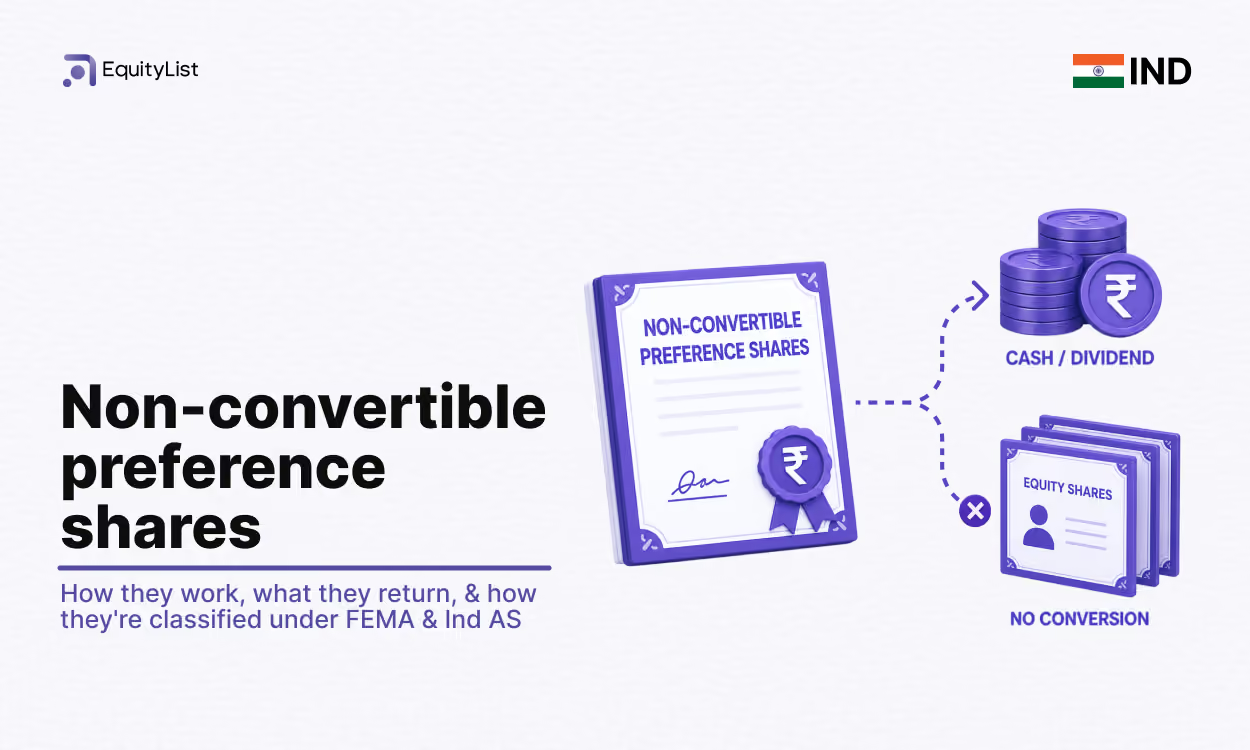
Non-convertible preference shares (NCPS) are a class of preference share that pays a fixed dividend and is redeemed in cash at the end of a defined term. The investor never receives equity. The company never converts the shares into equity. At maturity, the company pays back the agreed amount and the shares are cancelled.
That single characteristic (no conversion to equity, ever) separates NCPS from the compulsorily convertible preference shares (CCPS). CCPS is designed to eventually become equity. NCPS is designed to remain a fixed-return instrument from the day it is issued to the day it is redeemed. In economic substance, it behaves more like structured debt than like equity.
What makes a preference share "non-convertible"
Under Section 43(b) of the Companies Act, 2013, a preference share carries two rights that equity shares do not: the right to receive dividends at a fixed rate before equity shareholders are paid, and the right to repayment of capital before equity shareholders on winding up.
NCPS satisfies both of those conditions. The "non-convertible" part simply means the terms of issue specify that the shares will never convert into equity shares. The investor's only exit from the instrument is cash, paid by the company on the redemption date.
NCPS can be structured in different ways within that constraint:
- Cumulative or non-cumulative. Cumulative NCPS carries forward unpaid dividends to future years until the company has sufficient profits to pay them. Non-cumulative NCPS does not. If the dividend is not declared in a given year, that year's entitlement is permanently lost.
- Participating or non-participating. Participating NCPS gives the holder a right to share in surplus profits beyond the fixed dividend. Non-participating NCPS caps return at the fixed dividend only.
Each combination produces a different risk and return profile. But across all variants, the investor exits in cash, not in shares.
How an NCPS investor makes returns
An NCPS investor's return comes from two places: dividends during the tenure, and the redemption payment at maturity.
- Dividends. The fixed dividend rate is specified at issuance, expressed as a percentage of the face value. This dividend is paid from distributable profits. The company must have sufficient profits before it can be declared. If profits are insufficient in a given year, a cumulative NCPS carries those arrears forward. A non-cumulative NCPS does not.
- Redemption proceeds. On the agreed redemption date, the company pays the investor the subscription price plus any premium agreed at issuance, plus accumulated dividend arrears if applicable. The shares are cancelled. The investor exits in cash with a return that was entirely predictable from day one.
- Priority on liquidation. If the company winds up before the redemption date, NCPS holders rank above equity shareholders in the distribution of assets. They rank below secured and unsecured creditors.
The 20-year limit on NCPS
Section 55 of the Companies Act, 2013 prohibits companies from issuing irredeemable preference shares. Every NCPS must be redeemed within 20 years of issuance.
One exception applies to companies engaged in infrastructure projects (as defined in Schedule VI of the Act). These companies may issue preference shares for up to 30 years, provided at least 10% of the shares is redeemed per year from year 21 onwards, at the option of the preference shareholders.
The company may only fund it from two sources: distributable profits, or the proceeds of a fresh share issue made specifically for that purpose. Borrowed funds cannot be used for redemption.
When redemption is funded from distributable profits, the company must transfer an amount equal to the nominal value of the redeemed shares to a Capital Redemption Reserve (CRR). The CRR preserves the company's capital base after the shares are cancelled. The redeemed capital cannot subsequently be distributed as dividends to equity shareholders. If a redemption premium was agreed at issuance, that premium is charged against the company's profits or securities premium account separately, before the redemption happens.
NCPS and foreign investors: why it matters
Under the Foreign Exchange Management (Non-Debt Instruments) Rules, 2019, only instruments that are fully and mandatorily convertible into equity qualify as equity instruments for the purposes of foreign direct investment (FDI). CCPS passes this test because conversion is compulsory. NCPS fails because the shares never convert at all.
The consequence is that NCPS held by a foreign investor is classified as debt under FEMA. It falls under the External Commercial Borrowing (ECB) framework, which imposes caps on eligible borrowers, ceilings on the all-in interest cost, minimum average maturity requirements, and restrictions on permitted end-uses. These constraints do not apply to CCPS invested through the FDI route.
NCPS issued to resident investors is not subject to these FEMA constraints. The ECB classification applies only to non-resident holders.
How NCPS appears on the balance sheet
Under Ind AS 32, Financial Instruments: Presentation, the classification of a financial instrument as equity or liability depends on economic substance, not legal form.
The test is whether the issuer has an unavoidable obligation to deliver cash. NCPS with a fixed redemption date and a mandatory redemption obligation satisfies this test. The company is contractually required to pay the investor on the redemption date regardless of its financial position at that time. The fact that the instrument is called "share capital" in the articles does not change the accounting result.
Under Ind AS, NCPS is recognised as a financial liability on the balance sheet, not as equity.
NCPS vs CCPS
Issuing NCPS: the procedural requirements
The issuance process for NCPS in a private company follows the standard preference share procedure under the Companies Act, 2013 and Rule 9 of the Companies (Share Capital and Debentures) Rules, 2014.
a. The company's Articles of Association (AoA) must authorise the issue of preference shares.
b. A special resolution (where votes in favour are not less than three times the votes cast against) must be passed in a general meeting.
c. The explanatory statement must disclose the terms of issue and redemption.
d. The resolution must be filed with the Registrar of Companies in Form MGT-14 within 30 days of passing.
e. On allotment, Form PAS-3 (return of allotment) must be filed within 30 days.
f. For a preferential allotment, a valuation report from a registered valuer is required.
For listed public companies, NCPS issued through a public offer or private placement for listing is additionally governed by the SEBI (Issue and Listing of Non-Convertible Redeemable Preference Shares) Regulations, 2013, last amended August 2021. Under Regulation 4(4) of those Regulations, non-convertible redeemable preference shares (NCRPS) cannot be issued to provide loans to or acquire shares of any person in the same group or under the same management, other than subsidiaries of the issuer.
A detailed walkthrough of the preference share issuance process for private companies is covered in the EquityList post on preference shares in India.
FAQs on non-convertible preference shares
What is the difference between convertible and non-convertible preference shares?
Convertible preference shares can be exchanged for equity shares at a future date, either compulsorily (CCPS) or at the holder's option (OCPS). Non-convertible preference shares carry no such right. They remain as preference shares for their entire tenure and are redeemed in cash on the agreed maturity date. The investor in convertible shares exits as an equity shareholder; the investor in non-convertible shares exits as a creditor receiving a cash payment.
What is the difference between convertible and non-convertible securities?
Convertible securities (whether preference shares or debentures) include a right to exchange the instrument for equity shares on defined terms. Non-convertible securities carry no conversion right and are redeemed entirely in cash at maturity. In India, the distinction matters significantly under FEMA: only fully and compulsorily convertible instruments qualify as equity for foreign direct investment purposes. Non-convertible instruments are classified as debt and fall under the External Commercial Borrowing framework for foreign investors.
.avif)
.svg)
.svg)