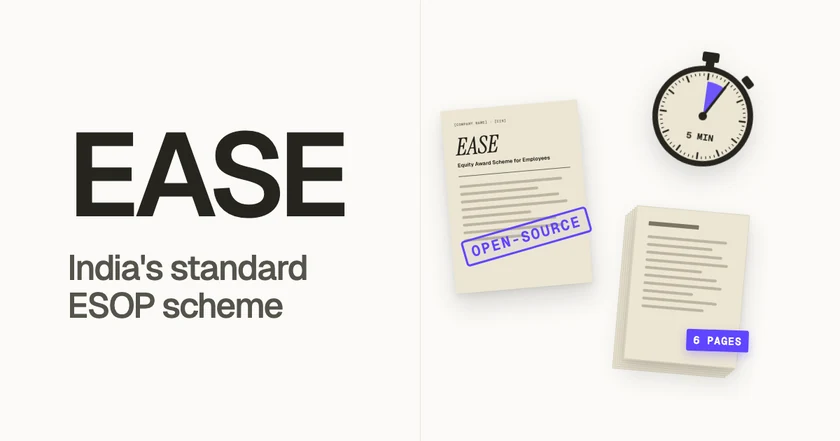





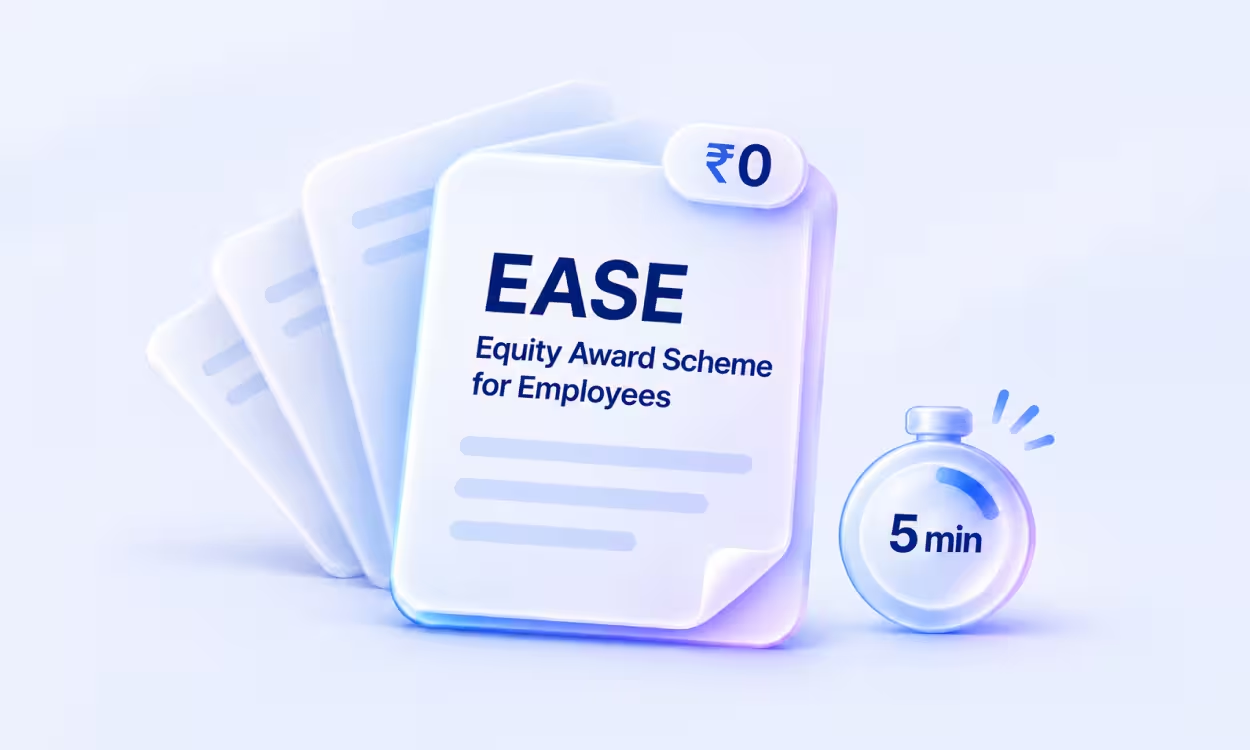
Today, we're launching EASE™ (Equity Award Scheme for Employees), a standard ESOP scheme for Indian private limited companies. Think of it as Y Combinator's SAFE, but for ESOPs: one short document that every founder, hire and investor reads the same way.
EASE is free at ease.equitylist.co, and it always will be. More than 20 companies used it through early access before today's launch.
With EASE, founders get:
- Free, forever. Law firms charge ₹1 lakh to ₹5 lakh to draft what is usually a boilerplate scheme. EASE costs nothing.
- Days, not months. Drafting, reviews and approvals eat up weeks while promised grants wait. EASE is board-ready the moment you download it.
- One short scheme everyone can read. At 2,889 words, EASE is less than half the length of the median real scheme.
- Verifiable by anyone. Upload any scheme at ease.equitylist.co/verify-scheme and see exactly which clauses differ from EASE.
- In sync with your Articles and SHA. Most schemes contradict the Articles or the investors' latest SHA, and those conflicts stall administration. EASE defers to both, so it stays fair to every stakeholder.
- Room to grow. Raise the pool with an amendment letter, not a new scheme. A Board-appointed Administrator approves grants, so the Board doesn't have to convene.
We benchmarked EASE against 237 ESOP schemes adopted by Indian startups, scoring every one on the same five-category rubric. EASE scored 4.84 out of 5. The best real scheme scored 4.45, and the average was 3.60. The full method is on the benchmark page.
Why most ESOP schemes fall short
Founders promise equity to early hires all the time. Most know they need an ESOP pool. Far fewer know the pool needs a scheme behind it, and without one, the promise has nothing backing it: no approvals, no grant letter, no record.
Getting a scheme in place today is slow and expensive. A founder finds a law firm, waits for a 17 to 30 page document, and pays anywhere from ₹1 lakh to ₹5 lakh for what is usually a boilerplate document. Then come the Board and shareholder approvals. The whole process takes weeks, often months, while hires wait for grants they were promised and trust quietly erodes.
The finished schemes often have problems of their own. They're drafted in isolation from the company's SHA and Articles, so the documents contradict each other. And the gaps surface in due diligence, when they're slowest and most expensive to fix.
Working with 650+ companies on their equity, we've seen these problems come up again and again, and our benchmark puts numbers to them. Most of the 237 schemes we scored work, but only just: 80% rated "adequate." These defects came up most often:
- 47% hard-code tax and legal citations that go stale.
- 42% leave out the promoter and independent-director exclusion.
- 20% let the Board set its own fair market value.
- 19% leave unfilled placeholders in the final document.
- 15% run past 9,000 words.
EASE has none of these defects.
What the SAFE did for fundraising, EASE does for ESOPs
Before Y Combinator's SAFE, every early round meant fresh legal drafting and a new round of negotiation. Then one short agreement became the standard, and founders and investors stopped re-arguing the same terms.
ESOP schemes in India never had that moment. Each one is still drafted from scratch, long and slightly different every time.
A few principles shaped every clause:
- Sensible defaults, not hard constraints. Four-year vesting with a one-year cliff and exercise at face value are what most companies would choose anyway. You can adjust the vesting period and frequency, exercise price and post-exit exercise window; everything else is standard on purpose.
- Key terms upfront. The terms that matter most are shown first, not buried on page 22.
- Fair to everyone at separation. Clear good-leaver and bad-leaver treatment, a workable post-exit exercise window, and no unreasonably harsh forfeiture.
EASE is licensed under CC BY-ND 4.0, which means anyone can use and share it, but no one can distribute a modified version. Companies fill in only the blanks and bracketed terms.
Being a standard also means EASE is deliberately narrow. It's built for early-stage Indian private companies adopting their first ESOP plan in their formative years. It isn't meant for companies that want a scheme tailored to their own requirements, companies looking to issue SARs, or listed companies. If your needs outgrow EASE, you can always move to a tailored scheme later.
Built from years of drafting and advising on Indian ESOP schemes
At EquityList, we've spent years drafting ESOP schemes for Indian companies, advising founders on them, and running grants under them once they're adopted. We also see many founders borrow a scheme from a founder friend or generate one with AI, then adopt it without being sure what it actually says. That uncertainty is why we wanted to build a standard in the first place.
EASE is the scheme we wished every company had started with. We drafted it in-house, had it reviewed by lawyers at venture capital firms, and refined it with feedback from the startups that used it in early access.
Once adopted, EASE keeps working as you grow. You can raise the pool or add a group company with a Scheme Amendment Letter instead of drafting a new scheme.
One ESOP standard for every Indian startup
The goal is simple. When a candidate hears "we use EASE," they should know what their options mean. When an investor finds it in a data room, they shouldn't need to call a lawyer. When an ESOP admin gets a question, the answer should be in a six-page document they've actually read.
Equity is one of the best tools a startup has to build a team that owns the outcome. Paperwork shouldn't be what holds it back.
You can download EASE and run it on your own. When you're ready to issue grants, track vesting and handle exercises without spreadsheets, EquityList already does this for 650+ companies.
Generate your scheme, read every clause, or get started with EquityList when you're ready to make your first grant.