







Key takeaways
- A board meeting under the Companies Act, 2013 is governed by Section 173 (frequency, notice, attendance), Section 174 (quorum), Section 118 (minutes), and Secretarial Standard 1 (SS-1), which Section 118(10) requires companies to observe.
- All companies (other than companies mentioned in section 173 (5)) must hold at least four board meetings in each calendar year, with no more than 120 days between two consecutive meetings.
- Under Section 173(5), one person companies, small companies, dormant companies, and DPIIT-recognised private start-ups need one board meeting in each half of the calendar year, at least 90 days apart.
- Section 173(3) requires at least seven days' written notice to every director. Shorter notice is allowed only for urgent business, and decisions taken without an independent director present need later ratification.
- Directors can attend any board meeting by video conferencing. Rule 4 of the Companies (Meetings of Board and its Powers) Rules, 2014, which barred certain matters, was omitted in June 2021.
- SS-1 requires draft board meeting minutes to be circulated within 15 days. Section 118(1) requires entry in the minutes book within 30 days.
- Section 118(11) penalises defective minutes with ₹25,000 on the company and ₹5,000 on each officer in default. Section 118(12) makes tampering with minutes punishable with imprisonment.
What is a board meeting?
A board meeting is a formally convened meeting of a company's directors, held with prescribed notice and quorum, at which the board takes the decisions the Companies Act, 2013 requires it to take collectively. Section 173 governs how often the board meets, how a meeting is called, and how directors may attend. Section 118 governs the minutes that record what was decided.
Both provisions are supplemented by the Secretarial Standard on Meetings of the Board of Directors (SS-1), issued by the Institute of Company Secretaries of India and approved by the Central Government (revised version effective 1 April 2024). Section 118(10) requires every company to observe the approved secretarial standards, so a departure from SS-1 is a default under Section 118 and attracts the penalty in Section 118(11). SS-1's own scope excludes one person companies with a single director and Section 8 companies.
What does Section 173 of the Companies Act, 2013 require?
How many board meetings must a company hold in a year?
A company must hold at least four board meetings in each calendar year, with no more than 120 days between any two consecutive meetings. Section 173(1) says "every year," and SS-1 paragraph 2.1 specifies the calendar year, which SS-1 defines as 1 January to 31 December, not the financial year.
Both tests apply together. Consider a hypothetical company that meets on 10 January, 15 February, 20 March, and 15 December. It holds four meetings, but 270 days pass between the March and December meetings, so it breaches the 120-day limit in Section 173(1).
Resolutions passed by circulation are as valid as resolutions passed at a duly convened meeting, but they do not count toward the four meetings. SS-1 paragraph 6.5 states that passing a resolution by circulation does not dispense with the requirement to meet at the specified frequency.
Which companies can hold two board meetings a year instead of four?
One person companies (OPCs), small companies, dormant companies, and private companies recognised as start-ups are deemed to comply with Section 173 if they hold at least one board meeting in each half of the calendar year, with a gap of at least 90 days between the two (Section 173(5), as substituted by the private company exemption notification of 13 June 2017). The 90-day gap is a minimum. A company that meets on 30 June and 1 July holds one meeting in each half of the year but fails the 90-day test.
A small company is a private company with paid-up capital of up to ₹10 crore and turnover of up to ₹100 crore for the immediately preceding financial year, under the Companies (Specification of Definition Details) Amendment Rules, 2025, effective 1 December 2025. Section 2(85) also excludes certain categories of company, so the limits alone are not conclusive. SS-1 paragraph 2.1 defines a start-up, for the purposes of the standard, as a private company recognised as a start-up under the notification issued by the Department for Promotion of Industry and Internal Trade (DPIIT).
An OPC with only one director is outside Section 173(5) and the quorum rule in Section 174, under the proviso to Section 173(5), and outside SS-1. For such an OPC, Section 122(4) treats any business required to be transacted at a board meeting as transacted once the director's resolution is entered in the minutes book, signed, and dated, and that date is deemed to be the date of the board meeting.
What notice is required to call a board meeting under Section 173(3)?
Section 173(3) requires at least seven days' written notice to every director at the address registered with the company, sent by hand delivery, post, or electronic means. SS-1 paragraphs 1.3.3 to 1.3.7 set the operational detail:
- The notice must state the meeting's serial number, day, date, time, and full address of the venue, and the option to attend by video conference.
- The agenda and notes on agenda (the supporting papers for each item) must reach directors at least seven days before the meeting, unless the articles prescribe a longer period.
- Two additional days apply where the notice or agenda papers are sent by speed post or registered post.
Urgent business can be taken up at shorter notice if at least one independent director (a non-executive director meeting the independence criteria in Section 149(6)) attends. If none attends, the decisions are circulated to all directors and become final only when at least one independent director ratifies them. Section 149(4) requires independent directors only in listed public companies and prescribed classes of public companies, so private companies are generally not required to appoint one.
Where a company has no independent director, SS-1 paragraph 1.3.11 makes short-notice decisions final only on ratification by a majority of all directors, unless that majority approved them at the meeting. The notice itself must state that the meeting is being held at shorter notice.
Can directors attend a board meeting through video conferencing?
Directors can attend any board meeting by video conferencing or other audio-visual means under Section 173(2) and Rule 3 of the Companies (Meetings of Board and its Powers) Rules, 2014. The proviso to Section 173(2) allows the Central Government to notify matters that cannot be dealt with over video. Rule 4, which listed such matters, including approval of the annual financial statements, the Board's report, and mergers, was omitted by G.S.R. 409(E) dated 15 June 2021.
Rule 3 requires remote attendance to produce the same verifiable record as physical attendance:
- Roll call (Rule 3(4)): Each remote director states their name, location, confirmation that they received the agenda and all relevant material, and confirmation that no one else is attending or has access to the proceedings at that location.
- Quorum (Section 174(1); Rule 3(5)): Directors attending by video count toward quorum, unless the Act excludes them for a particular item.
- Venue (Rule 3(6)): The venue named in the notice is treated as the place of the meeting.
- Recordings (Rule 3(2)(d)): Recordings are stored as part of the company's records at least until that year's audit is complete.
How is a board meeting conducted from opening to close?
The chairperson of the company chairs board meetings. If there is none, or the chairperson cannot attend, the directors present elect one of themselves, unless the articles provide otherwise. The chairperson then checks that the meeting is duly convened and constituted before any business is transacted (SS-1 paragraph 5.1.2).
SS-1 paragraph 5.1.2 gives the chairperson a second or casting vote when votes are tied, unless the articles provide otherwise. At the end of each item, the chairperson announces the summary of the decision taken.
What is the quorum for a board meeting under Section 174?
Quorum under Section 174(1) is one-third of the board's total strength or two directors, whichever is higher. Fractions are rounded up to one, and total strength excludes vacant seats. SS-1 paragraph 3.1 requires quorum to be present throughout the meeting, not only when it opens. Where interested directors make up two-thirds or more of the total strength, the non-interested directors present, being at least two, form the quorum (Section 174(3)).
A meeting without quorum stands adjourned to the same day, time, and place in the following week, or to the next day that is not a national holiday, unless the articles provide otherwise (Section 174(4)). If quorum is absent at the adjourned meeting as well, SS-1 paragraph 3.4.1 treats the meeting as cancelled.
When can the board pass a resolution by circulation?
A resolution by circulation is a board decision taken without a meeting. The draft resolution and supporting papers are sent to every director, and the resolution passes when a majority of the directors entitled to vote approve it (Section 175(1)). If at least one-third of the directors ask for the matter to be decided at a meeting, the chairperson must place it before a meeting.
Powers that Section 179(3) requires to be exercised at a board meeting, and the items illustrated in SS-1 Annexure A, cannot be passed by circulation. EquityList's guide to the board resolution format covers which matters fall on each side of that line.
Every resolution passed by circulation must be noted at the next board meeting and made part of its minutes (Section 175(2)), with its text and any dissent or abstention recorded (SS-1 paragraph 6.4).
What must board meeting minutes contain under Section 118?
Minutes are the formal written record, in physical or electronic form, of a meeting's proceedings (SS-1 definitions). Section 118 requires board minutes to contain:
- A fair and correct summary of the proceedings (Section 118(2))
- All appointments made at the meeting (Section 118(3))
- The names of the directors present (Section 118(4)(a))
- For each resolution, the names of any directors who dissented from or did not concur with it (Section 118(4)(b))
SS-1 paragraph 7.2 adds further contents, including each director's mode of attendance, the record of quorum, leave of absence granted, the text of resolutions passed by circulation since the last meeting, the start and end times of the meeting, and, for major decisions, the rationale behind them.
The chairperson may exclude matter that is or could reasonably be regarded as defamatory, is irrelevant or immaterial to the proceedings, or is detrimental to the company, and has absolute discretion on those three grounds only (Section 118(5) and (6)).
What is the timeline for preparing, signing, and circulating board meeting minutes?
SS-1 paragraph 7.4 fixes the 7-day comment window so that minutes are finalised and entered within the 30-day limit. Once entered, minutes can be altered only with the board's express approval at a later meeting, recorded in that meeting's minutes (SS-1 paragraph 7.5.3). Minutes kept electronically must carry a timestamp and be signed digitally by the chairperson (SS-1 paragraphs 7.1.3 and 7.6.2).
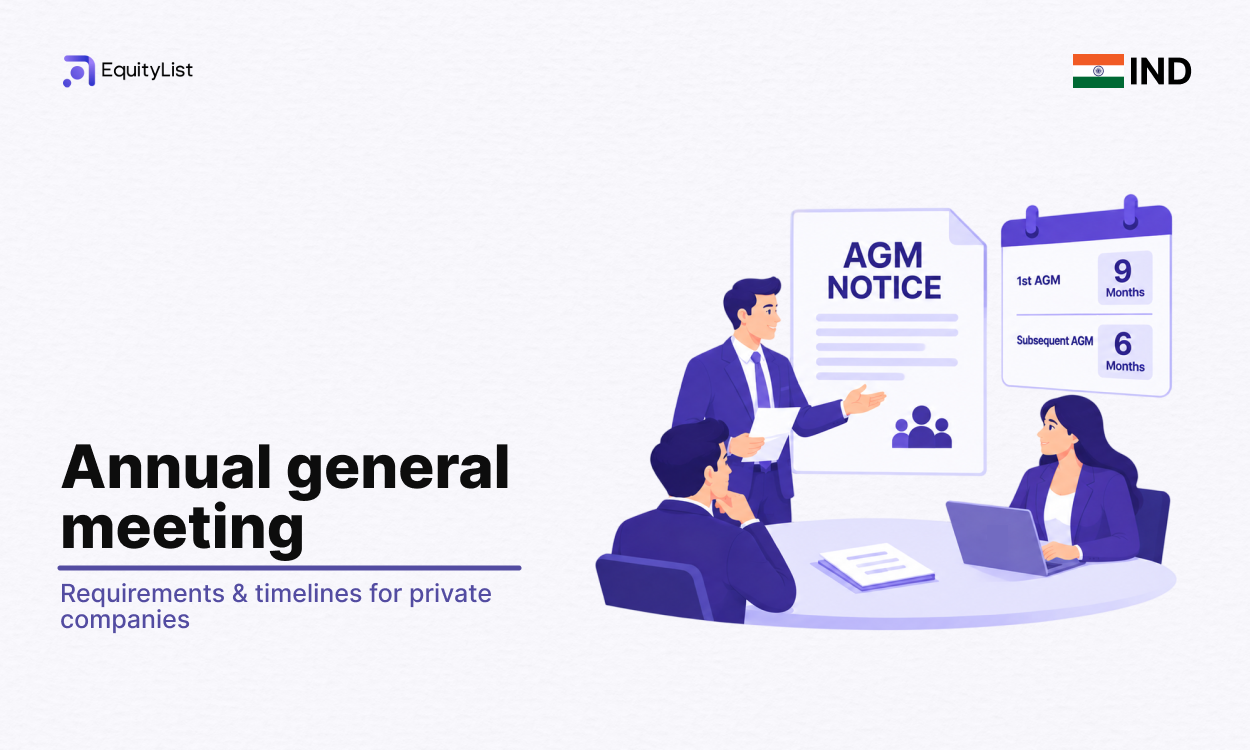
The minutes book is kept at the registered office or another place the board decides, in the custody of the company secretary or a director authorised by the board (Rule 25(1)(f)). Directors can inspect board minutes, as can the company's statutory, secretarial, cost, and internal auditors and a company secretary in practice appointed by the company, but members cannot (SS-1 paragraph 7.7.1). General meeting minutes follow separate rules, covered in EquityList's guide to AGM requirements for private companies.
What are the penalties for violating Sections 173 and 118?
Each breach carries a separate consequence:
- Failure to give notice: ₹25,000 on the officer responsible for sending it, under Section 173(4).
- Defective or missing minutes: ₹25,000 on the company and ₹5,000 on every officer in default, for each meeting, under Section 118(11). A departure from SS-1 falls under the same penalty, because Section 118(10) is part of Section 118.
- Tampering with minutes: Imprisonment of up to two years and a fine of ₹25,000 to ₹1 lakh, under Section 118(12). This is the only criminal sanction in either section.
- Holding too few meetings: Section 173 prescribes no specific penalty, so the residual penalty in Section 450 applies to the company and every officer in default (as amended by the Companies (Amendment) Act, 2020).
A director absent from all board meetings held over a 12-month period vacates office under Section 167(1)(b), whether or not leave of absence was sought.
Under Section 118(8), minutes kept in accordance with Section 118(1) create a presumption, until the contrary is proved, that the meeting was duly called and held and that appointments of directors, key managerial personnel, auditors, and company secretaries in practice made at it are valid. Minutes not entered within 30 days do not carry that presumption, and the company has to establish the meeting and its decisions by other evidence. Certain board resolutions must also be filed in Form MGT-14, although private companies are exempt for Section 179(3) resolutions while their filings are current.
Section 175(2) requires each resolution passed by circulation to be carried into the next meeting's minutes. EquityList's Board Consents feature records each consent sent for signature with its real-time signing status, and preserves the compliance record when a signed consent is rescinded or amended, so the text and signing history of each circulated resolution are available from one place when those minutes are drafted.
.svg)
.svg)
.svg)