





Key takeaways
- ROC compliance for a private limited company is the set of filings made with the Registrar of Companies under the Companies Act, 2013.
- Form AOC-4 is due within 30 days of the AGM and Form MGT-7 or MGT-7A within 60 days, so both deadlines move with the AGM date.
- For a 31 March year-end, the AGM must be held by 30 September, which places AOC-4 on 30 October and MGT-7 on 29 November.
- ADT-1, DPT-3 and MSME-1 apply only when a company appoints an auditor, holds deposits or exempt loans, or owes micro and small suppliers beyond 45 days.
- Private companies that are not small companies file Form PAS-6, a half-yearly share capital reconciliation, by 30 May and 29 November.
- Small companies (paid-up capital up to ₹10 crore and turnover up to ₹100 crore) file MGT-7A. Holding and subsidiary companies never qualify as small companies.
- DIR-3 KYC moved to a three-year cycle from 31 March 2026, and directors with completed KYC are next due by 30 June 2028.
What ROC compliance means for a private limited company
ROC compliance is the set of filings a company makes with the Registrar of Companies to keep its public record accurate: financial statements, the annual return, changes to directors, capital and registered office, and a few conditional disclosures. Investors, lenders and acquirers inspect this record during diligence.
Section 92 requires "every company" to file an annual return, and Section 137 requires financial statements adopted at the AGM to be filed with the ROC. Neither provision is linked to revenue or activity.
ROC compliance calendar for private limited companies (FY 2025-26 cycle)
The table below applies to a private limited company whose financial year ended on 31 March 2026 and which holds its AGM on 30 September 2026, the last permitted date. Dates that depend on the AGM move earlier if the AGM is held earlier.
Every date assumes a financial year ending 31 March. AGM-linked dates exclude the AGM day from the count, following Section 9 of the General Clauses Act, 1897; counting the AGM day moves each deadline one day earlier, so filing by the earlier date avoids any dispute.
Why annual ROC filing deadlines depend on the AGM date
Shareholders adopt the audited financial statements at the AGM, and the two main annual filings report what was adopted. Under Section 96, a private company must hold its AGM within six months of the end of its financial year, with no more than 15 months between two AGMs. For a 31 March year-end, the outer limit is 30 September.
AOC-4 is due within 30 days of the AGM under Section 137(1), and MGT-7 within 60 days under Section 92(4). A company that holds its AGM on 14 August 2026 therefore has an AOC-4 deadline of 13 September 2026 and an MGT-7 deadline of 13 October 2026, well before the dates in the calendar above.
Three situations change the starting point:
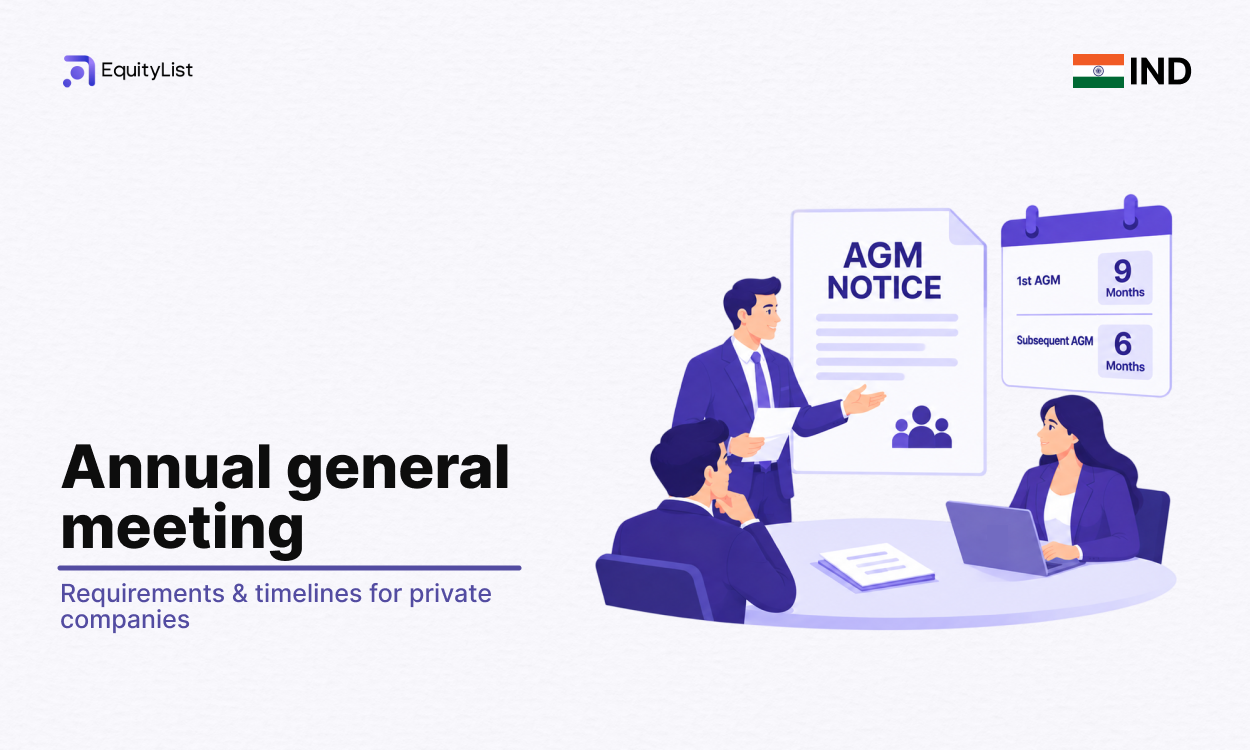
- The first AGM can be held within nine months of the close of the first financial year. Under Section 2(41), a company incorporated in February 2026 closes its first financial year on 31 March 2027 and holds its first AGM by 31 December 2027.
- An ROC extension of up to three months, available for any AGM except the first, moves the AOC-4 and MGT-7 deadlines with it.
- An AGM that is not held does not postpone the filings. Section 137(2) and Section 92(4) require them within 30 and 60 days of the date the AGM should have been held, with a statement of reasons.
A One Person Company (OPC) does not hold an AGM and files its financial statements within 180 days of the close of the financial year.
Annual ROC filings for private limited companies, form by form
Form AOC-4 for filing financial statements
Form AOC-4 files the audited financial statements, board's report and auditor's report adopted at the AGM, placing them on the company's public record under Section 137. Companies with paid-up capital of ₹5 crore or more, turnover of ₹100 crore or more, or Ind AS reporting file in XBRL.
Form MGT-7 and MGT-7A for the annual return
Form MGT-7 is the annual return under Section 92, recording shareholding, directors, meetings and changes as at the close of the financial year. Small companies (paid-up capital up to ₹10 crore and turnover up to ₹100 crore) file the shorter MGT-7A; holding and subsidiary companies never qualify.
Form ADT-1 for auditor appointment
Form ADT-1 notifies the ROC of an auditor appointed at the AGM under Section 139(1) for a five-year term. It is filed only in the year an auditor is appointed or reappointed, so it is not an annual filing for most companies.
Form DPT-3 for the return of deposits
Form DPT-3 reports outstanding deposits, and loans that the Deposit Rules exclude from the definition of deposits, as on 31 March. Because exempt receipts are reportable, a company that has only borrowed from directors or issued convertible notes still files.
Form MSME-1 for dues to micro and small enterprises
Form MSME-1 is a half-yearly disclosure, required by an order under Section 405, of amounts owed to micro and small enterprise suppliers for more than 45 days from acceptance of goods or services, with reasons for the delay. A company with no such overdue payments files nothing.
Form PAS-6 for share capital reconciliation
Form PAS-6 reconciles the share capital in a company's register of members with the securities held at the depositories. Rule 9B requires private companies that are not small companies to dematerialise their shares and file PAS-6 every half-year. Subsidiaries are always in scope because they cannot be small companies.
Form DIR-3 KYC for director KYC
Form DIR-3 KYC confirms each director's identity and contact details against their DIN. Since 31 March 2026 it is filed once every three years, and directors who had completed KYC are next due by 30 June 2028. The same form updates contact details or reactivates a deactivated DIN.
Board meeting requirements for private limited companies under Section 173
Section 173 requires a first board meeting within 30 days of incorporation and at least four meetings every year after that, with no more than 120 days between two meetings. Board meetings are not filed with the ROC, but AOC-4 records the date of the meeting that approved the accounts, and MGT-7 reports the number of meetings and each director's attendance.
For private companies, Section 173(5), as modified by the MCA exemption notification of 13 June 2017, allows OPCs, small companies, dormant companies and private companies that are start-ups to hold just one meeting in each half of the calendar year, at least 90 days apart.
The two meetings are counted by calendar half-year (January to June and July to December), not by financial year.
Event-based ROC filings for private limited companies
Event-based filings are due within a fixed number of days of the corporate action that triggers them, independent of the financial year or the AGM.
Penalties for missing ROC filing deadlines
Additional fees. Under the Companies (Registration Offices and Fees) Rules, 2014, the additional fee is charged automatically at the time of filing. For AOC-4 and MGT-7, it is ₹100 for each day of delay. For most other forms, it is a multiple of the normal filing fee of ₹200 to ₹600, rising from two times for a delay of up to 30 days to twelve times beyond 180 days.
Statutory penalties. These are imposed by an adjudicating officer under Section 454 after a hearing, not charged automatically.
- Late annual return. Under Section 92(5), ₹10,000 plus ₹100 per day of continuing failure, capped at ₹2 lakh for the company and ₹50,000 for each officer in default.
- Late financial statements. Section 137(3) sets the same amounts, with the officer-level penalty falling on the managing director and CFO.
- MSME-1. Under Section 405(4), ₹20,000 plus ₹1,000 per day of continuing failure, capped at ₹3 lakh for the company.
Disqualification and strike-off. Under Section 164(2)(a), a director of a company that has not filed its financial statements or annual returns for three continuous financial years cannot be reappointed to that company or appointed to any other company for five years. Separately, Section 248(1)(c) permits the ROC to strike off a company that has not carried on business for two immediately preceding financial years and has not applied for dormant status.
FAQs on annual ROC compliance
Is ROC filing mandatory for a private limited company?
ROC filing is mandatory for every private limited company, because Section 92(4) and Section 137(1) require every company to file its annual return and financial statements each year. Neither provision depends on turnover or activity, so a company that has not started operations files on the same timelines. Three continuous years of non-filing exposes its directors to disqualification under Section 164(2)(a).
What is the ROC filing due date for a private limited company?
The ROC filing due dates for the two main annual forms are set by the AGM: AOC-4 within 30 days and MGT-7 or MGT-7A within 60 days. For a 31 March year-end with the AGM on 30 September, those deadlines fall on 30 October and 29 November. DPT-3 (30 June), MSME-1 (30 April and 31 October) and PAS-6 (30 May and 29 November) run on fixed dates.
Who is responsible for ROC filing?
Responsibility for ROC filings rests with the company and its officers in default, defined in Section 2(60) to include whole-time directors, key managerial personnel and directors aware of the default. Section 92(5) and Section 137(3) set the penalties for late annual returns and financial statements. DIR-3 KYC is the exception, because each director files it individually.
.png)
.svg)
.svg)
.svg)